



Picture yourself - you are running, the finish line is glimmering ahead, in front of you, like an old promise. You run not so much towards it, but away from the centre, away from anything else, persuaded that revelation and long-desired answers are awaiting you just beyond that very limen. Yet, for every single breathless step, the line recedes, and you find yourself diminishing, shrinking, as if that very act, that very run is a kind of vanishing.
There must be something you have not understood, a secret no one has ever told you. You spent all your life running towards that elusive threshold, only to find that the faster you run, the further it slips away, and the smaller you become in its wake.
We have been told that what lies beyond is better, that yonder you will find the answers to all your questions. Yet, the stubborn finish line remains out of reach. Instead, you find yourself dwarfing, arriving not at some luminous goal, but at a disappearing point - no-where and no-when.
Perhaps this is how the fish in Escher’s Circle Limit III feels; forever swimming, forever approaching a boundary that ineluctably slips away at every stroke. Imagine the doubts flickering in its head, suspended in that endless, circular pursuit.
Or perhaps those are our own questions and doubts, the ones that surface in our minds as we race towards the thresholds of your life. Maybe these are the silent interrogations that Escher is whispering in our ears when standing before his impossible geometries.
We are perennial seekers, constantly looking for what there is beyond, for the promise of infinity. But what if, as in an Escher lithograph, infinity is not a distant country, but the very air we breathe? What if infinity resides within the finite, secretly nested in the Everyday?
The first taste of infinity.
Escher’s lifelong obsession began, as these things often do, with a journey. In 1922, at the age of twenty-four, he travelled over two thousand kilometres to Granada, where the Moorish tessellations of the Alhambra cast the fatal spell. The sight of those repeating patterns, colours and shapes locked in endlessness, set his heart ablaze, and he wondered whether infinite repetition could ever be conjured onto the flatness of a page.
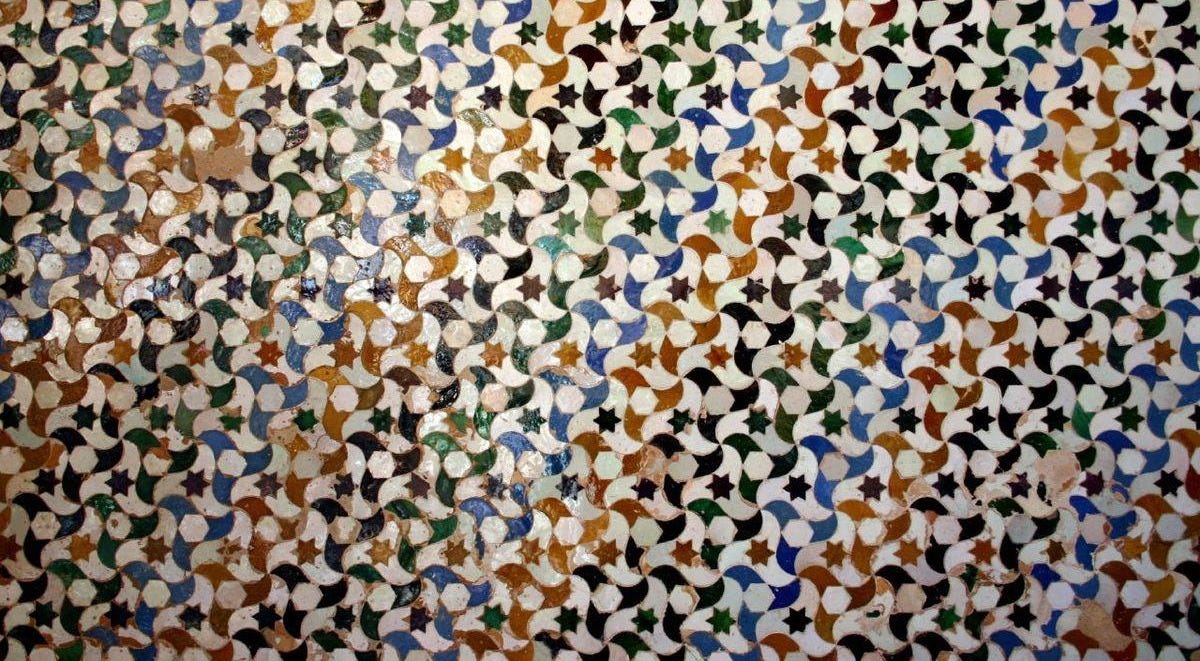
Shunned by the arts for his unusual representation, recognition came not from galleries but from the International Congress of Mathematics, where Escher found kinship among mathematicians and, in Coxeter, a lifelong friend. Here, his obsession found understanding and puzzles that further fueled the flames of his imagination.
In 1957, Coxeter sent a letter to his friend Escher with a Poincaré disk, a model of hyperbolic geometry in which tesselations fill a circle with motifs that shrink as the edge narrows. Within a year, Escher produced Circle Limit I, a feat of mathematical precision that shocked Coxeter himself. He had achieved it without any formal training and without relying on the necessary mathematical equations.


In Escher’s circle series, fish, bats, and frogs embark on this frantic run towards infinity. They move along straight lines transforming into arcs, where distances distort, and boundaries lie only at infinity. His prints offer a kind of hallucinatory experience of infinity, where the hopeful eye follows the fish towards the unreachable limits of the world, only to see it disappear as it gets closer to those drawn Pillars of Hercules.
Standing before his prints, we face a choice. We can join the repeating figures towards the edges with our hearts pounding in heroic sympathy for their endless race. Or we can step back, resist the current, and learn how to become intimate with infinity.


Infinity can be understood, but never possessed. The threshold of reality is uncrossable; transcendence is a mirage, immanency the condition. The more you chase it, the more you shrink and lose yourself. Yet, if we pause, Escher’s prints, like Spinoza’s Ethics, whisper to us that infinity is not elsewhere but everywhere, that every tesselation, every fish, each of us, is a fleeting mode of the infinite. We should not sprint toward the unreachable, because boundlessness is already within us. Only in stillness, not in the racing dash to the edge, can we truly contemplate infinity itself.
The hovering loop
Imagine scaling a mountain, breathless with effort, only to find that the summit is, impossibly, the valley itself. Escher delights us with such antinomies and visual loops - hands that draw themselves, staircases that spiral into vertigo, galleries that transform into cities and vice versa.


Escher’s loops are visual hierarchies you ascend with the eye, only to find yourself returned to the starting point. This is not the infinity that evaporates into abstraction or accumulates in some unreachable eternity. His impossible architectures are self-contained worlds: you can wander their labyrinths forever, yet never lose yourself. They are, in Hegel’s sense, true infinity; a closed totality that feels, paradoxically, boundless. Infinity here does not flee toward a blurry horizon, but it resides, quietly, within the finite.
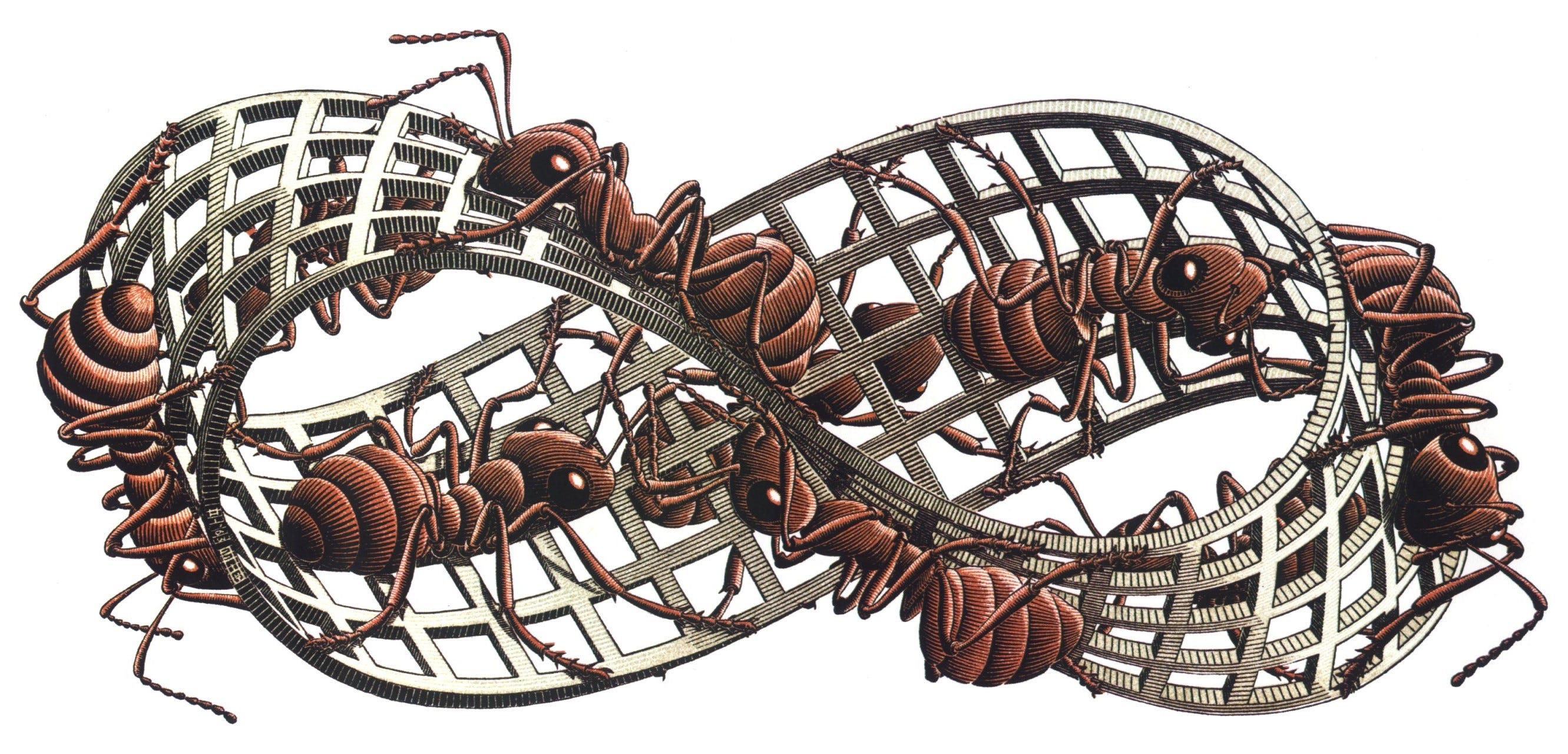
At first, one might think that Escher’s work is tailored for a public of mathematicians, philosophers of language, or logicians, as it was indeed his first audience. Yet what he renders, in truth, are the very structures that underpin our daily lives. Just think about the entangled dilemma of consciousness, think about the way you perceive yourself, and you are aware of your existence - these, too, are self-sustained loops.
What we are, the self, and the elusive “I” that stands at the very base of your existence, is a strange loop - our existence is a foundation without a floor. The old Catesian dictum - Cogito, ergo sum - is a loop, sustaining itself, hovering like magic. At our core, we are not so different from those hands that draw themselves, or the ant that circles endlessly, afloat in infinity.
Boundary as Gift, Infinity within
So often, we run without knowing where we are headed. The room is dark, the walls invisible. We run towards the walls of the room to find the door to a hoped-for luminous next room, or the exit towards a shining view. Seldom do we pause to search for the switch - the quiet, improbable bulb of infinity suspended in the centre, waiting to be lit. It seems absurd, this notion of a light floating in darkness. And yet, there it is.
Escher prints transcend his mathematical fandom, and speak to us about how to relate to the world surrounding our everyday life, and to our very consciousness. He tells us not to be like the fish swimming tirelessly towards a fading horizon, approaching a limen that is not there to be reached. But we should take a step back, wary that we are the tessellation of an endless artwork, that we are the particular finite mode of infinity. It seems paradoxical. But he also reminds us that thus are the eternal principles governing our lives, thus is our consciousness, thus is the very reality in front of us - unending principles, self-sustained by the very act of existence, floating mid-air in no need for a floor to lie upon.
If this piece made you pause and look at the world a little differently, consider subscribing.
Every week, I explore the places where art, philosophy, and everyday life quietly collide. It's free, it lands in your inbox, and you can leave whenever you like.
This was such a beautiful and thought-provoking read! I love how you turned Escher’s work into something so human and relatable, that feeling of chasing something just out of reach. The idea that what we’re searching for might already be within us is very powerful…It made me pause in a good way. Thanks for sharing such a great read✨
I have been interested in Eschers work for sometime. I fell upon one of his books on a coffee table and couldn’t resist looking at the intertwining and connected repeated horses, fish, and drawings. My interest in your writing is your reference to the liminal. This concept is intriguing and relates to my current art exhibition I’m developing a theme around. Threshold. Would love to connect and share my writing with you for feedback.