

Most of us live with a plan for ourselves. We keep it somewhere between the calendar and the back of our minds, and it shows a person we know well: the one who will move to another city in the spring, finish the book by the summer, learn the language at last and stay with the person we love until the end. We describe that person to others, and to ourselves at night, with the calm of an architect explaining a building that has not been built yet, every floor in its place and every window turned towards the light we have chosen for it.
Then something comes that was not in the plan: a telephone call at an hour when nobody calls, a letter, a doctor choosing her words, a car that leaves the road, and the building falls before a single stone has been laid. When we can look again, the one standing in the dust is someone we never planned, slower perhaps, or lighter, or harder, someone who walks with a step we have to learn the way we learn a language, and who turns out, in a way we cannot quite explain, to be more ourselves than the person in the plan ever was.
The truth is that the self is made by abrasion and not by invention, and that none of us knows who we are: we can only wear ourselves down until we reach ourselves, digging our way out of the hard ground of our own plans. Yet abrasion is only friction seen from the side of what it takes away. Seen from the other side, friction is the reason anyone can walk at all. On a floor without it, the foot that pushes back would slide from under us, and the body would stay where it was, so that every step we have ever taken was given to us by the same resistance that, slowly, wears through the soles of our shoes.
Alberto Giacometti lived on both sides of that force. One night in October 1938 a car knocked him down in the middle of Paris; in the years that followed, his own knife wore his figures down until they crumbled into dust; and out of all that wearing came the figures we know him for, tall and thin, with almost nothing left of them except their height and their feet, which are as heavy as the ground they stand on.

At last something is happening to me
In the small hours of 19 October 1938, Giacometti had walked Isabel Delmer back to her hotel and was going home alone, under the arcades of the rue de Rivoli and into the little Place des Pyramides, where a gilded Joan of Arc rides her horse above the street, when a car came along the rue de Rivoli and knocked him down. The driver, an American woman from Chicago, was drunk and unhurt; the arch of his right foot was crushed.
Years later, what he described was a strange doubling: lying on the pavement with his foot twisted, he felt that one Giacometti was down in the road while another watched him, coolly, from somewhere above. He spent the following week in a clinic and counted it, afterwards, among the best times of his life; he left on crutches, went on to a cane, and kept a slight limp until he died. He told the story often, and it grew with each telling, the fractures multiplying and the week in the clinic stretching into months, but the limp stayed exactly as it was, the one version of the story that no one could rewrite.
Twenty-five years later his friend Jean-Paul Sartre told it too, in Les Mots. He moved the accident to the Place d’Italie, on the other side of the city, and gave his friend, lying in the road with his leg twisted, “une espèce de joie”, a kind of joy, with a sentence to go with it: « Enfin quelque chose m’arrive ! », at last something is happening to me. Giacometti felt that the story had been taken from him and bent to fit someone else’s philosophy. “Sartre told his story of my accident the way it suited him,” he said in 1964.
Smaller and smaller
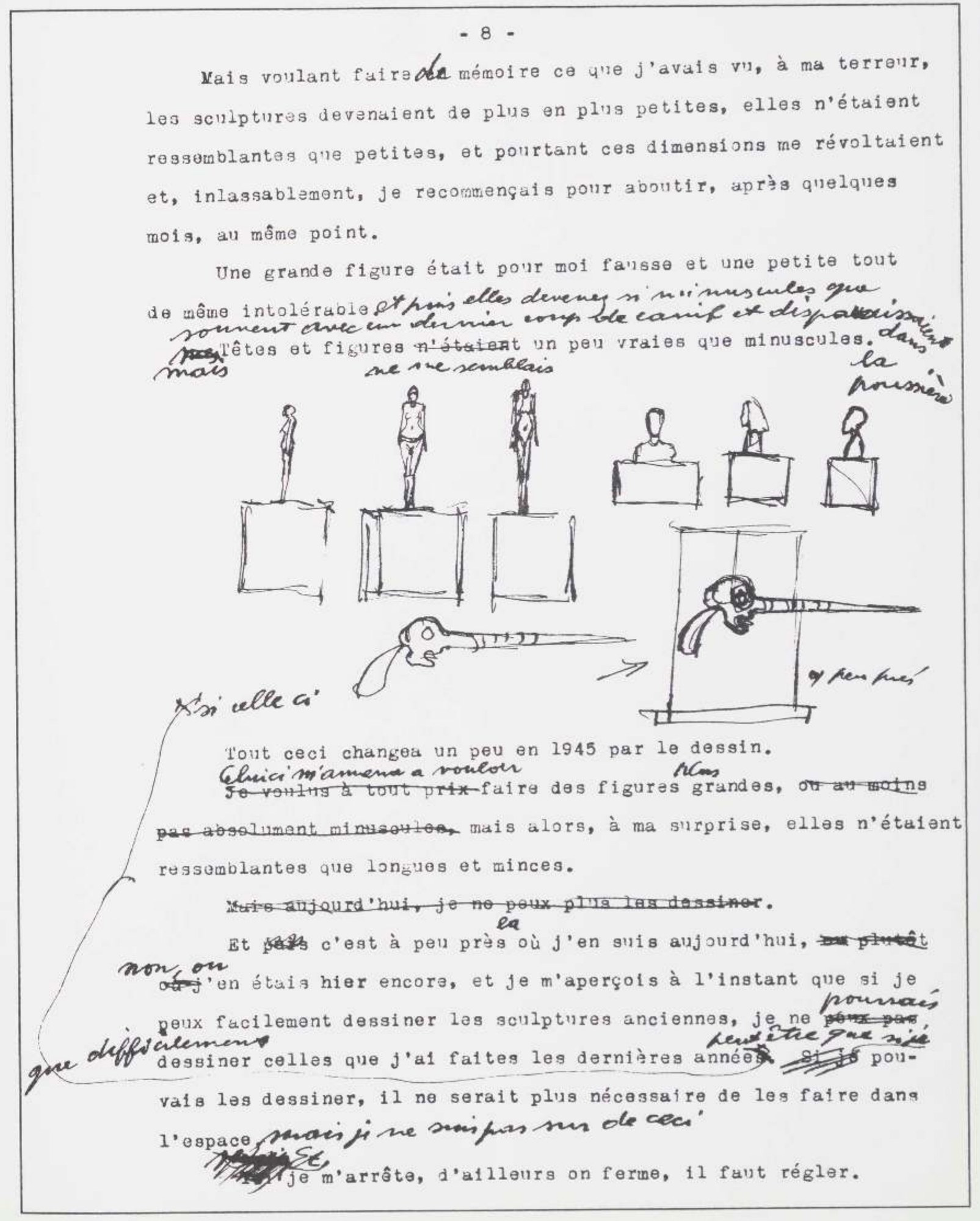
From 1935 to 1940 he had worked with a model trying to make a head the way he saw it, and when he turned to working from memory something happened that he later described to his dealer, Pierre Matisse, as plainly as a patient describes a symptom: “to my terror the sculptures became smaller and smaller.” A large figure seemed false to him and a small one “equally unbearable”, and so they went on shrinking until, often, “with one touch of my knife they disappeared into dust”.