



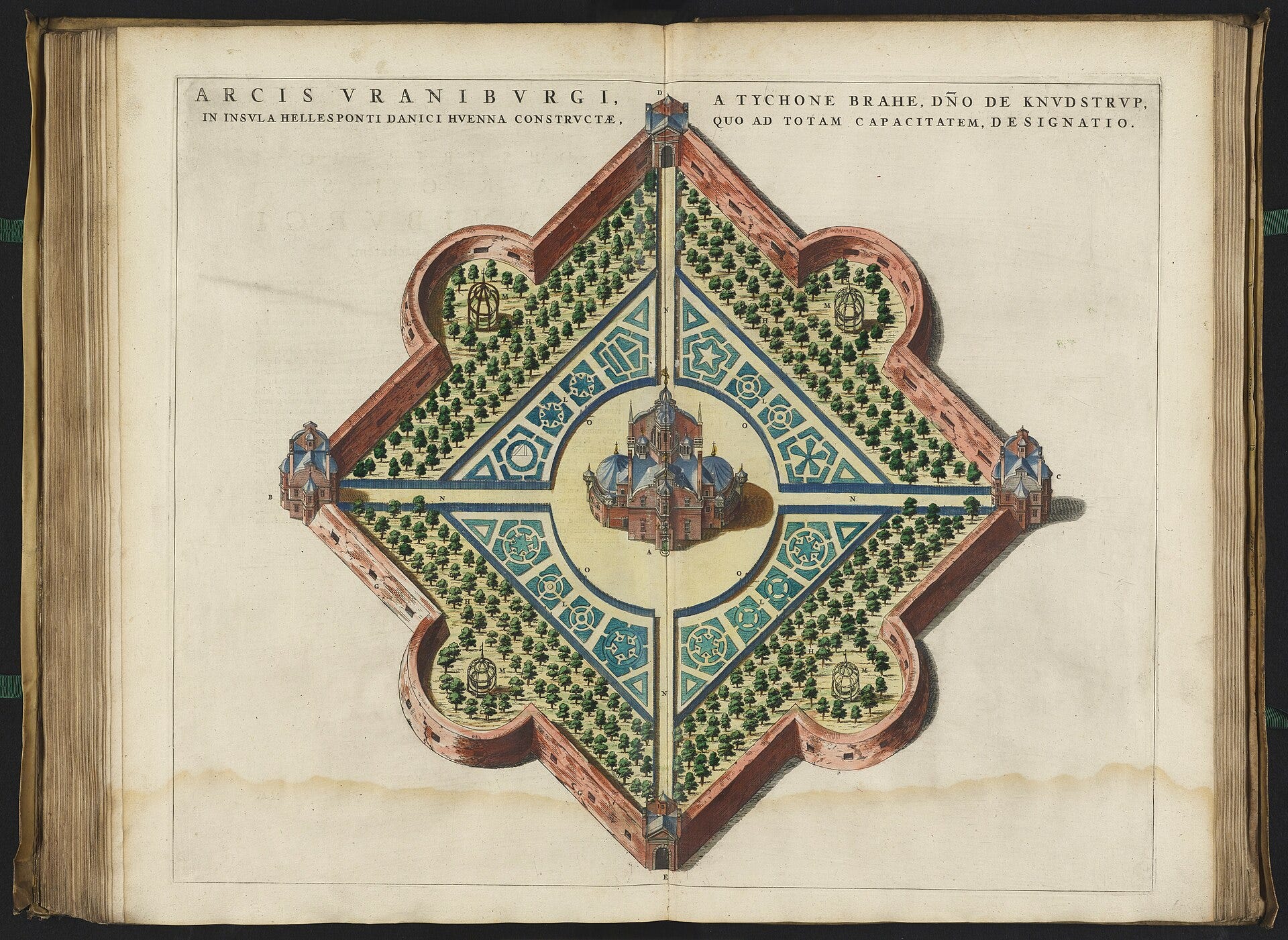
Take the small ferry out of Landskrona in December and climb from the harbour, the wind coming off the Sound from every side, until the island of Ven stops rising and there is nothing above you but a great deal of sky. Forty-five metres above the water, lies a square bank of earth about seventy-five metres on each side, rebuilt in the 1980s along the line of the old rampart. Inside it is a garden, and inside the garden, a circle where a house once stood, because the man who laid it out meant the square for the earth and the circle for the heavens.
The house was Uraniborg, the castle of Urania, muse of astronomy, and when they laid its cornerstone in August 1576, it became the first building in modern Europe raised above all to watch the sky, some thirty years before the first telescope. From its towers, Tycho Brahe fixed the positions of the stars to within about a minute of arc, closer than anyone before him had come, using quadrants and sextants that did not enlarge what he saw but only aimed it, so nothing stood between his eye and the night. When the wind that crossed the island made the instruments tremble in the towers, he sank the finest of them into the ground beside the house and called the place Stjerneborg, the castle of the stars.
Three and a half centuries later, a Swedish painter nearly seventy years old drew a round building for this island in her notebook: three stacked, narrowing rings around a tower, with a path inside that turns as it climbs. In her own words, Hilma af Klint wanted the whole of it “imbued with a certain power and calm”. The temple was never built.
The first coil
The spiral had begun twenty-five years earlier, and much smaller. In January 1906, during a séance, a spirit her circle of women friends called Amaliel offered Hilma af Klint a commission, and she accepted immediately, as her Foundation puts it. In November she began The Paintings for the Temple with its first series, Primordial Chaos, twenty-six small pictures. No. 16 among them is barely fifty-three centimetres high, a deep blue brushed outward in rays, with two sea-green coils sprung loose across it and a gold zigzag running down into pale yellow rings that tighten around an orange core. It looks like a snail’s shell seen end-on, and in the key she kept for her own symbols, the snail and the spiral mean one thing: development, a movement that turns and rises at the same time. The series, as Guggenheim Bilbao reads it, starts from a oneness that has splintered, so everything after it is the long labour of joining what was divided again, female and male, light and dark.
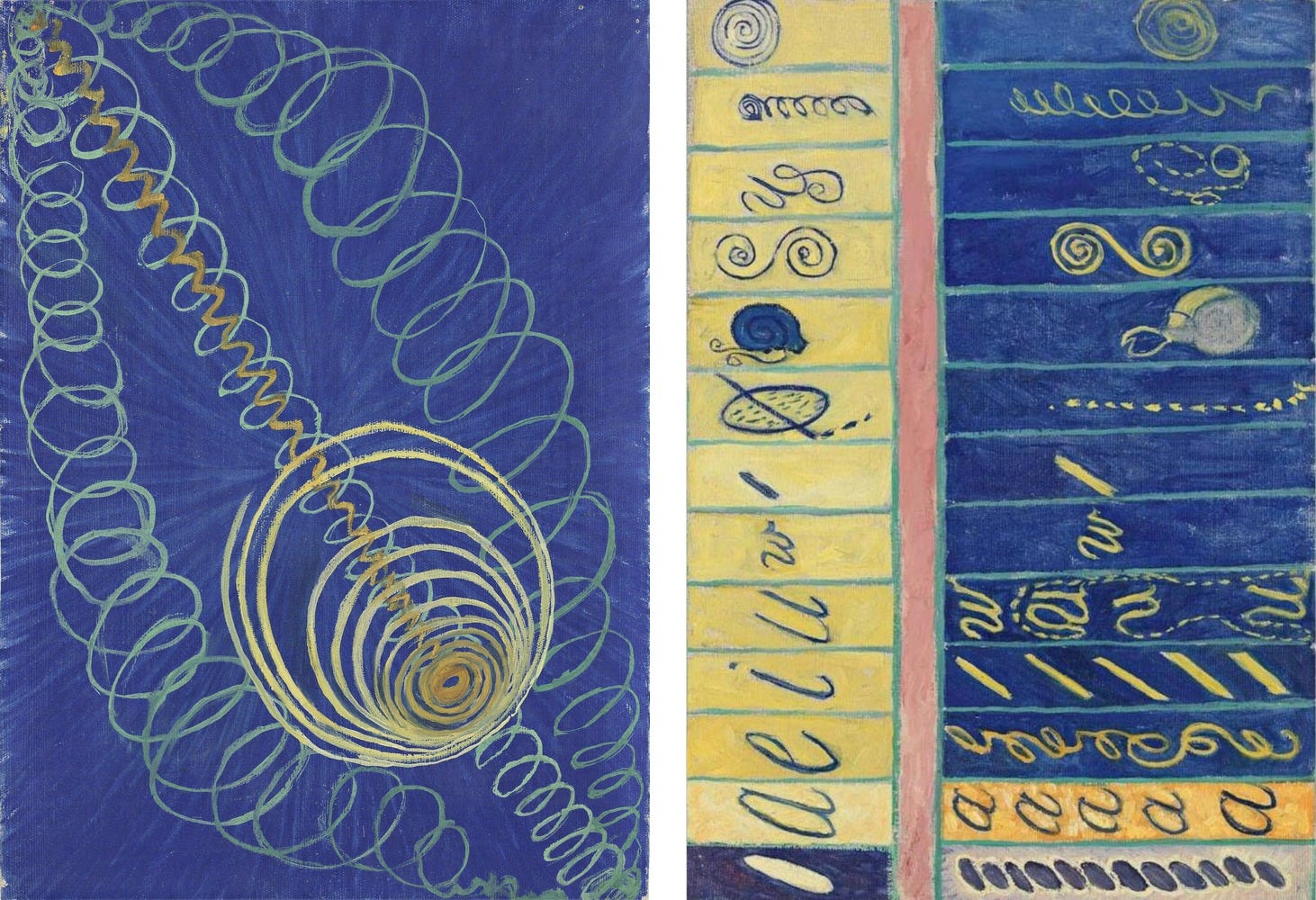
The climb was quick, and then it stopped. The Ten Largest came in 1907, each more than three metres tall, and by April 1908 there were a hundred and eleven paintings; then her mother went blind, she gave up the studio, and for four years the cycle waited. When she took it up again in 1912, she no longer felt her hand being guided, and the forms grew geometric, as if the spiral had begun to count its own steps. The Swan followed, then the Altarpieces, and in 1915 the cycle stood complete at 193 paintings.
As for the famous twenty years of silence, they are not in her will, which asks only that the works be kept together on Munsö “så länge det är möjligt”, for as long as it is possible. They come from an X she marked on some of her notebooks in 1932, and the paintings were never hidden either, since seventeen of them hung in Stockholm in 1913 and works from the cycle travelled to London in 1928.
Until 1931 the temple had been mostly a figure for the growth of the soul, and only then did it take on walls and floors and look for ground, which it found on Ven. The notebooks published so far don’t say why that island, but her life points to it: a family known for its sea charts, a father who taught astronomy and navigation, and, according to her biographer Julia Voss, lessons in astronomy when she was young. It took nine years to climb from the snail to the altar, and sixteen more to find the altar a hill.
The seed at the top of the stairs
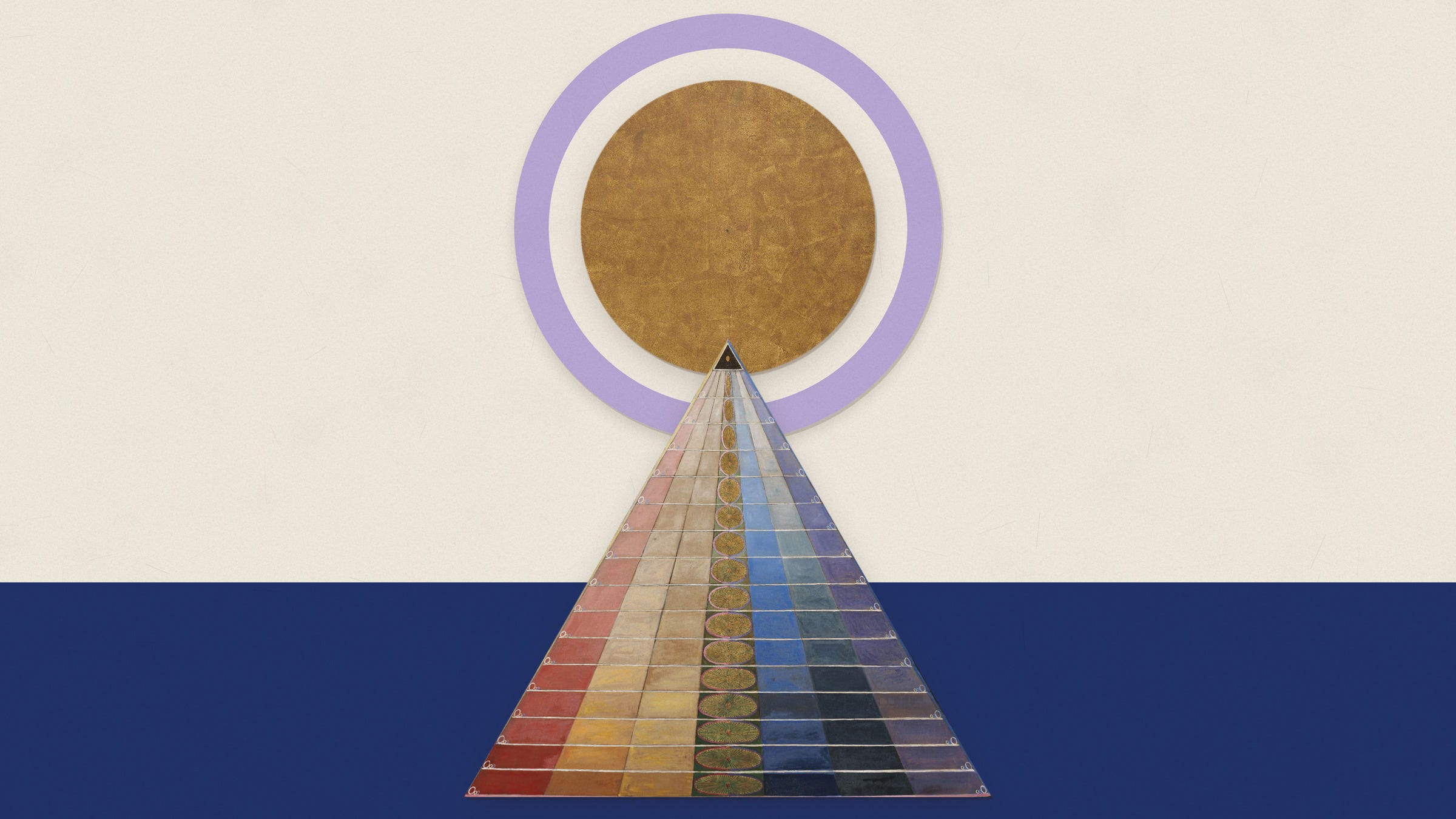
Go in as she drew it. The plan is a round building with three rings narrowing around a four-storey tower, with The Ten Largest one floor up and the Altarpieces at the top. You walk inward from the edge and up a spiral path, which ends in an altar room with three paintings. The first of them is Group X, No. 1, Altarpiece, painted in 1915 in oil and metal leaf on a canvas almost two metres forty high, from the group she called “the summary of the series so far”, and it is the painting the National Gallery of Ireland has chosen as the face of its exhibition this winter.
