



January 1896
Dear Mom,
Yesterday, I escaped the city and found refuge in a concert hall, at Alexey’s insistence. I escaped the city only to find it playing in my heart once more. I saw the colours of our beloved fairy Moscow, dancing and reverberating with the strength of the limen between the West and the East in a Waltz of winds and emotions.
As you know, the job is trying me. It is true, Economics is easy to me, and teaching is a very respectable profession. Yet, I needed to go and distract myself somehow, going back to the world of ideas. I did not want to go out. I thought a book would have been the privileged choice.
But I cannot thank Alexey enough for his stubborn insistence.
He dragged my reluctant soul to the columned entrance of the Bolshoi Theatre. I did not even know what we were going to see. I mean, he had told me, yet I had not paid too much attention.
But mom, the colours lived. The prelude of Lohengrin started, and “I saw all my colours in my spirit before my eyes… wild, almost crazy lines were sketched in front of me”.
The violins, held and supported by the melody of the deep basses, and all the wind instruments… I saw them drawing the pinks, the light blues, and the hidden violets of the hour before dawn.
Imagine, Mum, if one could treat colours like the notes of the piano, imagine if one day I can understand and speak the hidden spiritual language of colours and shapes, like Wagner did with notes, and the great poets with words.
Your Beloved Vasya.
Colours and Geometries of Becoming
A handful of years slipped by, and soon colours began to dance to the tempo of Kandinsky’s brush. Yet the choreography spilt beyond the canvas. Wassily stayed true to his obsessions, treating colours and shapes as a composer handles notes, as a lexicographer handles words. For the artists, every hue, every angle, every point must spring from what he called Inner Necessity - the spiritual compulsion of the artist - rather than the whims of observation or the seductions of mere decoration.
Colours and shapes, Kandinsky believed, possess spiritual reverberations; they strike the soul as a hammer strikes the piano’s strings. Born of the artist’s Inner Necessity, they emerge to immerse into the beholder’s soul. The soul is not passive, waiting to be impressed like the films of a camera, but resonant. Colours do not manufacture feelings; they awaken sensations already slumbering in the soul’s architecture, much as a piano’s keys do not invent notes, but summon them from the instrument’s wooden heart.
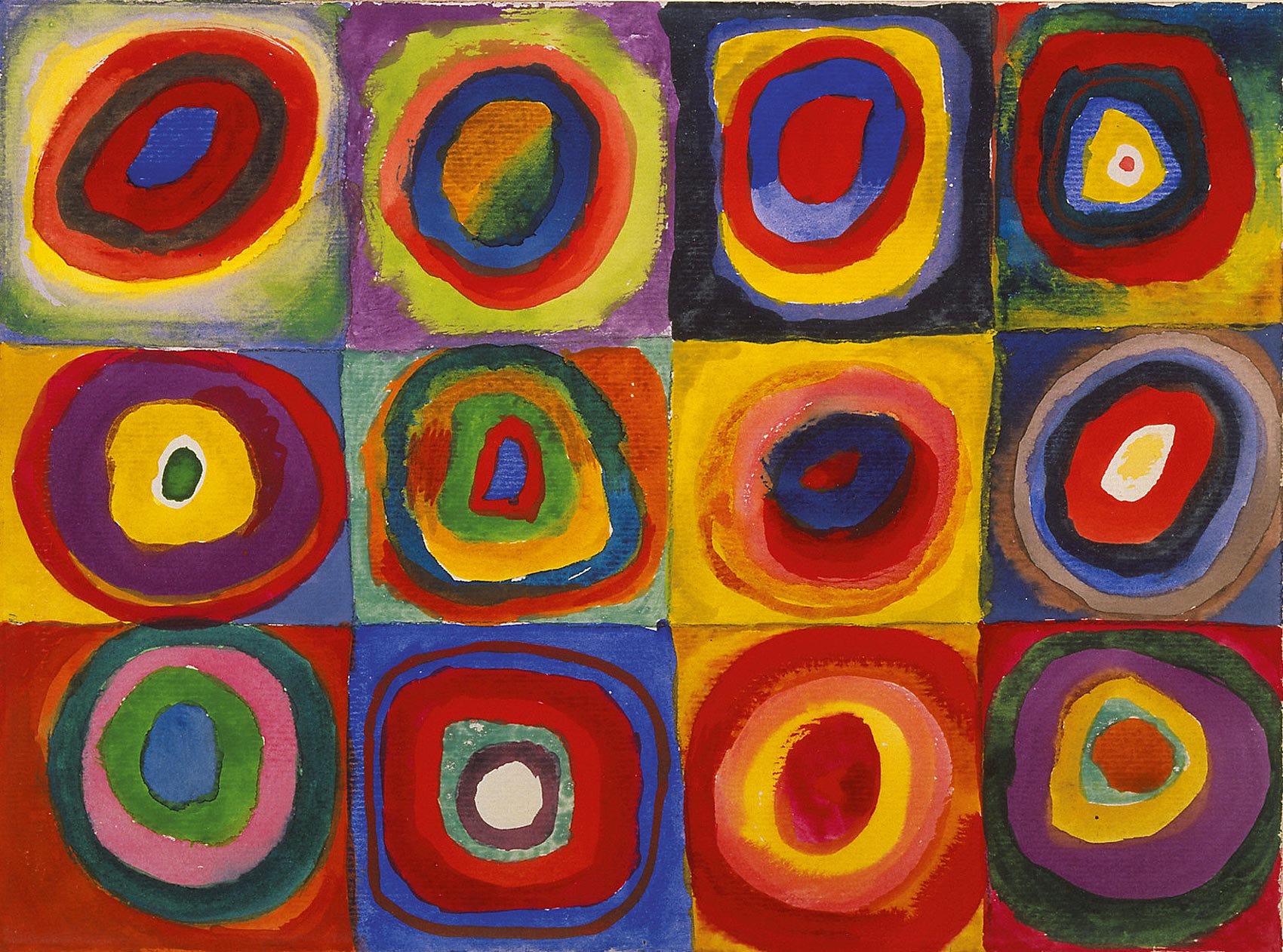
So Kandinsky set about his work as a translator.
Lemon yellow blares like a trumpet’s sustained note, sometimes stinging the eye as the trumpet stings the ear. Yellow, for Kandinsky, is the most terrestrial of colours - shallow, restless, the manic pulse of a city that never sleeps. Blue, by contrast, plays the cello’s soothing gravitas. Where yellow thrusts outward, blue draws inward, pulling the gaze toward the soul’s quiet centre. Blue is the colour of depth, of sky, of the infinite. Its shades follow the orchestra’s lead; light blue flutes, darker blue cellos, deeper still the thunder of double basses, and at the farthest edge, the organ’s midnight sonority.
The music score of colours continues; red is the compromise force of yellow and blue, possessing the irresistible appeal of yellow, but the passionate inward direction of the blue. Green, on the other hand, is restful, narrow, and self-satisfied, defined by Kandinsky as the bourgeoisie of colours. Orange has the strength of red warmed by yellow - a sort of humanity soffused by the mundane. Violet instead, red cooled by the spiritual strength of the blue, is passion withdrawn into contemplation.
Symphonies on Canvas
Music scores were written, colours were given a syntax, but then it was also time for the symphonies, for the compositions. It is in his compositions where every element is deliberate, every relationship between colour and form is weighed, every tension calculated with the mastery of an orchestra, resulting in a concert that feels yet spontaneous and inevitable.
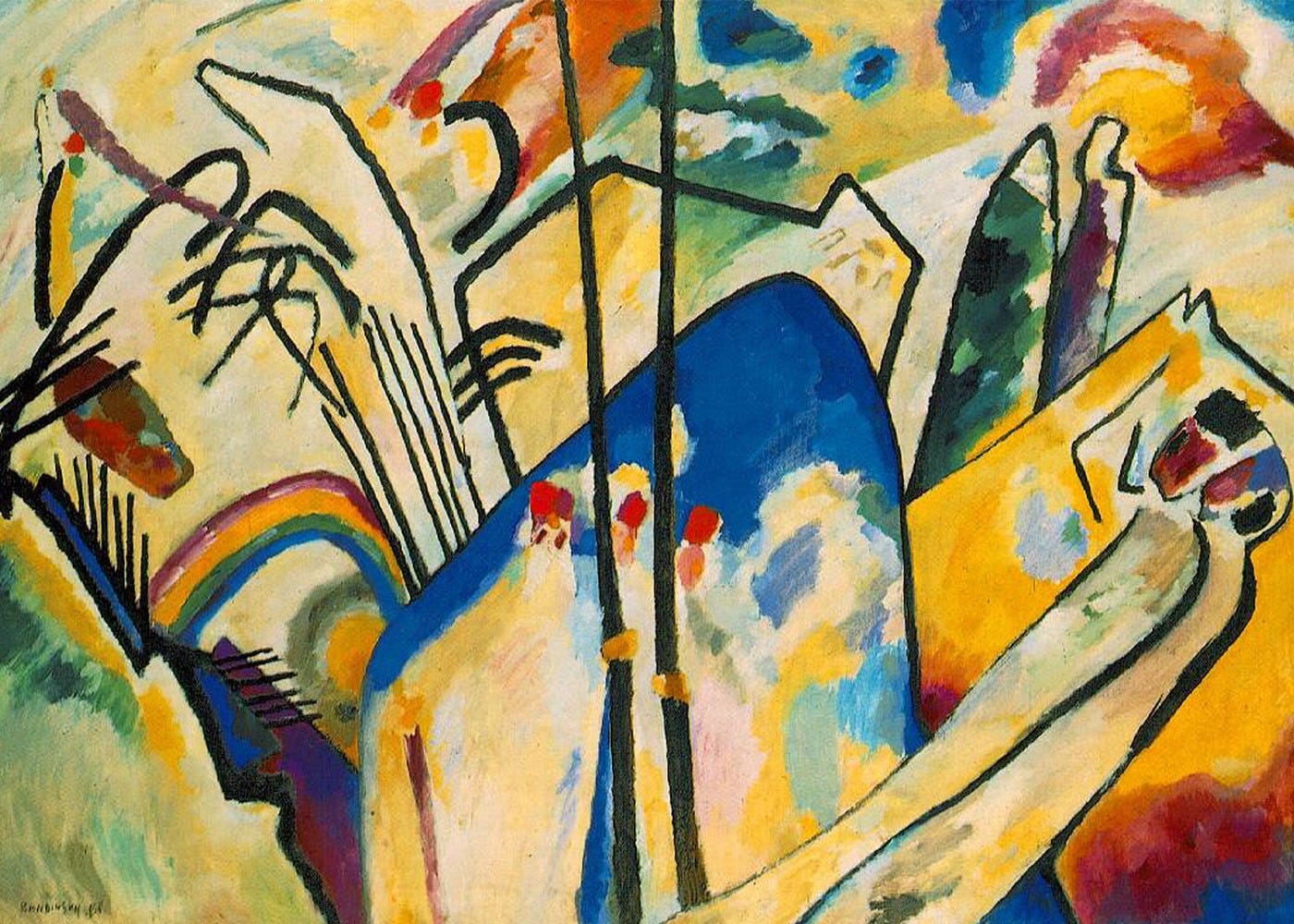
Take, for example, Composition IV. The canvas stages a confrontation; on the left, black lines clash with the fury of an impending apocalypse; on the right, forms soften and curve, echoing the gentle bend of a riverbank and the hush of resurrection. The whole painting maps a journey from catastrophe to redemption, told in nothing but colour and line, unfolding like a Beethoven sonata - first the storm, then the intricate development, and finally a tranquil recapitulation that gathers all the scattered threads.
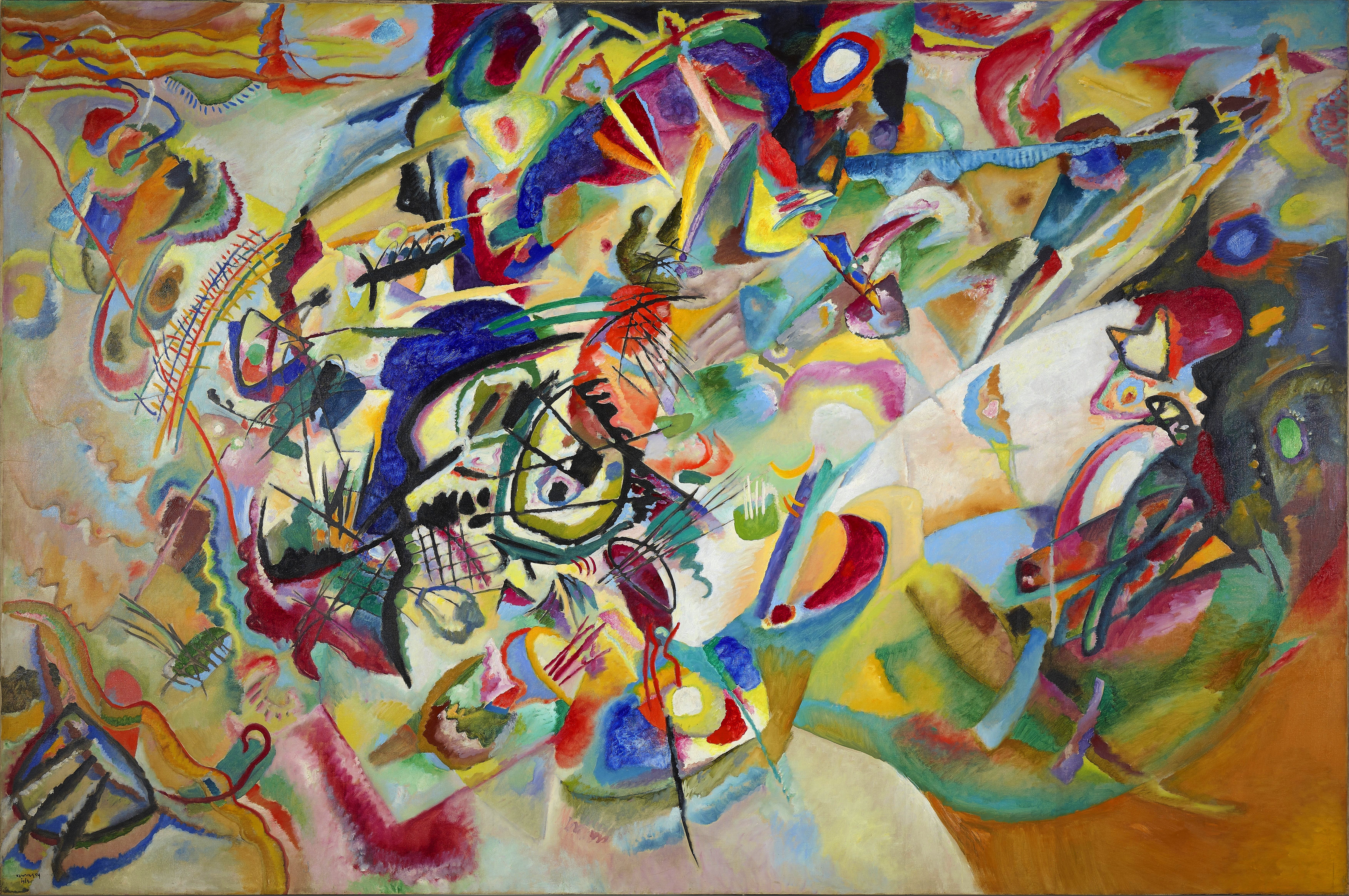
Composition VII, by contrast, erupts with apocalyptic force. Lines and blurred colours collide in a chaotic minefield, teetering on the edge of cacophony. At first glance, you are swept into a vortex, pulled toward the centre as if by a whirlpool, with no hope of escape. The painting engulfs you before you can begin to grasp it - your individuality is swept away, dissolved in the totality, as in Scriabin’s Prometheus.
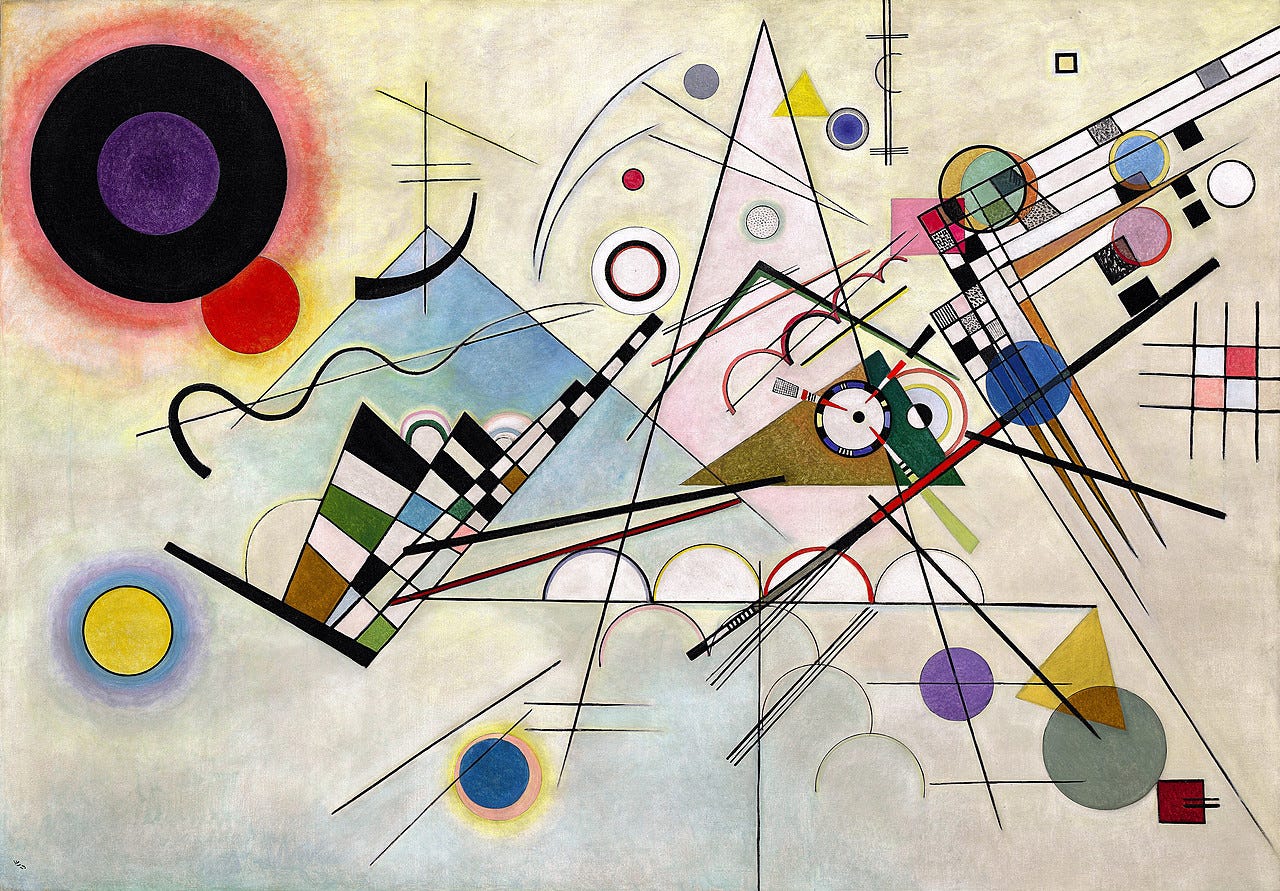
If Composition VII is all molten lava and tempestuous clouds, then Composition VIII finds its peace in crystalline geometry. The canvas is a lexicon of circles, semicircles, triangles, squares, and lines, all drawn in black and primary colours against a luminous pale ground. Here, the logic is Bach’s; linear, mathematical, serene - a melody that seems to echo into eternity.
Artists - Translators of the Invisible
Kandinsky’s syntax of colours, chromatic metaphysics, and geometry of becoming intended to liberate art from representation and give it the power to speak for itself, with its own natural language. But then the very act of building a system raises the question; can you truly speak of the ineffable? Can you write grammar for what lies beyond language?
He could listen to Lohengrin and watch colours dance; see yellow and hear a chorus of trumpets, gaze at blue and feel the fathomless basses. But at the Bauhaus desk, surrounded by awestruck students, metaphors were not enough. They wanted grammar - something to replicate, something to decode.
Language and syntax demand precision. Yet, if you wish to feel the soul’s depths, to wander the night’s darkness, you cannot do so by flooding it with rational light, because then the night will vanish. Knowing and feeling are complementary; where one reigns, the other recedes.
The artist, then, is a translator between the visible and the invisible - not a legislator, not a jailer of the ineffable. Artists must linger at the threshold between matter and spirit, and not a single step further. Only there can they reveal what, in other worlds, is spoken only in whispers.
If colours strike the soul like hammers on piano strings, then perhaps reading about art is its own form of listening. If this piece made you hear something, consider subscribing — each essay is an attempt to tune the invisible keyboard a little closer to the music.
it’s art is a free newsletter. If you enjoyed this essay, the best way to support it is to share it with someone who still believes that art can change the way we see.
A thoughtful and beautifully written reflection on Kandinsky’s attempt to give form to what cannot be seen directly. I especially liked how the piece treats abstraction not as decoration or theory, but as a serious search for inner reality, emotion, and spiritual presence. It captures very well why Kandinsky still feels so modern: his art turns the invisible into something intensely felt. Kandinsky’s own writing and later commentary on his work are strongly tied to the spiritual, inner necessity, and making the invisible perceptible.
A great musical piece of writing, which immersed me in it entirely.for a long time I was clueless about kandinsky's paintings.but now, thanks to you,I might have found it.