


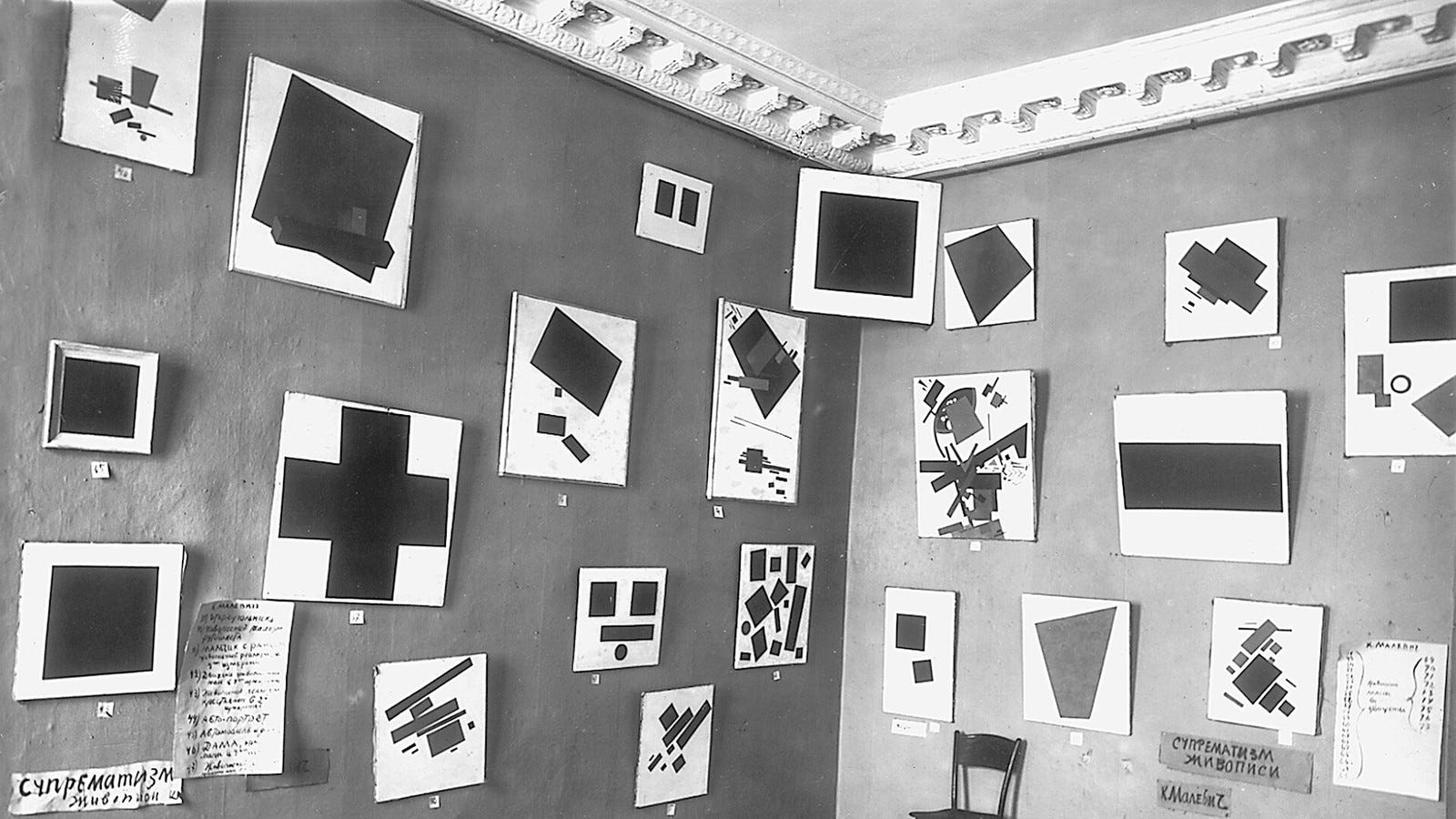
Petrograd, a winter afternoon, December nineteenth, 1915. The Field of Mars lies silenced beneath snow, and inside the Dobychina Art Bureau, fourteen artists have gathered under a cypher: 0,10, zero-ten. You step in and, as every visitor does, your gaze drifts upward, then you slide inevitably to the corner.
The krasny ugol, the beautiful corner, is where the icon hangs and the little lamp burns under it, and you cross yourself towards it from the door; you do not approach, no one stands there, and yet it steadies the room as a keel steadies a boat, anchored in a place forever out of reach.
In the far corner of that room, high up, across the angle of the two walls, there is a black square.
Alexandre Benois saw it and wrote in Rech’ that January that it was the abomination of desolation, a sermon of nothingness and destruction.
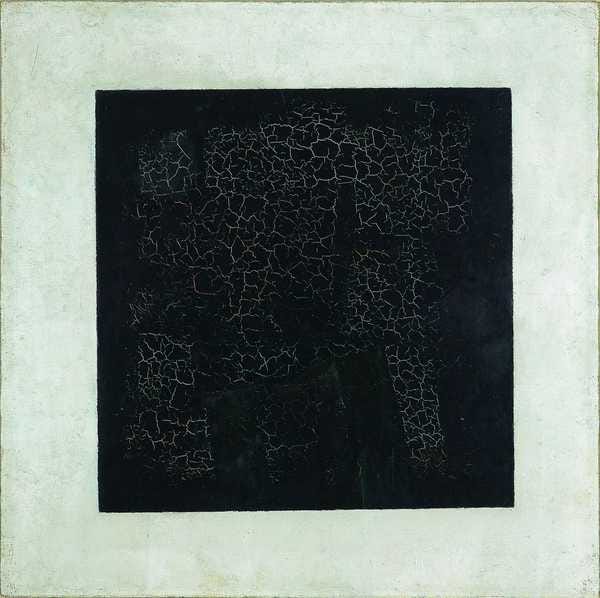
Kazimir Malevich wrote back to him in May, saying that he owned only “a single bare, frame-less icon of our times”.
In the pamphlet he sold at the door, From Cubism to Suprematism, he explained what the 0-10 over the door meant: he had transformed himself “in the zero of form”.
He dated the square 1913, though he painted it in 1915, and twelve years later, in a book the Bauhaus printed for him, he was still telling it his way, “in my desperate attempt to free art from the ballast of objectivity, I took refuge in the square form”, and on the same pages he admitted he took refuge from the frightening fear of leaving the world where a picture is of something, where the eye is handed a face, or a jug on a table, or a road going off towards the horizon.
He took the object away and found that the feeling stayed in the room after all. Without a name and without a sky, he stood in front of it, in the corner where the house had always kept its lamp, frightened the whole time, yet he did not take the square down.
A window or a board
Pavel Florensky was three years younger than Malevich, a mathematician first and a priest from 1911, who had spent two years cataloguing the icons of the Trinity monastery at Sergiev Posad, and in the winter of 1920, in Moscow, he gave a lecture on why the icon painters had drawn the world as they did, with the lines opening towards the viewer instead of running away from him to a point on the horizon.
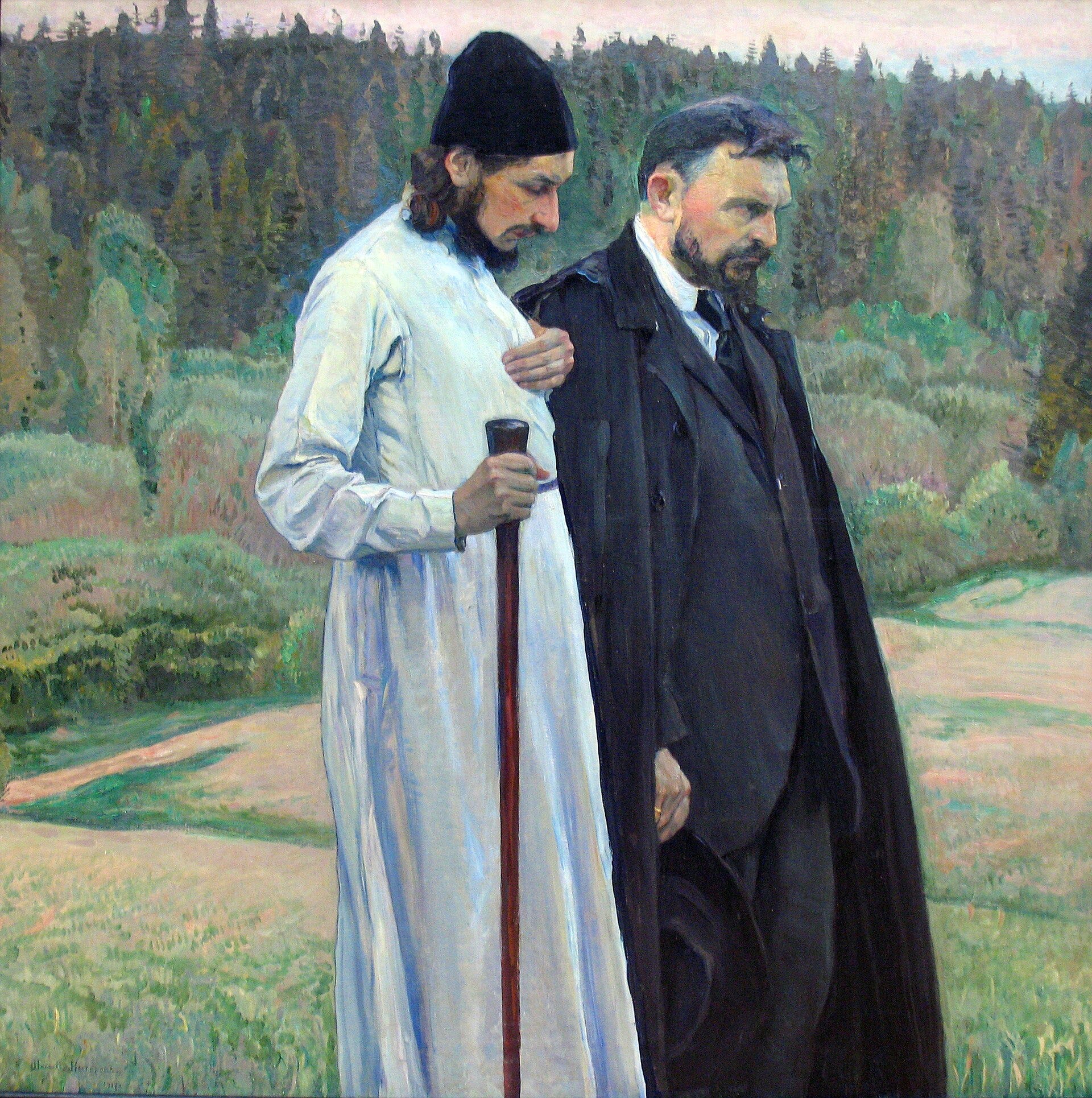
Since the fifteenth century, painters schooled in the Italian tradition dismissed this as a technical lapse. Florensky, who had measured the boards himself, argued that it was a decision. The vaunted perspective of the Renaissance, he argued, was born in Athens for the theatre, for a spectator “separated from the stage by a glass barrier”, with “just one immobile eye” and “his will paralysed”, a man who looks and cannot enter. The icon painters, he said, rejected that spectator entirely. The person before an icon is no mere onlooker; the icon is already present in the room, and has been watching him since he arrived.
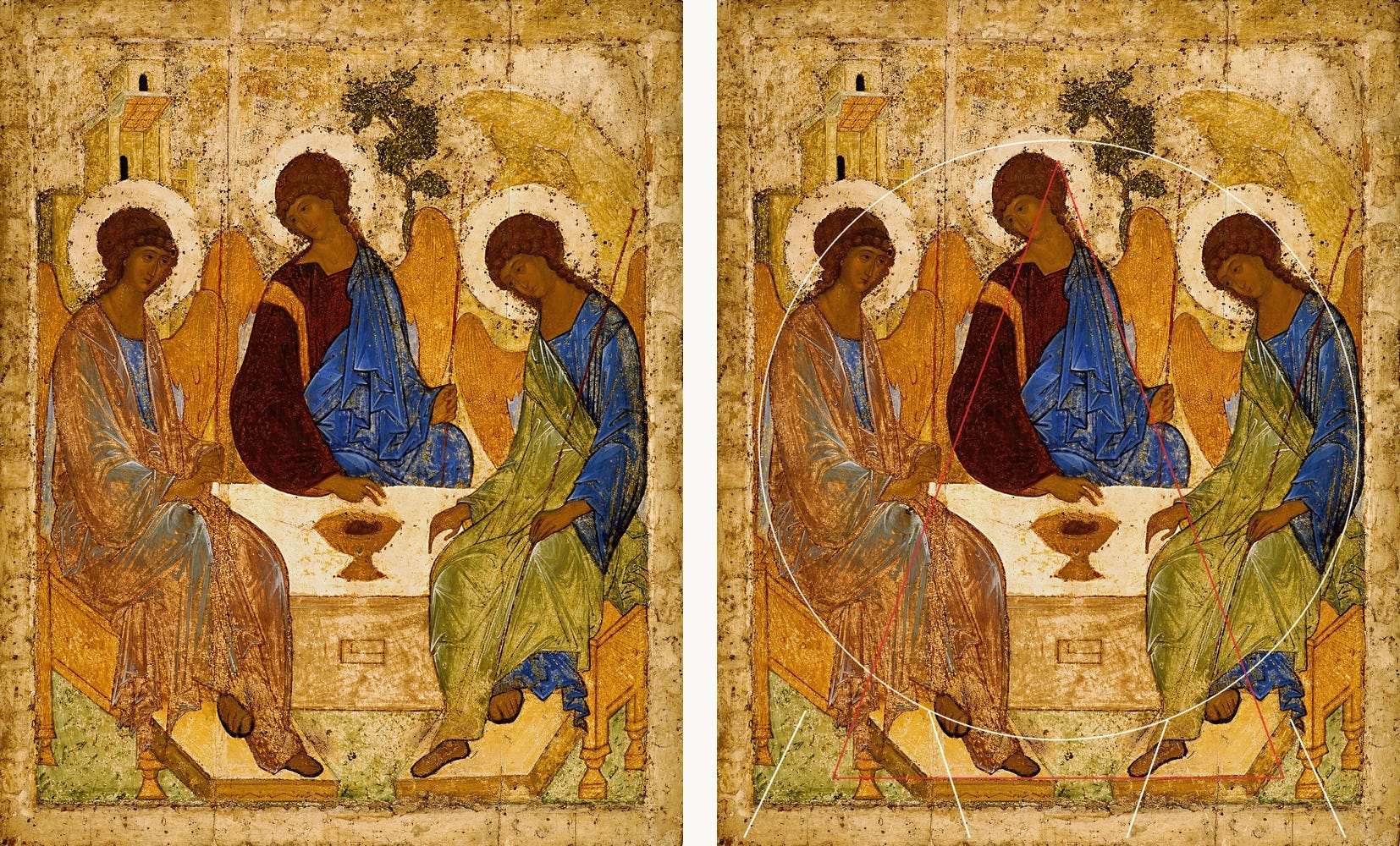
Two years later, in Iconostasis, he described what actually hangs in the corner, and he did it by refusing the word picture. An icon of the Mother of God, he wrote, is a window through which one sees the Mother of God herself, face to face, and a window is a stranger thing than it seems:
Или окно есть свет, или оно дерево и стекло, но никогда оно не бывает просто окном.
Either a window is light, or it is wood and glass, but it is never simply a window.
So an icon is always either more than itself, a vision, or less, mere boards and paint and drying oil, with nothing in between. Florensky’s entire argument settles on a single sentence, which he called the most convincing proof of God he knew, and which no theology textbook has ever dared to include:
Есть Троица Рублева, следовательно, есть Бог.
There is Rublev’s Trinity; therefore, there is God.
Hold the square up to that sentence, and both Benois’s joke and Malevich’s manifesto fade into the background. What remains on the wall is a question the priest had already answered, unwittingly, before it was ever asked.
Malevich hung a board where the window should be, knowing that in that corner, a board cannot remain just a board.
Florensky’s rule allows it only two destinies: light, or plank. In 1927, Malevich called the square feeling, and the white around it “the void beyond this feeling.” Florensky, never having seen it, had already named that void as the thing he was fighting: the space of perspective painting, “qualitatively homogeneous, infinite and boundless”, “formless and devoid of individuality,” a space whose very logic “rejects both nature and man in one fell swoop”. The white field is that space, and the square sits within it as the icon once did in the corner: a solitary presence that keeps its feeling, even as everything else has been let go.
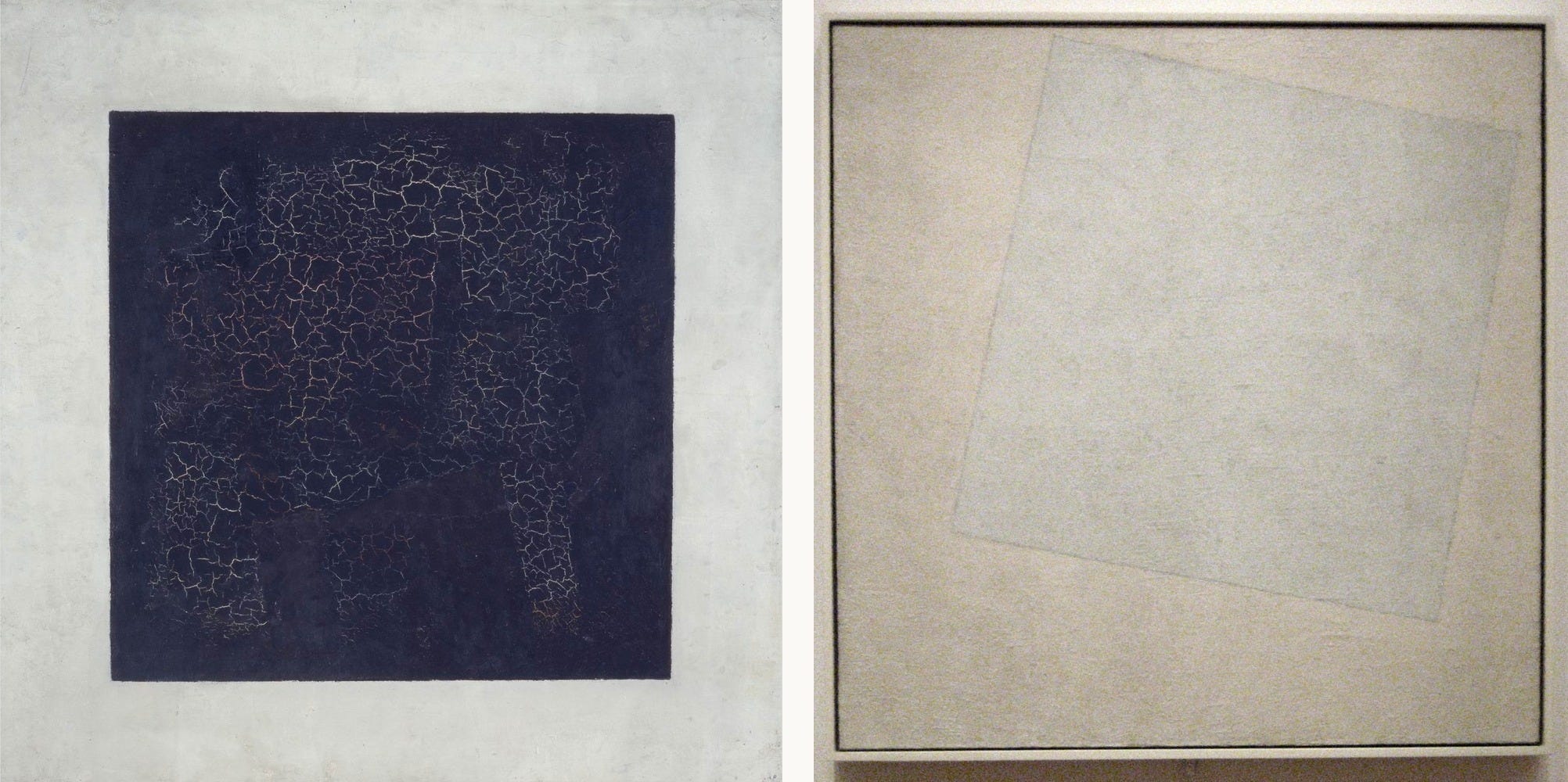
In 1918, Malevich painted White on White, a white square tilted a little on a white ground, and in 1919 wrote that he had “breached the blue lampshade of colour limitations and passed into the white beyond: follow me, comrade aviators, sail on into the depths.” He was sailing, in other words, straight into the very space the priest had warned was no place for a human being. In 1922, in Vitebsk, he published a pamphlet with a title that could have doubled as Florensky’s biography: God Is Not Cast Down: Art, Church, Factory. All three, he argued, seek the same thing, a state of rest. Florensky, meanwhile, was living all three at once: still chanting the liturgy, still writing on icons, and, since 1921, at Trotsky’s behest, working as an engineer electrifying Russia, striding into the ministry each morning in his cassock.
Everything passes
After the revolution, the state emptied the corners, the icons came down from the walls of schools and offices, and the old name, krasny ugol, was kept for the place where the portraits of the leaders went up instead. Florensky was arrested on the twenty-sixth of February 1933 and given ten years, and in November 1934 he was sent north to the old monastery on the Solovetsky islands in the White Sea, where the camp set him to extracting iodine from seaweed. From there he wrote to his children letters about Racine and Khlebnikov and how to read ten lines of good prose a day, and in April 1935, to his daughter Olga, this:
Всё проходит, но всё остаётся. Это моё самое заветное ощущение, что ничего не уходит совсем, ничто не пропадает, а где-то и как-то хранится.
Everything passes, but everything remains. It is my most cherished feeling that nothing goes away entirely, nothing is lost, but is kept, somewhere and somehow.
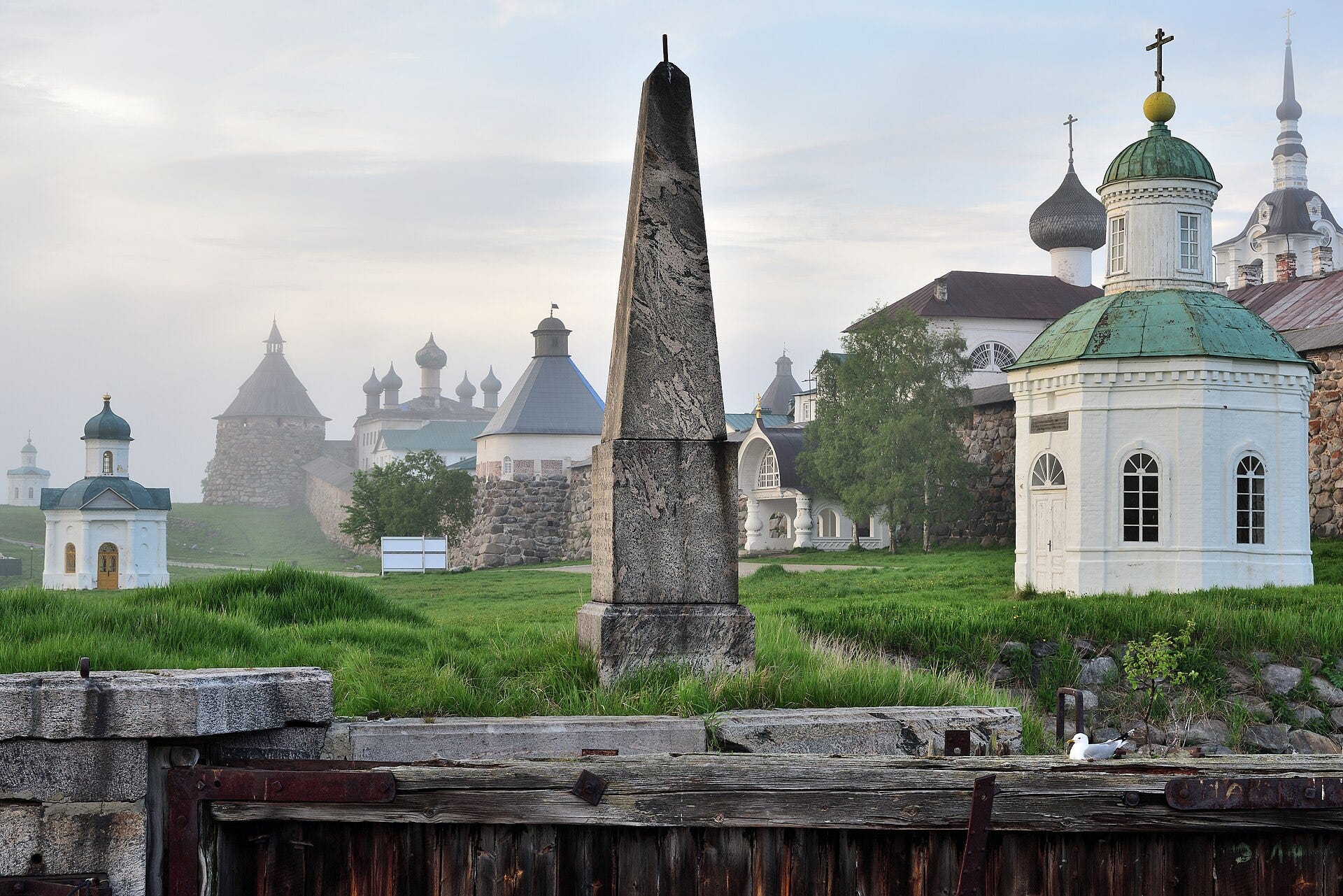
A window or a board: he had chosen, and that choice endured even in a camp built within a monastery whose corners had all been stripped bare. On November twenty-fifth, 1937, a board of three men sentenced him to death. On December eighth, he was shot near Leningrad with several hundred others. His family received a false date, and believed it for decades.
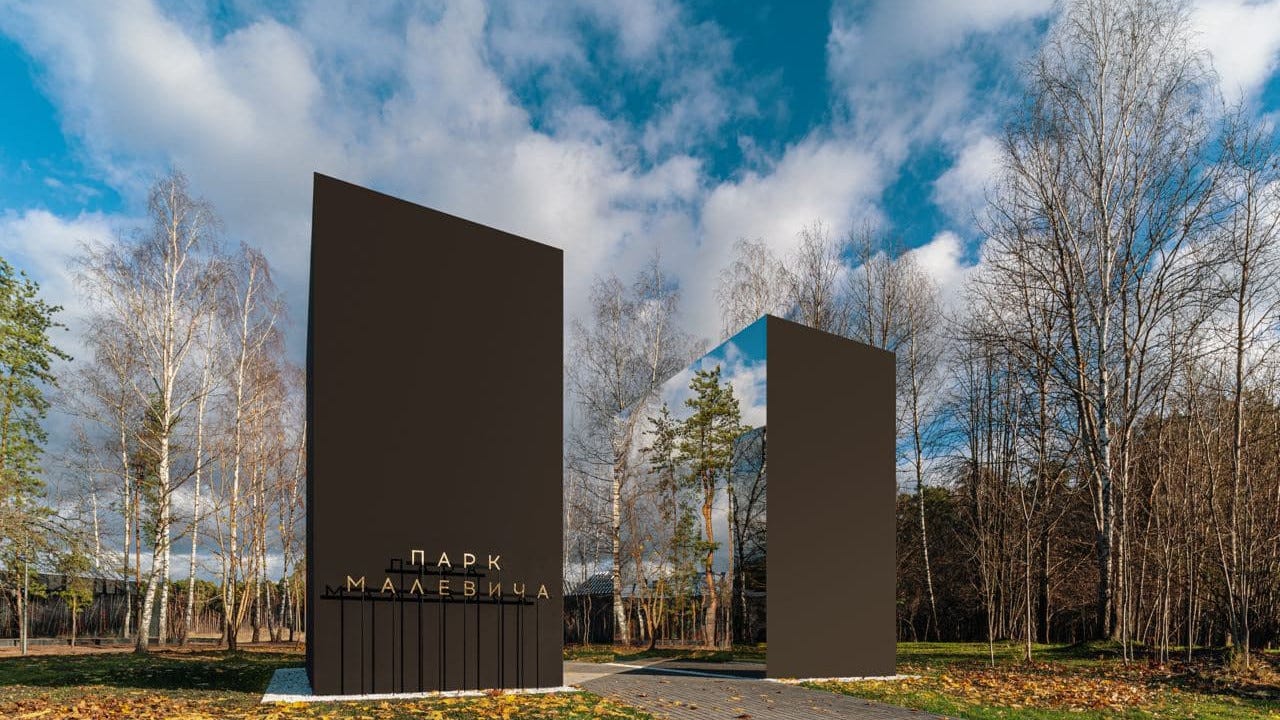
Malevich died two years earlier, in his bed in Leningrad, cancer his final adversary. He was laid out among his paintings, the square suspended above his head. His students placed a black square on the coffin, no cross. The ashes were buried beneath his oak at Nemchinovka, marked by a wooden cube crowned with a black square. War swept away the cube, the tree, and the grave, so that the memorial erected in 1988 stands two kilometres from where he likely rests. What remains is a field outside Moscow, empty but for memory. If a sentence must be spoken over that field, let it be the priest’s, from the island: nothing goes away entirely; it is kept, somewhere and somehow.
Step into a room and look up, to the corner, at whatever hangs there - a print, a clock, a crucifix, a square of nothing - and pose the priest’s question: light, or wood and glass? Then wait for the lamp to go out, for the object to remain silent, and the darkness in that corner will answer, as it always has, for every child who ever lay awake beneath it.
it's art is free: one essay a week, when something is worth saying.
If you know someone who looks up when they enter a room, send them this.
Munch's Sun: The army he could not see.

It is late afternoon on the Ekeberg hill above Kristiania, the city we now call Oslo. A road runs along …
The Fullness of Absence: Soulanges and Bosso

These pages do not seek to explain, but to linger: beside the black of Pierre Soulages, beside the silence of Ezio Bosso.
Great article. Kudos.. Thanx..
Malevich's black square was also featured in one of my posts a while back, with artworks that convey a sense of "vast and slow processes"
>> https://substackcdn.com/image/fetch/$s_!ngUR!,w_1456,c_limit,f_webp,q_auto:good,fl_progressive:steep/https%3A%2F%2Fsubstack-post-media.s3.amazonaws.com%2Fpublic%2Fimages%2Fce573091-d521-4277-930a-62844f933caf_1468x1468.png
>>
https://cnorahs.substack.com/p/natures-wonders-big-and-small-fast