



The voice in the opening paragraph is invented. The boy, the streets, the paintings, the will of 1487 and the day of his death are real.
Slower, Marco. From the door of the Badia to the fountain is a hundred and twelve of my paces, and you take three steps to my two, so you must count for both of us. Tell me when the wall ends; it’s the only thing left I can measure. A man who cannot measure becomes a parcel carried, not a person walking through his town.
One hundred and twelve paces.
The boy was six or seven, a lantern-maker’s son, and sixty-three years later, an old man at the conservators’ table in Borgo San Sepolcro, he told the town chronicler what he had done as a child, and on the seventh of September 1555 it went into the ledger:
Menava per mano Mastro Pietro di la francesca pittore eccellente che era accecato, tanto lui mi disse.
He led by the hand Master Piero della Francesca, excellent painter, who had gone blind; so he told me.
Vasari claims blindness struck him at sixty, felled by a catarrh, but his will from July 5, 1487, shows him still sound in mind and body past seventy. Darkness came late, to a man who had written three books, including the first European treatise on perspective: how to set a body at a measured distance and draw what it would see.
In the end, a child told him where the wall ended. For a man who measured everything, what remains when one thing resists his grasp?
The floor that tells you where you are
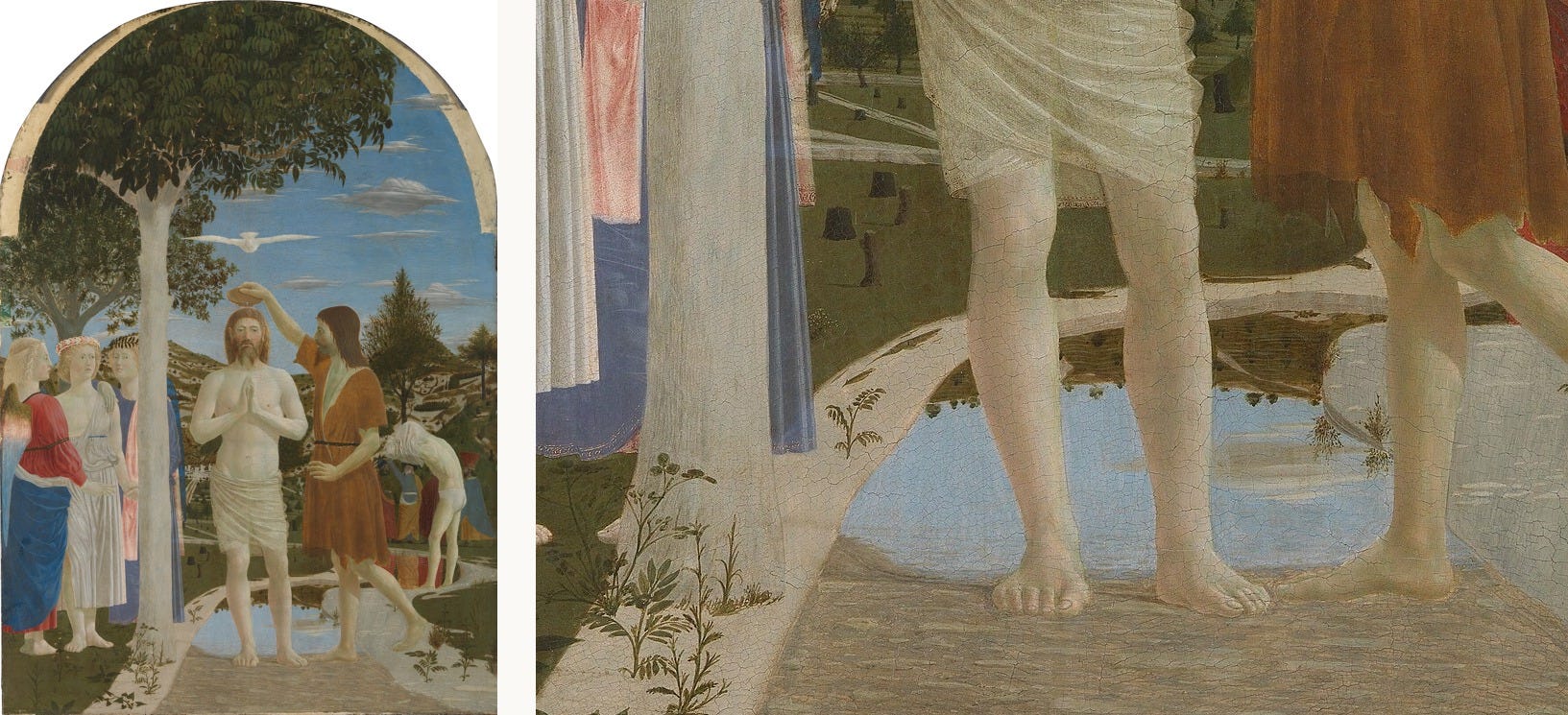
From the outset, in The Baptism of Christ, his earliest surviving painting, the river appears as a mirror, yet where Christ stands, the reflection dissolves, and the pebbles gather at his feet. The Jordan is not a barrier, but the precise place where a reflection gives way.
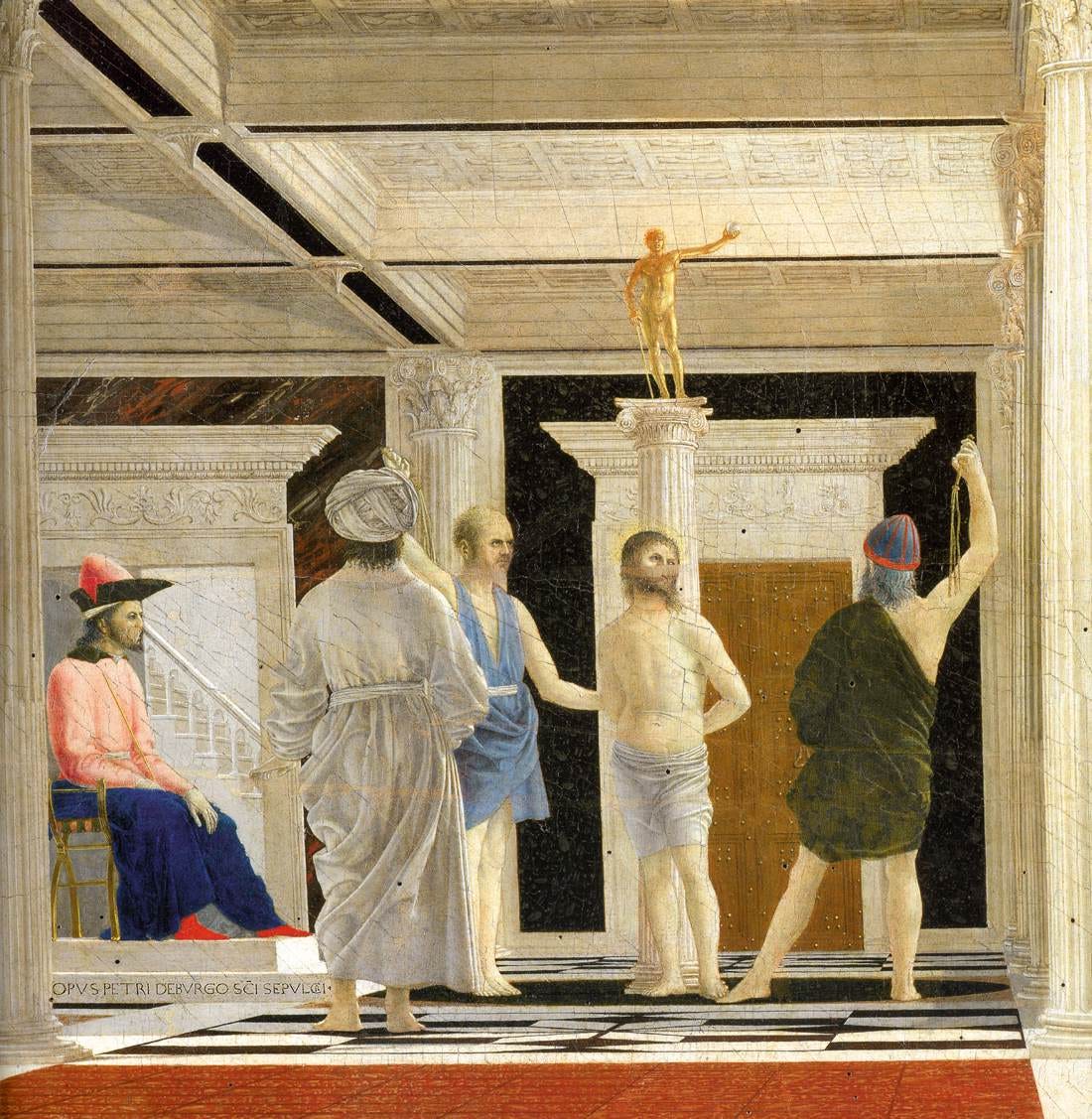
The Flagellation at Urbino, modest in scale and quietly signed, has stirred more debate than nearly any panel in Italy. Christ, remote, stands beneath a coffered roof in cold light; in the foreground, three men with their backs to the event are lit from the left. Their identities are uncertain, and the only certainty is the viewer’s own position.
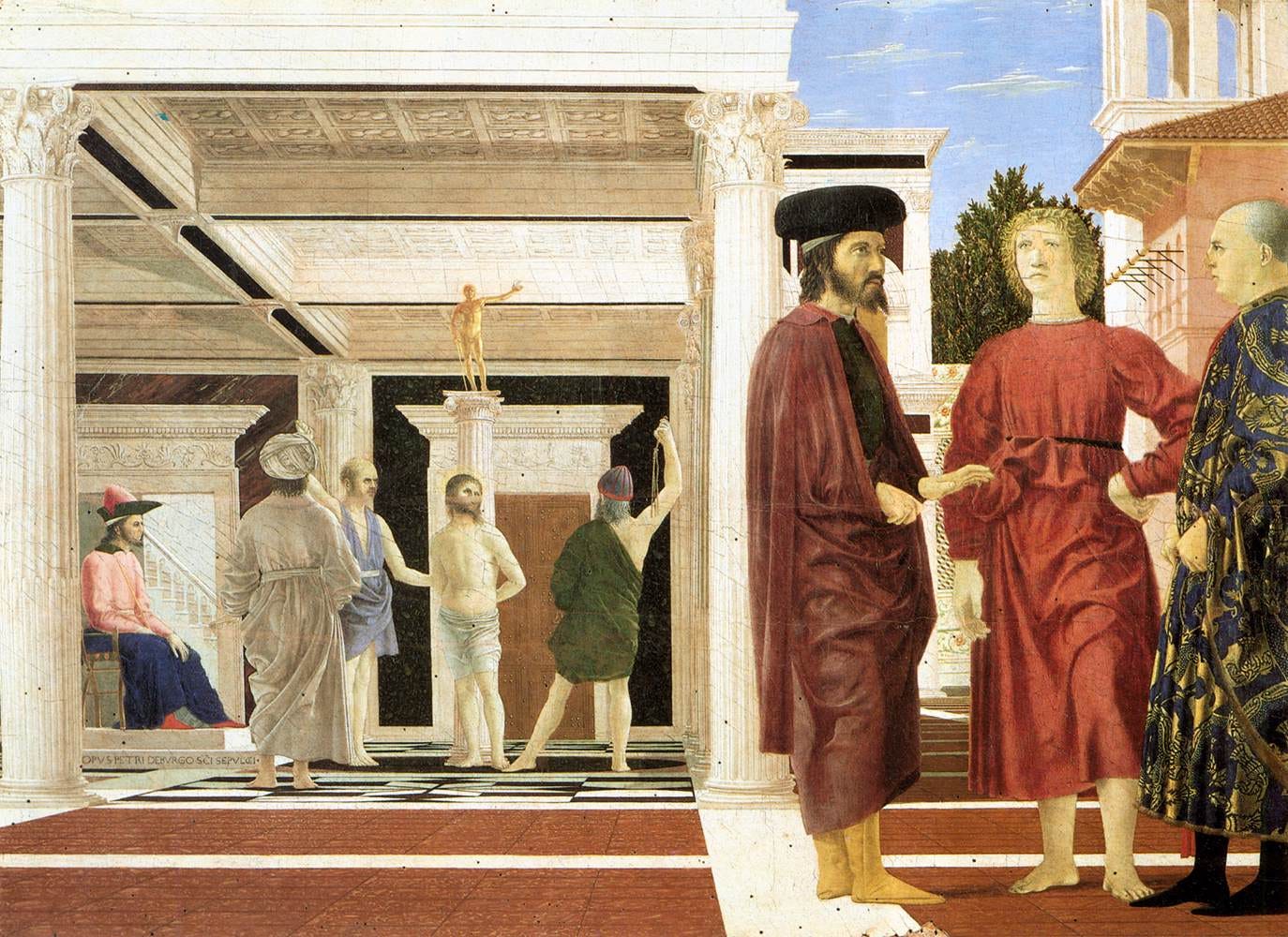
In 1953, Rudolf Wittkower and B. A. R. Carter examined the painted pavement, which, viewed at such a shallow angle, appears as little more than a series of stripes. They measured it, square by square, reconstructed the building in plan and elevation, and determined the precise distance at which the perspective unites: approximately one hundred and forty-eight centimetres from the panel. Stand at that point, and the floor gathers itself, the room becomes whole; step away, and it dissolves.
His book had said as much. Painting, he writes in its first sentence, contains three principal parts, drawing, commensuration and colouring, and he will treat only the second, which we call perspective: things seen from afar, represented with proportion according to the quantity of their distances. Of the eye itself, he adds, he will speak no further than painting requires. He is not writing about vision. He is writing about position.
He painted the position from which you must stand to see what he saw.
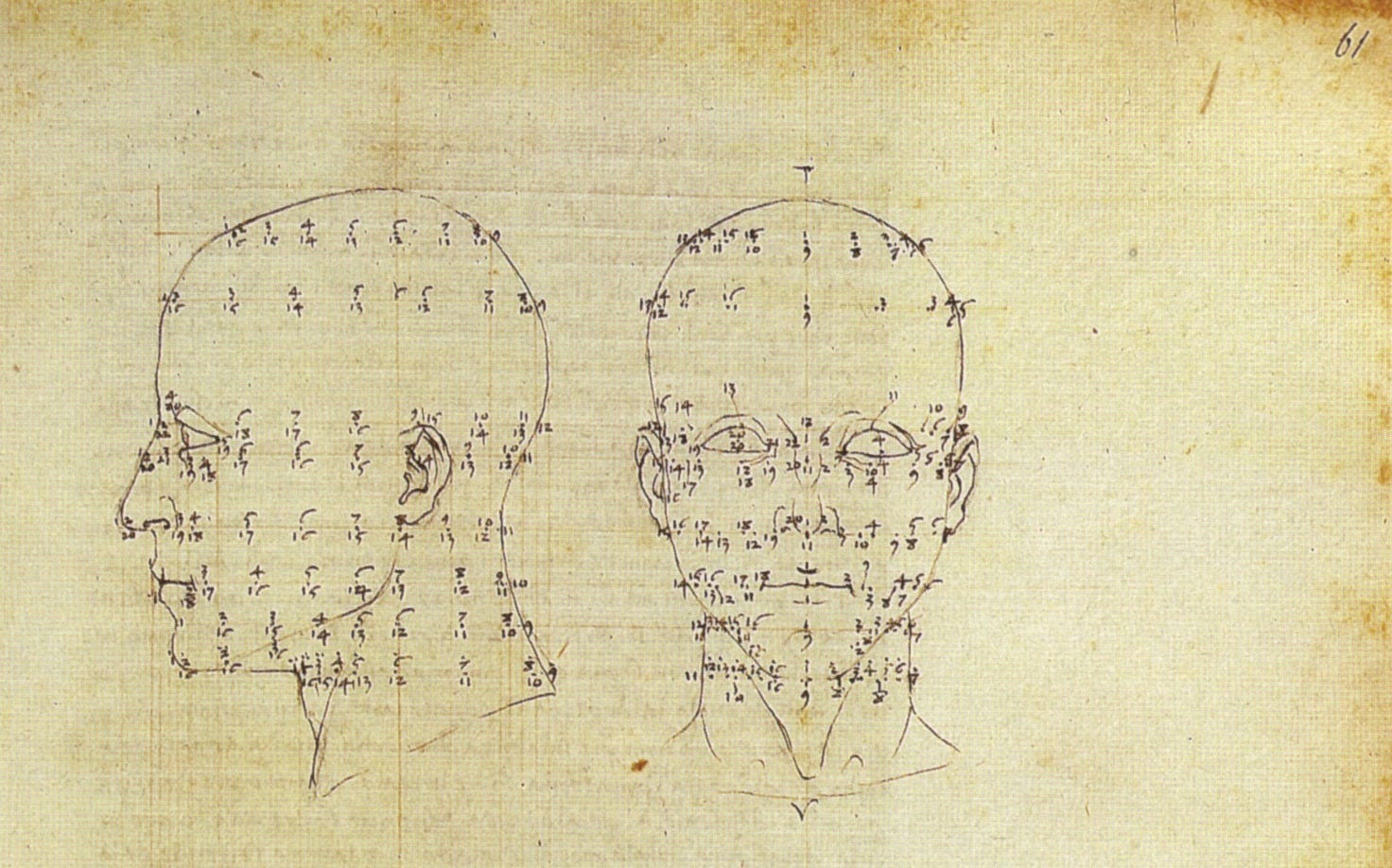
The mind is called mind because it measures
This was never arithmetic for its own sake. Every geometer in Piero’s Italy worked under a single verse from the Book of Wisdom:
Omnia in mensura et numero et pondere disposuisti.
Thou hast ordered all things in measure and number and weight.
If the world is composed in measure, number, and weight, then to measure it is not to impose order from outside. It is to read what is already inscribed.
In 1450, Nicholas of Cusa wrote a dialogue in which a layman, carving a spoon, explains that the mind is called mens because it measures (a mensurando). His spoon imitates nothing in nature; he brings form out of wood until due proportion appears. The Church’s most formidable mind put his philosophy in the mouth of a craftsman.
Set beside it the famous definition: in 1435, Alberti instructed painters to begin with a rectangle, an open window through which the subject would be viewed. The charge against that window has always been that it leaves the viewer outside, one eye, fixed, behind glass, presented with a world he cannot enter. Cusanus later sent the monks of Tegernsee a painted face whose eyes follow every man in the room at once, and called it the icon of God.
Nothing in Piero’s paintings ever returns your gaze. He constructed a floor, humble and enigmatic, to tell you, with precision, how far you stand from what you cannot reach. The spectator behind glass remains outside the painting. A body given its precise distance from a mystery is already in the posture of reverence.
Bare on the left, in leaf on the right
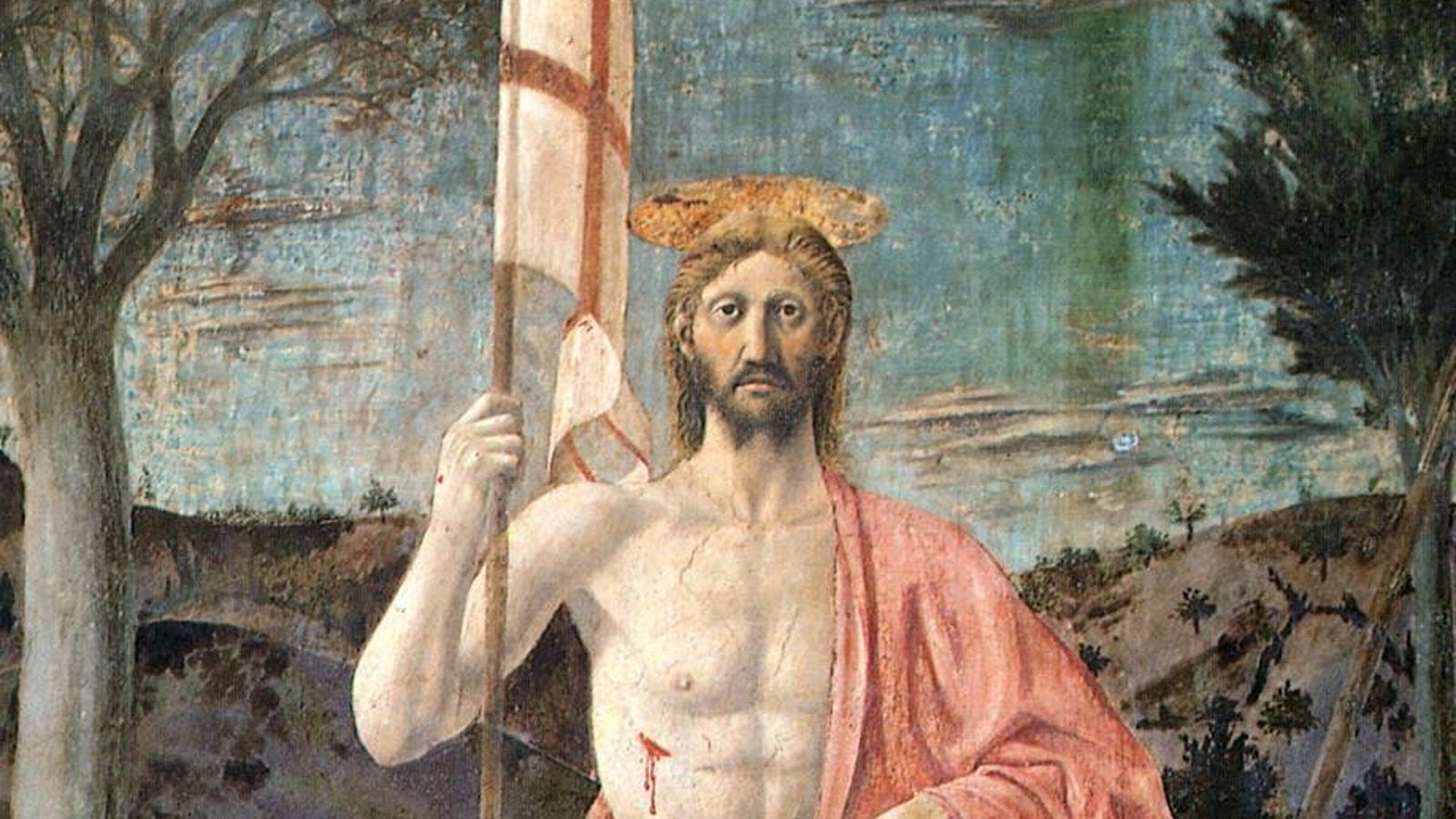
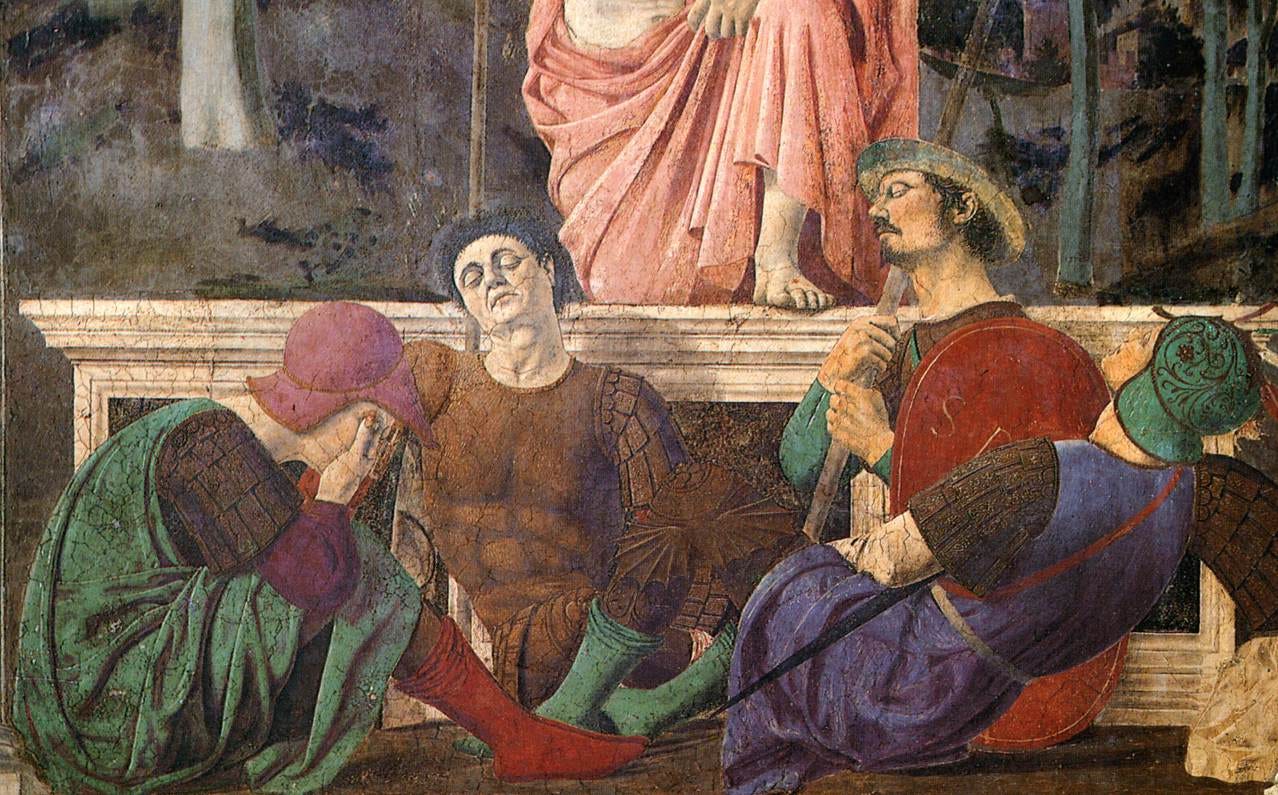
He returned home, to a town named for two relics of the Holy Sepulchre brought by pilgrims, its coat of arms bearing the risen Christ, and painted the Resurrection on the wall where governors assembled before their decisions. The figure rising from the tomb wears the face of a local, weighty, unadorned, fully awake, while four soldiers sleep in a tangle below. Behind him, the trees on the left stand bare, those on the right are in leaf, and the boundary between them passes through his body. Winter and spring are not merely symbols, nor are they explained; they are measured along a vertical, as he measured all things.
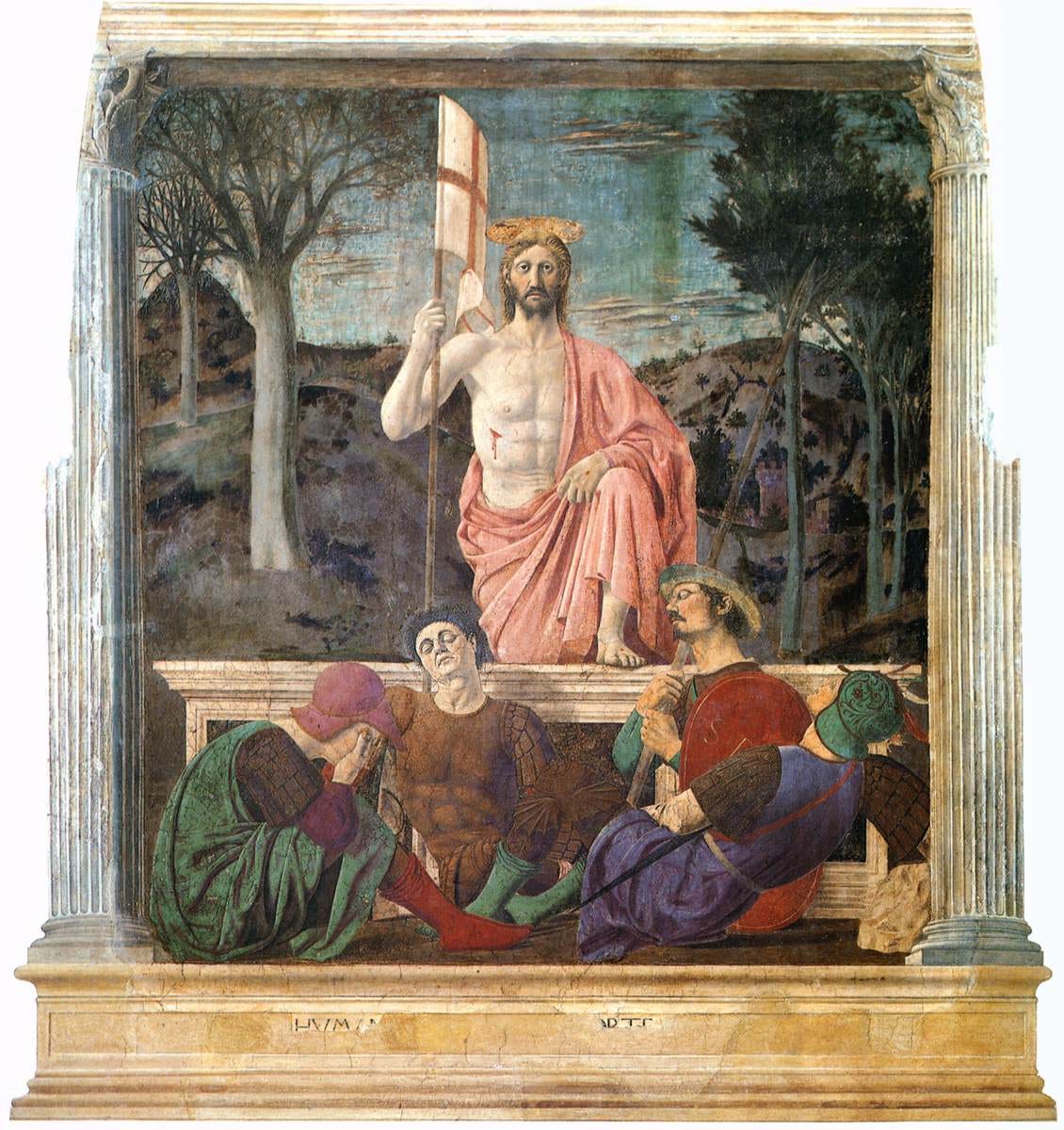
Aldous Huxley called it the greatest picture in the world in 1925, and in the late summer of 1944 a British artillery officer named Anthony Clarke stood on the hills above the town with orders to shell it, remembered the phrase, and held his guns. He said afterwards that he always liked to think he was responsible for the safety of Piero’s Resurrection.
The book with his name taken off
On the twelfth of October 1492 the Fraternità di San Bartolomeo, of which he had been prior, wrote in its book of the dead: Maestro Piero di Benedetto dei Franceschi, famous painter, on the twelfth, at the abbey.
Two years later his fellow townsman Luca Pacioli, whom Vasari calls his pupil, printed the Summa de arithmetica and named him the monarch of painting in our time; then in 1509 printed Piero’s treatise on the five regular solids inside a book of his own, with Piero’s name nowhere on it. Vasari said it without ceremony:
come empio e maligno cercò d’annullare il nome di Piero suo precettore,
like an impious and malignant man he sought to blot out the name of Piero, his teacher
Let the record stand: the paintings endured on their walls, the books circulated across Europe under another’s name. Their author lingered between the Badia and the fountain, one hand on the wall, a child counting his steps. The truth of a correct measurement is austere: once made, it belongs to no one. It persists in rooms you will never enter, for people who will never know your name. He measured, to the last wall of the last street, with his hand.
So go and stand where the floor tells you to stand. A hundred and forty-eight centimetres from the panel, an arm and a half, no further. From there the tiles close, the building becomes one building, and you can look through it at the small far figure under the roof, lit from the wrong side, attended to by no one in the painting. You will not know who the three men in front of you are. You will not know what they are saying. You will know, exactly, to the centimetre, where you are standing.
He could not see where the wall ended. He still knew how far away it was. Count for both of us.
it’s art is free: one essay a week, when something is worth saying.
If you know someone who counts their paces, send them this.
If this kept you company:
Malevich's Black Square: The painting with nothing in it.

Petrograd, a winter afternoon, December nineteenth, 1915. The Field of Mars lies silenced beneath snow, and inside the Dobychina Art Bureau, fourteen artists have gathered under a cypher: 0,10, zero-…
148 centimeters! Now I want to go there with a tape measure, stand in exactly the right spot, and then move six inches to the left just to see what I've screwed up.
Also, poor Marco. Imagine being six years old and getting the job of counting Piero della Francesca's steps.
I remember the moment I first became interested in art history. It was through a painting of the Resurrection. There was something magical about it that captivated me and awakened a real nice curiosity in me. That moment stayed with me;) and ultimately inspired me to devote myself to art.