



Cross the Ponte Vecchio going south and keep walking until the street narrows and the river noise thins. Santa Felicita is the church you do not notice. It sits back behind a small square, with Vasari’s corridor running across its front like a sleeve pulled over an arm, and most people pass it on the way to the Pitti without looking up.
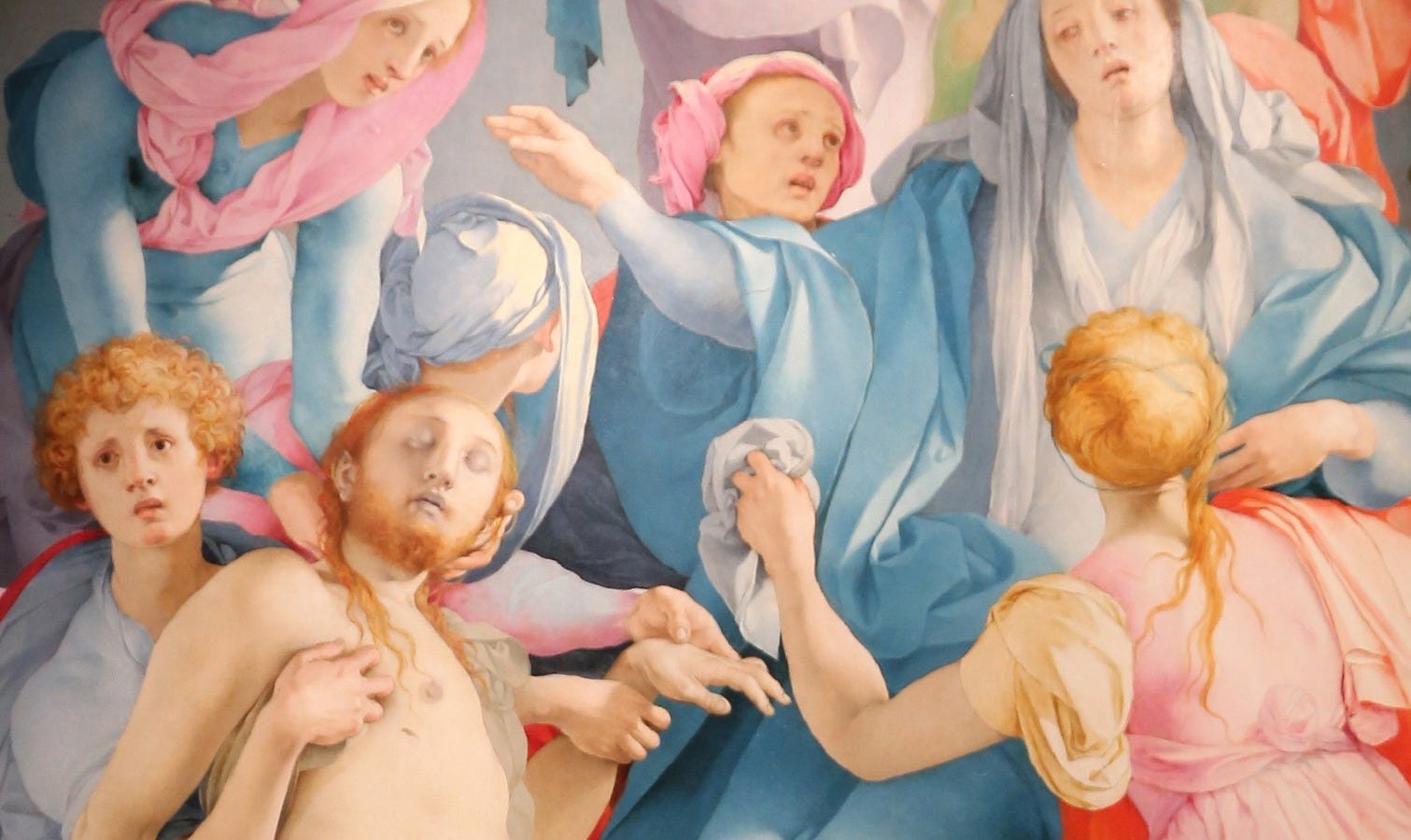
The chapel waits just to the right, behind a fretwork of iron, its illumination governed by the mechanics of small change. Drop in a coin, hear the click, and suddenly a wall of colour flares to life: coral, sky blue, acid green, lilac, rose, gold, all laid on with a flatness that refuses shadow. These are the hues of festivity, but what they enfold is a corpse.
And then, inevitably, your eye begins to register what the picture withholds.
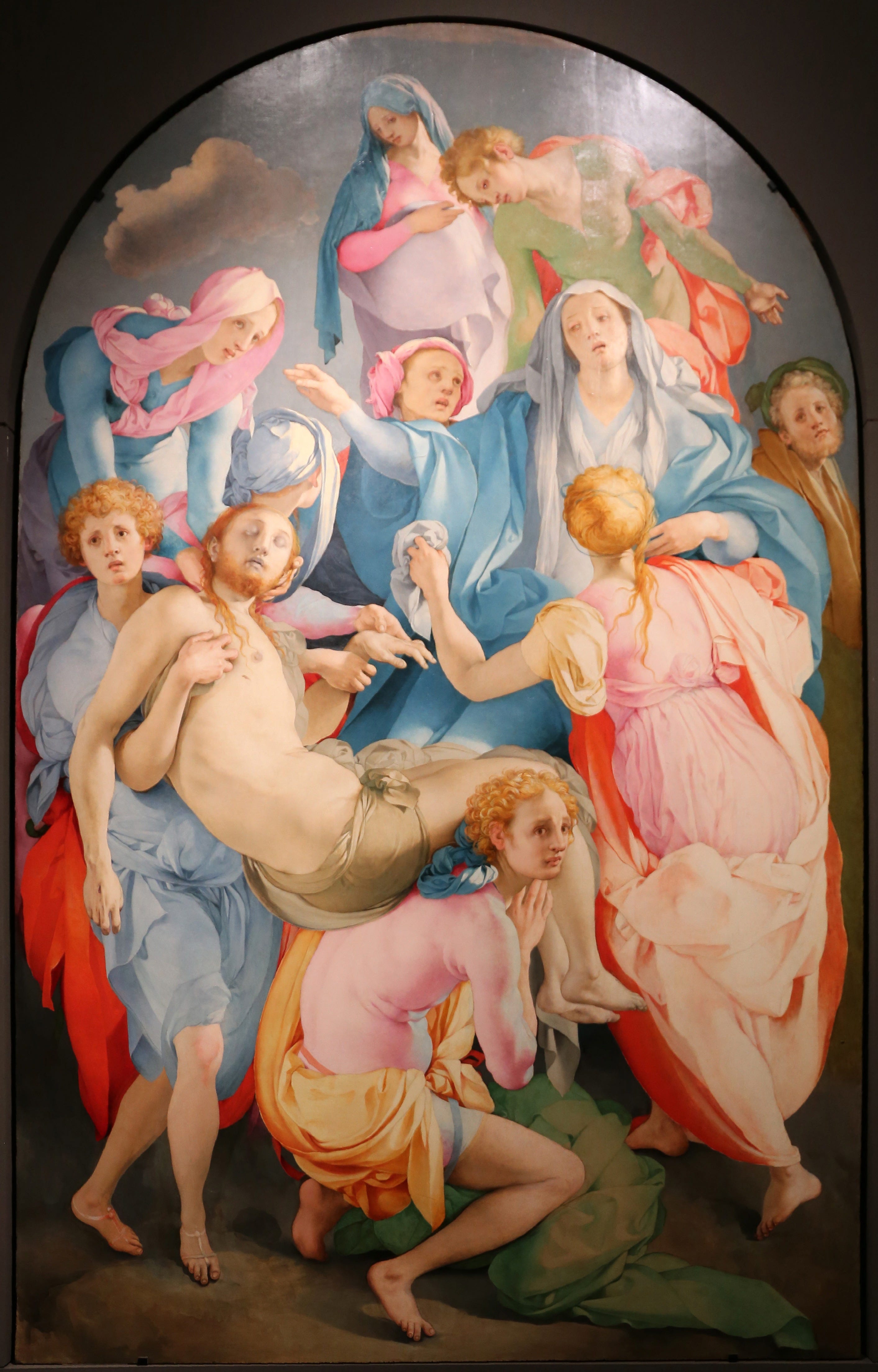
No cross, no ladder, no tomb, no rock, no city, no soldiers: only a brown-grey ground that barely acknowledges the feet, a sky that is little more than a smudge of grey, and, in the upper left, a solitary cloud, as if the weather itself had been painted and then quietly retracted.
The Lap With Nothing In It
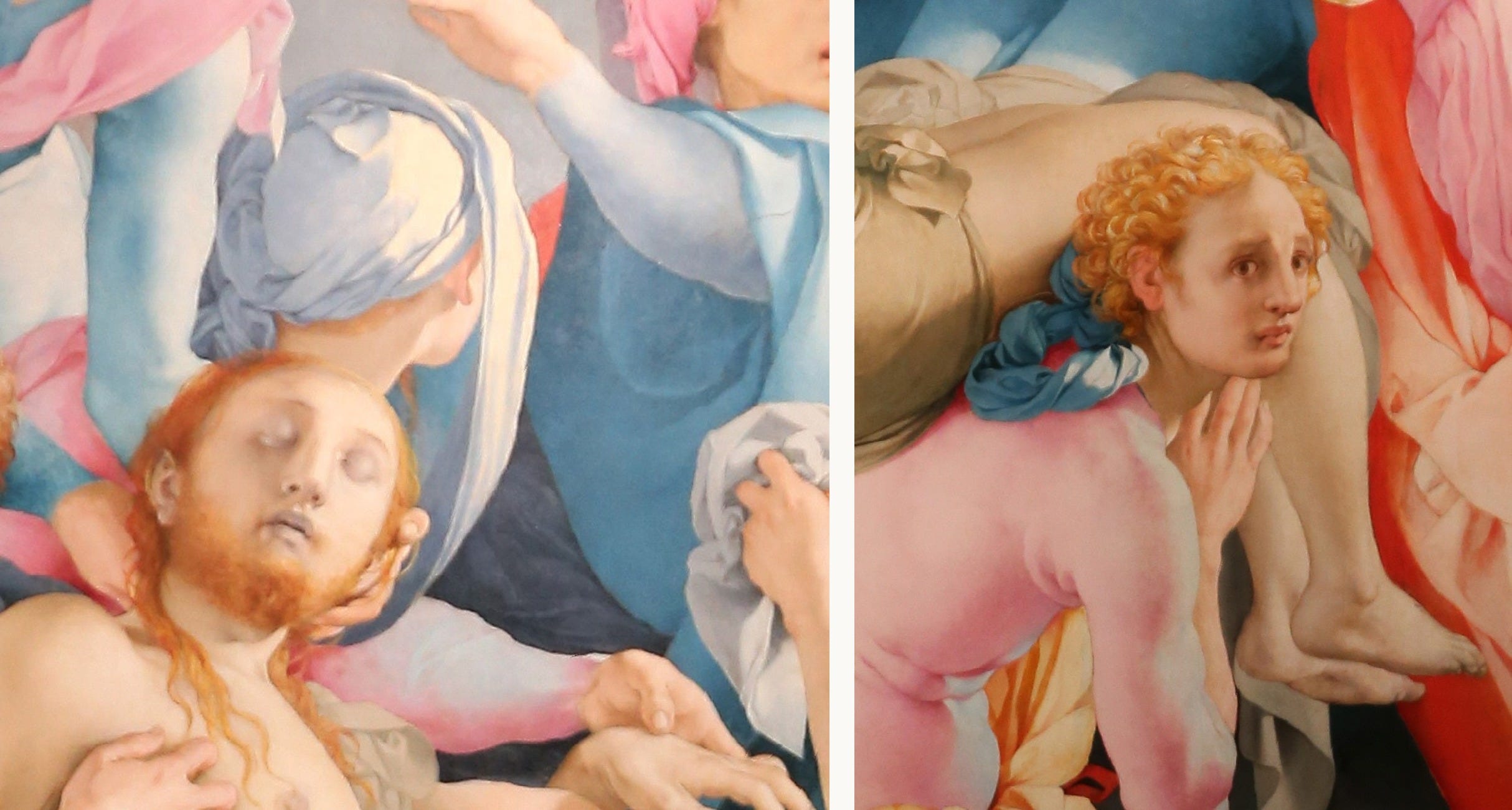
Everything in the panel is in motion. Eleven figures, Christ among them, revolve around a center like water circling a drain, and if you follow their spiral inward, you arrive at a great blue mass of drapery that enfolds nothing. Kurt Forster gave it a name:
das sonderbar leere Zentrum des Bildes,
the strangely empty centre of the picture.
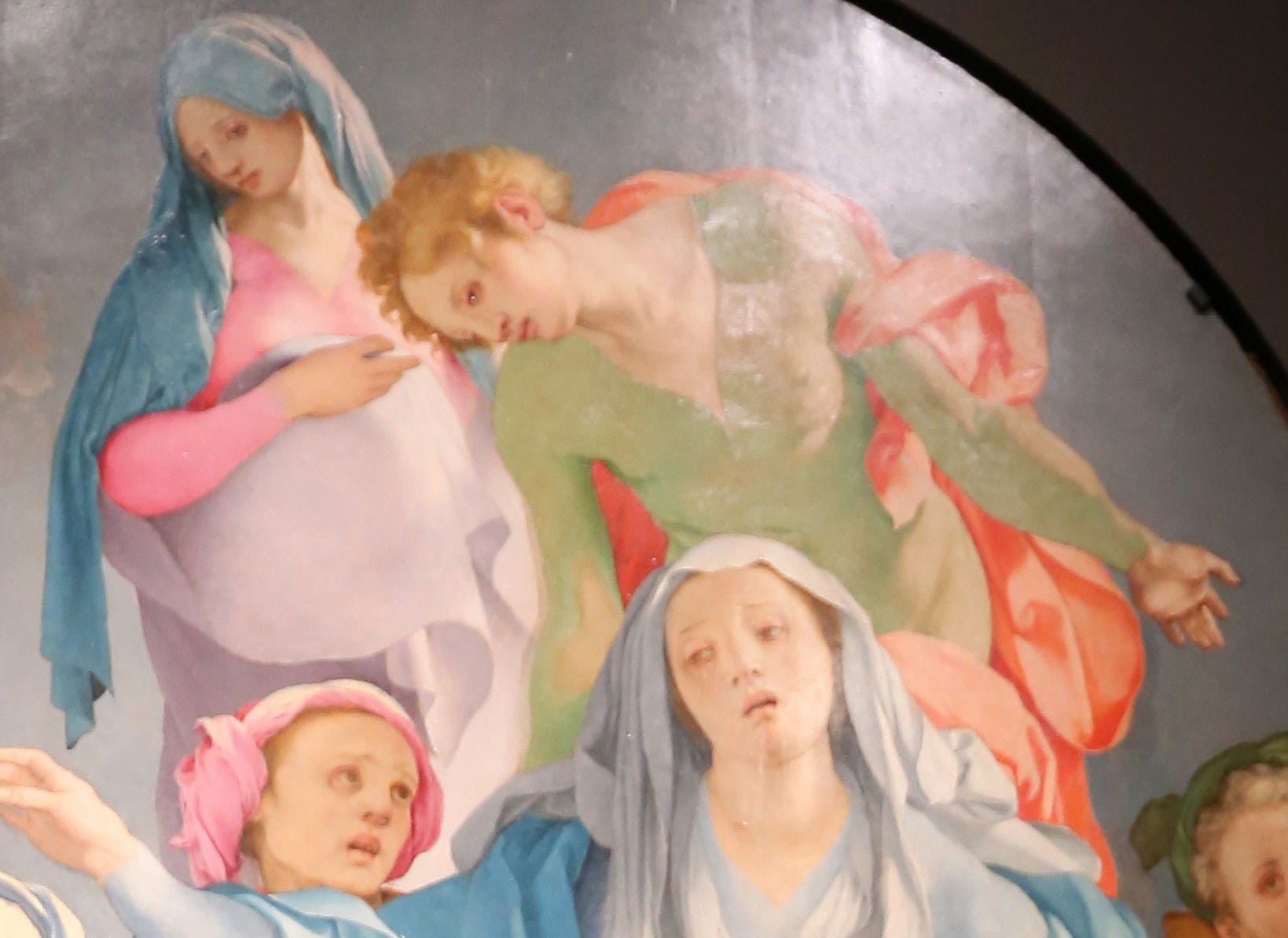
It is the Virgin’s lap. Leo Steinberg, writing about the chapel in 1974, called it “the widowed centre of the design”, and widowed is the exact word: two seconds ago the body was in it.
Only one Christ before this one bends this way: Michelangelo’s marble at Saint Peter’s. Pontormo alludes to that famous image of mother and son, then removes the son as you watch. The more indissoluble the union implied, the more grievous the severance you can show, and Pontormo implies the closest one
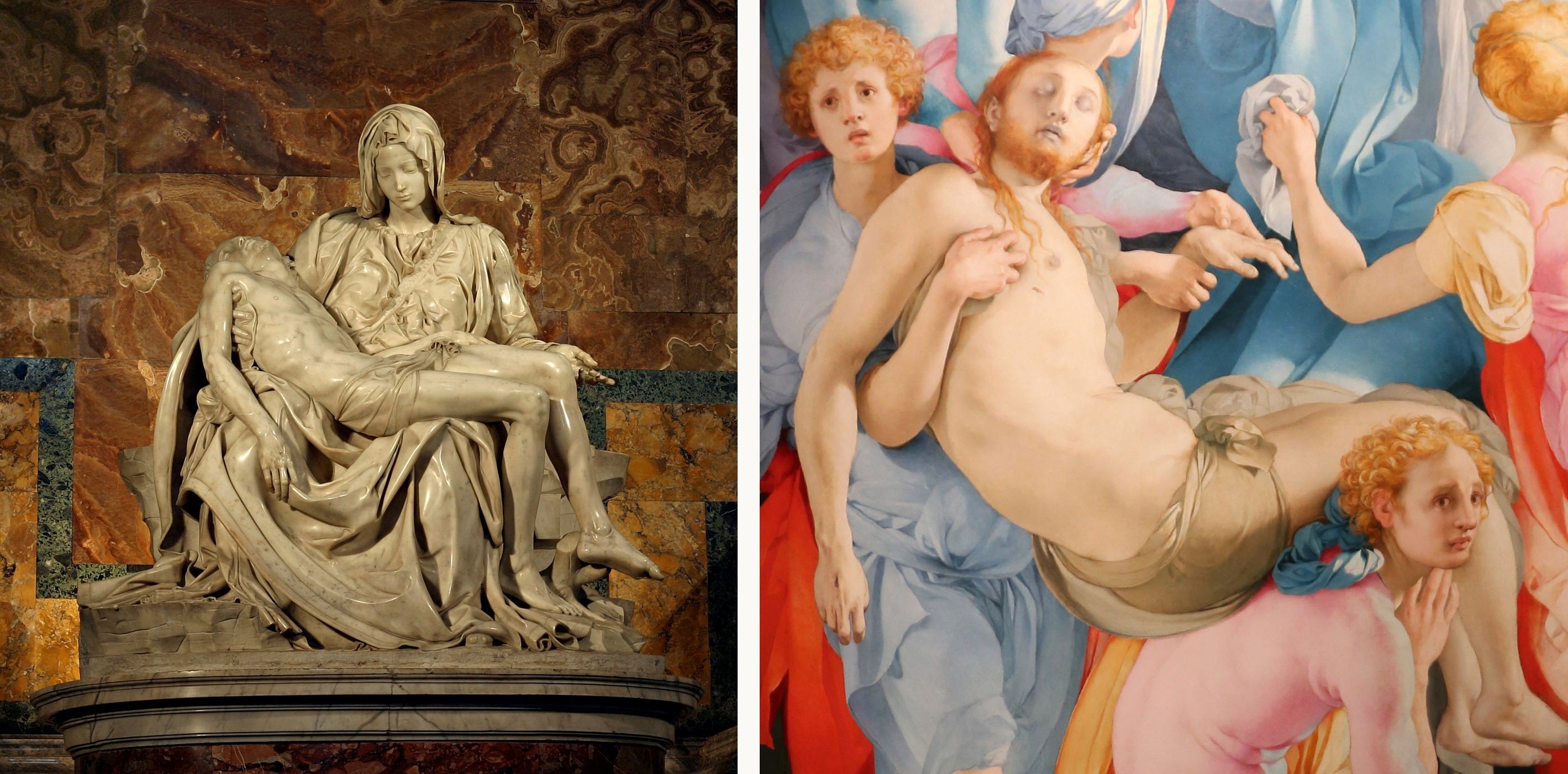
.
She is not fainting, though every reader expects the swoon. In these years, the swoon was under theological scrutiny; some argued a woman who accepted the sacrifice could not have swooned as painters depicted. Instead, she sits unsupported and elevated, immense, open-eyed, her head high. The wave of her hand is a movement she has chosen.
So the emptiness at the heart of this painting is not a theft. It is a gesture of relinquishment.
Where the Boys Are Taking Him
The picture keeps its destination to itself. Scholars have called it a Deposition, a Pietà, an Entombment, a Grabtragung. A painting that sustains such disagreement is usually holding something back.
The chapel already has an entombment. In 1526, before the panel was finished, Guillaume de Marcillat designed the window glass with the same scene the altarpiece is meant to be showing, and a chapel does not say the same thing twice in the same small room.
The bearers are boys. Tradition names them Nicodemus and Joseph of Arimathea; others simply call them ‘two unidentifiable youths.’ Lithe and blond, they balance the weight on tiptoe - nothing like two elderly men. Steinberg alone suggests they are angels, for only angels may lift the divine body from the mother’s lap.
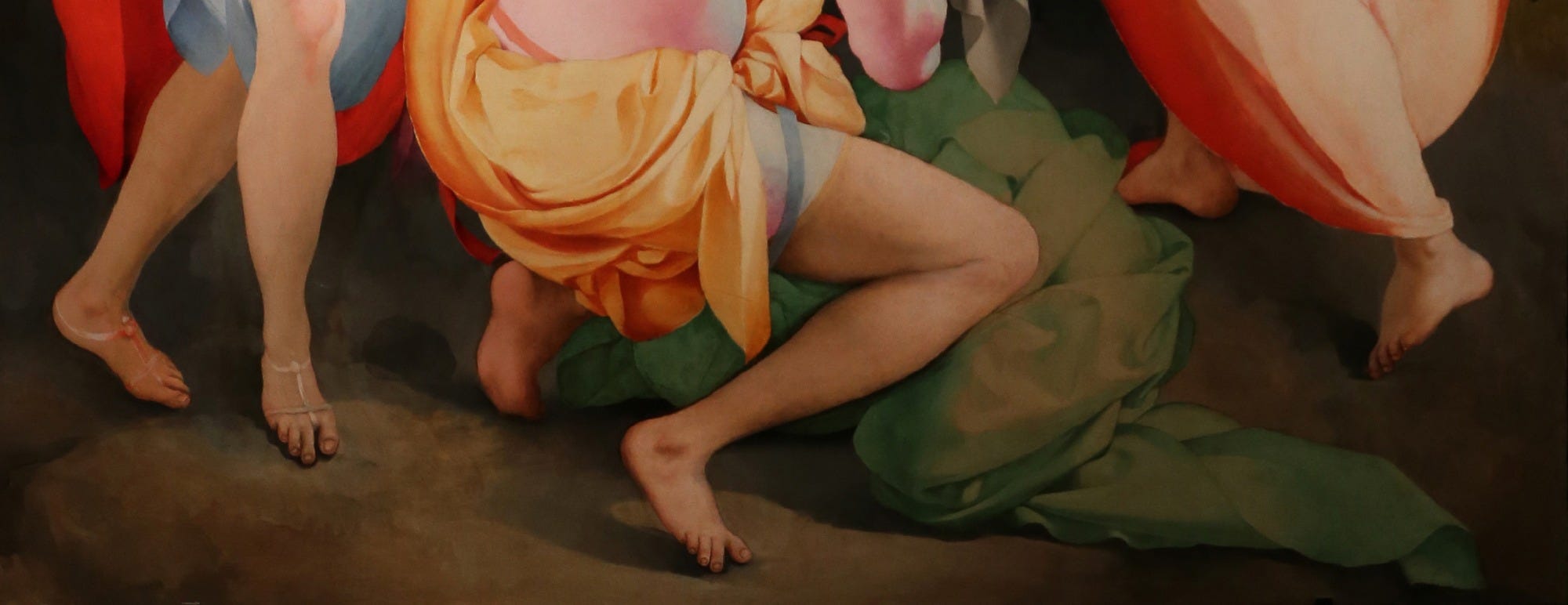
Angels or not, the evidence is in the heads. In Botticelli’s Lamentation, in Raphael’s Borghese panel, in Michelangelo’s London panel, the head of Christ points at the place the body is going. It is a directional sign. Here, not one of the figures in contact with the corpse lowers their gaze. The standing bearer advances with his head erect, his hands under a burden that does not appear to weigh. The crouching bearer strains to keep his head lifted and turns on the spot like the fixed foot of a compass, while Christ’s upper body swings through ninety degrees. And the woman cradling Christ’s head does not look down at it: she presents it, in Steinberg’s phrase, as one would an offering. Shearman read it as a lowering onto the altar, but a body rotating backwards out of its own frame is not being lowered into anything.
Once, there was a ladder: in a preparatory drawing, a diagonal descends from the upper left to the Madonna’s lap. In the finished panel, the ladder is gone, replaced by a solitary cloud, lit from the east but set against the westward light that rules the room. Pontormo severed the last tether to Jerusalem and replaced it with weather.
The destination was never in the painting, but above the frame. Once, a dome over the altar showed God the Father and four patriarchs. The Father is not blessing, but reaching. Below, the Son rotates to meet him, and when both turns finish, the two face each other: the Throne of Grace, the Father holding the dead Son.
On the window wall, Gabriel and Mary stand on either side of the real opening, with Florence’s light coming in between them. That is the gift arriving. The altarpiece is the same gift going back, and the hand that takes it was painted on the ceiling.
The body in this painting has been turning for five centuries, and for most of that time, there has been nothing above it to turn toward.
The Tree Florence Was Drawing
Still, there is no cross. Everyone in this city knew the shape of salvation. Bonaventure, around 1260, wrote the Lignum vitae, forty-eight meditations as a tree with twelve branches. Taddeo Gaddi painted it at Santa Croce, where friars ate beneath its branches for centuries. The cross was a tree, and the tree bore fruit.
And Pontormo uprooted the tree. He removed the cross and left only the fruit, borne aloft by two boys who do not trouble themselves with the direction.
Another tree hung in the air, and the city debated it for decades. Pico della Mirandola printed nine hundred theses in 1486, forty-seven from kabbalist sages. In 1516, a Latin abridgement of Gikatilla’s Gates of Light showed the first Tree of the Sefirot printed in Europe. In 1525, a Venetian Franciscan argued that Hebrew letters, numbers, and the spheres’ harmony were one system - the year Lodovico Capponi bought this chapel, and Pontormo began work.
The diagram is not hard to say: ten degrees on three columns, a Crown at the top and the world at the foot, and light that comes down through the degrees and goes back up the way it came. In it, the patriarchs are not men standing near God; each carries one of God’s own degrees: Abraham, loving-kindness; Isaac, severity; Jacob, beauty, holding the two in balance.
In a dome in Florence, in 1525, on the only reconstruction we have, a painter put God the Father high against open sky with four patriarchs around him, looking up in astonishment at a gesture.
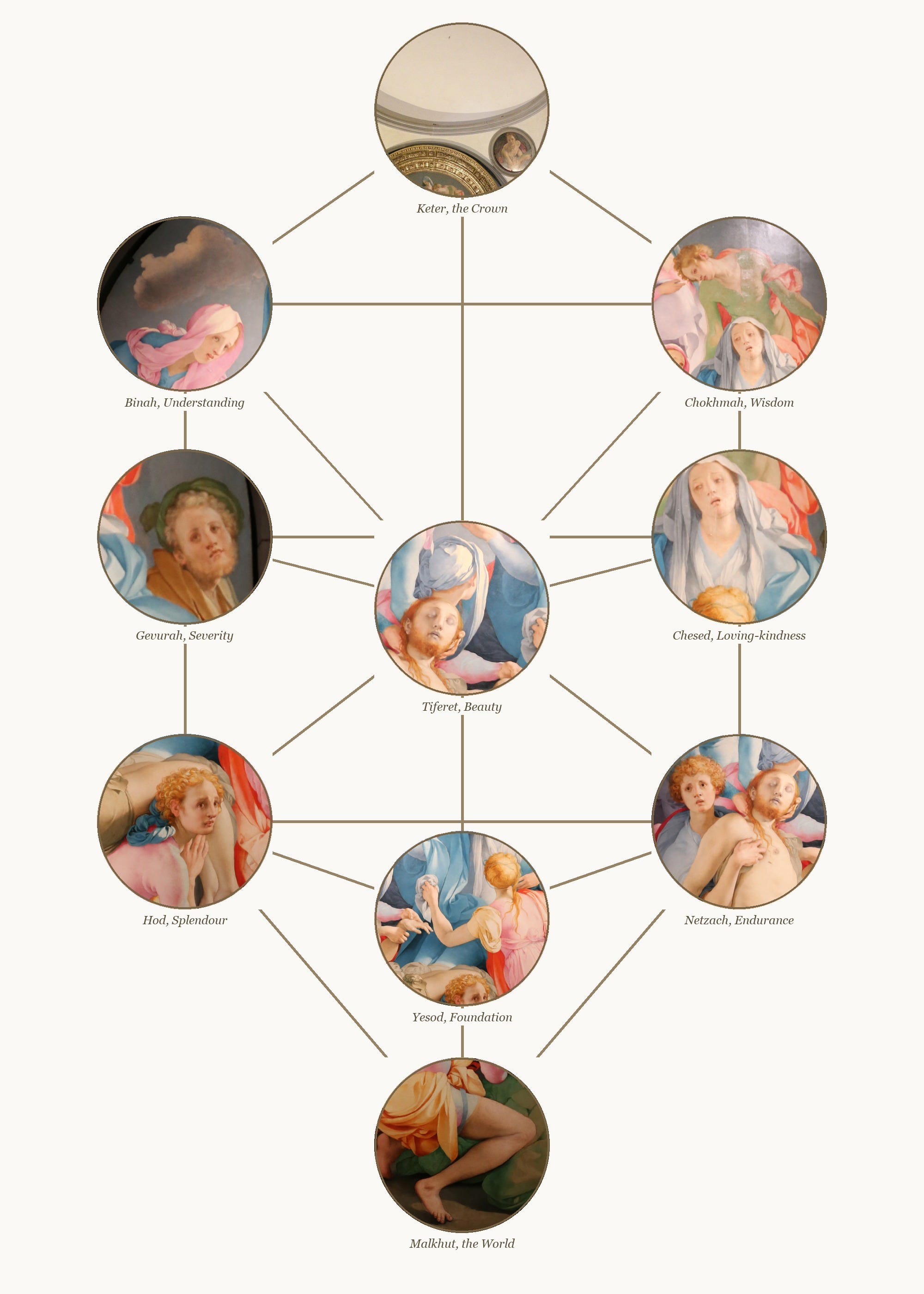
No document binds Pontormo to any of this. Vasari omits the patriarchs; no inventory lists a kabbalistic book; scholarship finds no direct link to the sefirot, nor does this claim one. A code would be paltry compared to what transpired. For forty years, a handful of men here pondered a shape - a gift that descends and returns - and then it was built into a room, unsigned.
The dome is gone. The Father, the four patriarchs, whatever once presided above: all taken down, replaced by a plain ceiling. No one can say when. Three dates are championed - 1589, 1736, 1766 - but no hand recorded the moment. The chapel lost its crown, and the city misplaced the century.
Nothing of that fresco could be pictured until 1914, when Frederick Mortimer Clapp noticed a drawing in the Uffizi and guessed its purpose. Only in 1956 did Janet Cox-Rearick find seven more and make the ceiling imaginable again. So for at least two centuries, people stood here before a painting whose destination had been erased, called it a Deposition, and were moved without knowing why.
The lap is empty because she relinquishes him; the cross is absent because the fruit is already in transit. As for the vanished ceiling, no one thought to write it down.
The light, obedient to a coin, flickers off, and you find yourself in darkness before a painting now invisible, beneath a vault erased just as completely. You may feed the slot again, or not. In the dark, your head tilts back all the same, searching the plaster for the thing this picture has been turning toward for five centuries, and which is no longer there.
The reading of the chapel as one programme, the body turning towards the Father in the dome, is Leo Steinberg’s, in The Art Bulletin, September 1974. Janet Cox-Rearick found the seven drawings for the lost vault. If you go, take a coin: the light lasts about a minute.
There's something powerful in open spaces -- like the blue between the clouds. They invite contemplation.
The idea that people stood in front of this for centuries trying to understand where Christ was being carried, while the answer had literally been demolished from the ceiling above them, is extraordinary. It makes me wonder how many other works we think we understand are actually missing part of the conversation.