


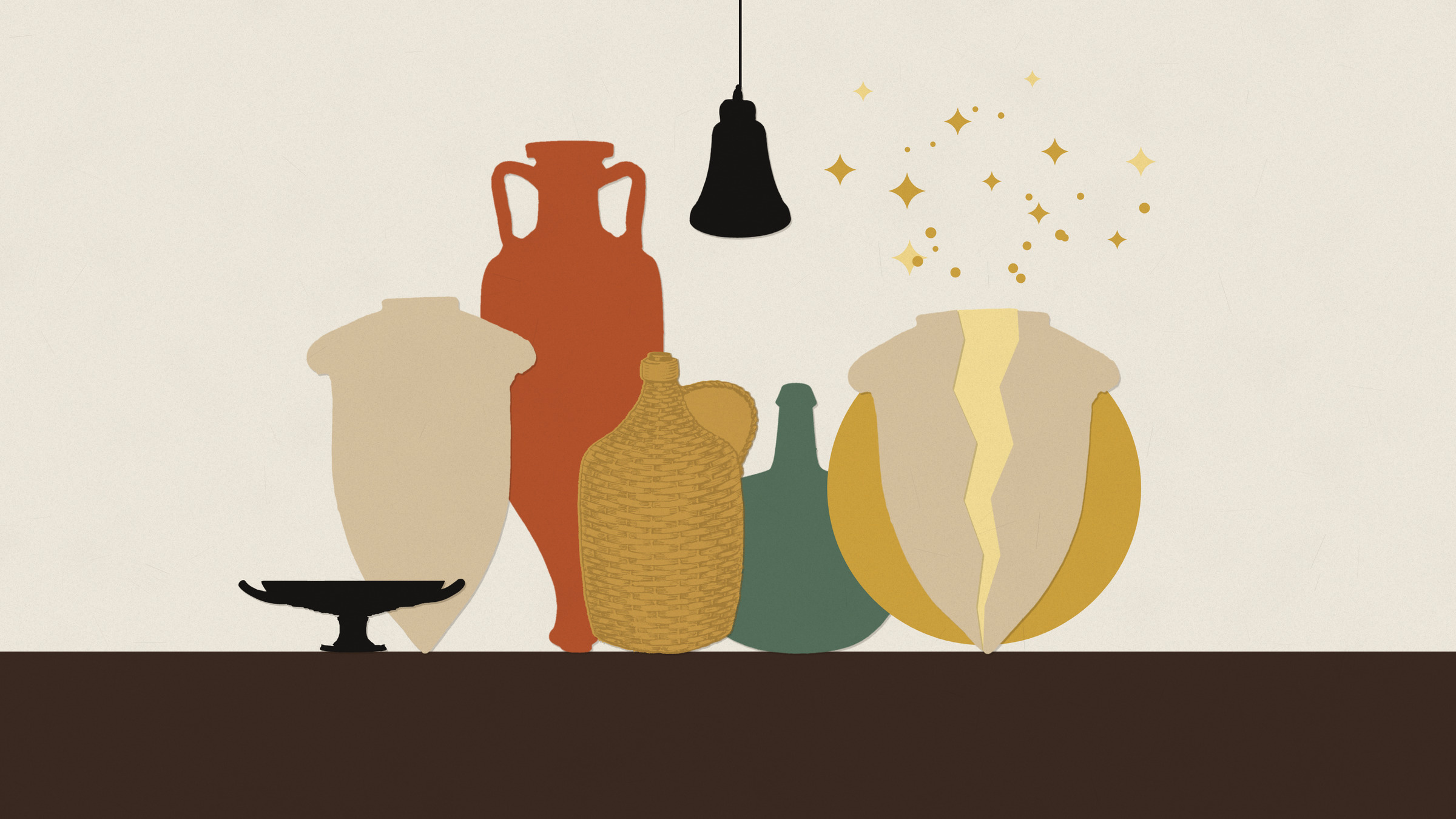
There is a room beneath certain old Tuscan houses that the house itself seems to have forgotten. You go down a few uneven steps, and the air drops a decade, cool and mineral, smelling of stone and vinegar and something patient. I remember visiting one in an old relative’s home just outside the town called Impruneta. What I clearly remember is not the wine or the oil but the vessels that once held them: terracotta orci taller than a child, green glass demijohns with a hay coat, their mouths stopped with rag. Everything they contained was drunk, or poured, or given away long ago, as contemporary traces of former joys. Only the empty vessels survived.
I have carried that cellar with me for years without quite knowing why. Lately I think I understand. Walk through any museum of the ancient world, read any book of the past, and count what remains of the people who are gone. It is not their wine, not their bread, not their gold, but the jars that held these things: amphorae, kraters, cups, the patient hollows that have outlived their own contents by three thousand years. We keep the containers, their forms deprived of matter.
Yet we pass through our days as if the opposite were scripture. We lavish our years on whatever fills us, and give a thought scarcely to the vessel that must bear it all.
Lives That Only Inhale
We are taught, without anyone quite saying it aloud, to measure a life the way one measures a tank: by how full it is. An unoccupied hour feels like a leak. An unanswered question feels like a debt. We furnish every silence and make busy every afternoon; the feed refills itself before we have reached the bottom of the last thing it gave us. Emptiness has become the one condition we treat as a catastrophic emergency.
But the body remembers what our calendars have forgotten. You cannot draw breath until you have let one go. Emptying is not the failure of breathing; it is breathing itself.
Nothing can enter a cup already brimmed. As a bell cast solid is only a lump of bronze. It rings because the founder shaped a hollow, and left it there.
What if the hollow we spend our lives outrunning is not the enemy of fullness, but its instrument?
The God Who Withdrew
In the sixteenth century, in the hill town of Safed above the Sea of Galilee, a young mystic named Isaac Luria asked a question a child might ask. If God is everywhere, where is there room for a world?
His answer is among the strangest and most beautiful things anyone has ever proposed. Before creation, Luria said, God did not expand. God contracted. He drew Himself inward, a kind of held breath, and in the space left behind, in that deliberate absence, a world became possible. The mystics called it tzimtzum, the withdrawal. Creation began not with a making, but with a making-room.
The first act of love was a step back.
Then the divine light poured into the cleared space, and it was to be held in vessels; and the vessels, unable to bear it, broke. Their fragments fell, and the sparks of light scattered down into the matter of the world, where they wait. The task of a life, in this telling, is to gather them, to find the light caught in ordinary things and lift it free.
The alchemists, labouring through the same centuries in another tongue, murmured: Unum est vas or the vessel is one. The vessel is the whole secret of the art. They were trying to free the spirit they believed was locked inside matter, waiting — like a spark in a shard — for someone patient enough to release it. Hold the two ideas together, and a strange job description appears. Someone has to build the vessels.
The Chemist Who Defected
Marco Bagnoli was born in Empoli in 1949. He took a degree in chemistry, and then he defected: not from science, but from the disenchanted way it had learned to describe matter. Since a February day in 1975, his signature has been a single red band set at the golden mean, first printed in a broadsheet he named Spazio × Tempo. Critics call him an alchemist, and for once the word is a job title rather than a compliment.
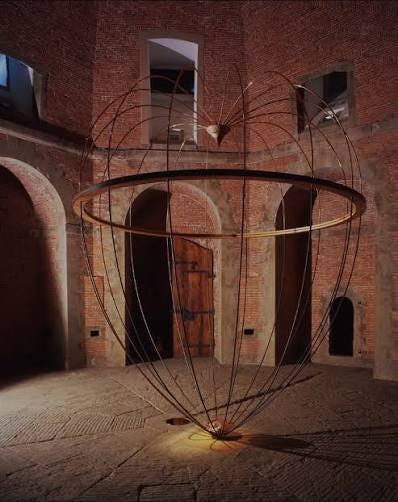
His work is a long inventory of hollows, each deliberately left open.
There are vessels of air: in 1989, in the octagonal hall of the Fortezza da Basso in Florence, he raised a hot-air balloon, the vessel that rises by holding nothing but warmed breath, and set beneath it a shallow pool of mercury, so that anyone who leaned in to catch the balloon’s summit met their own face instead.
There are vessels of water: at the Castello di Rivoli, fifty-six slender tubes of aluminium, blue and red and five metres tall, stand in a nineteenth-century basin and let fall a continuous rain.
There are vessels of sound: an earthenware vase he calls Sonovasoro, from which a low drone rises, its name an anagram of vaso sonoro, the sounding vase, with io sono — I am — and oro, gold, folded quietly inside the letters.
And there are vessels of light: alabaster worked so thin it stops being stone and becomes a lantern, pieces he names for the aleph, the letter that stands, silent, before all speech.
He does not, in any of this, translate the invisible for us. He does something quieter. He builds the instrument, steps back, and lets the invisible find its own way in.
The Vase That Turns with the Sky
The work I cannot stop thinking about is called Locus Solis. It is a vase, nearly five metres tall, and it is broken, but the wound in its flank has been worked open into a window. And it turns. One degree every seventy-two years, keyed to the precession of the equinoxes, that slow wobble by which the earth redraws its own sky. Around it Bagnoli has laid seventy-two stones of alabaster in the ancient quincunx pattern, and from the vessel’s hollow a landscape of sound rises. He borrowed the title from Raymond Roussel’s Locus Solus, the solitary place; in his hands the solitary place becomes the place of the sun.
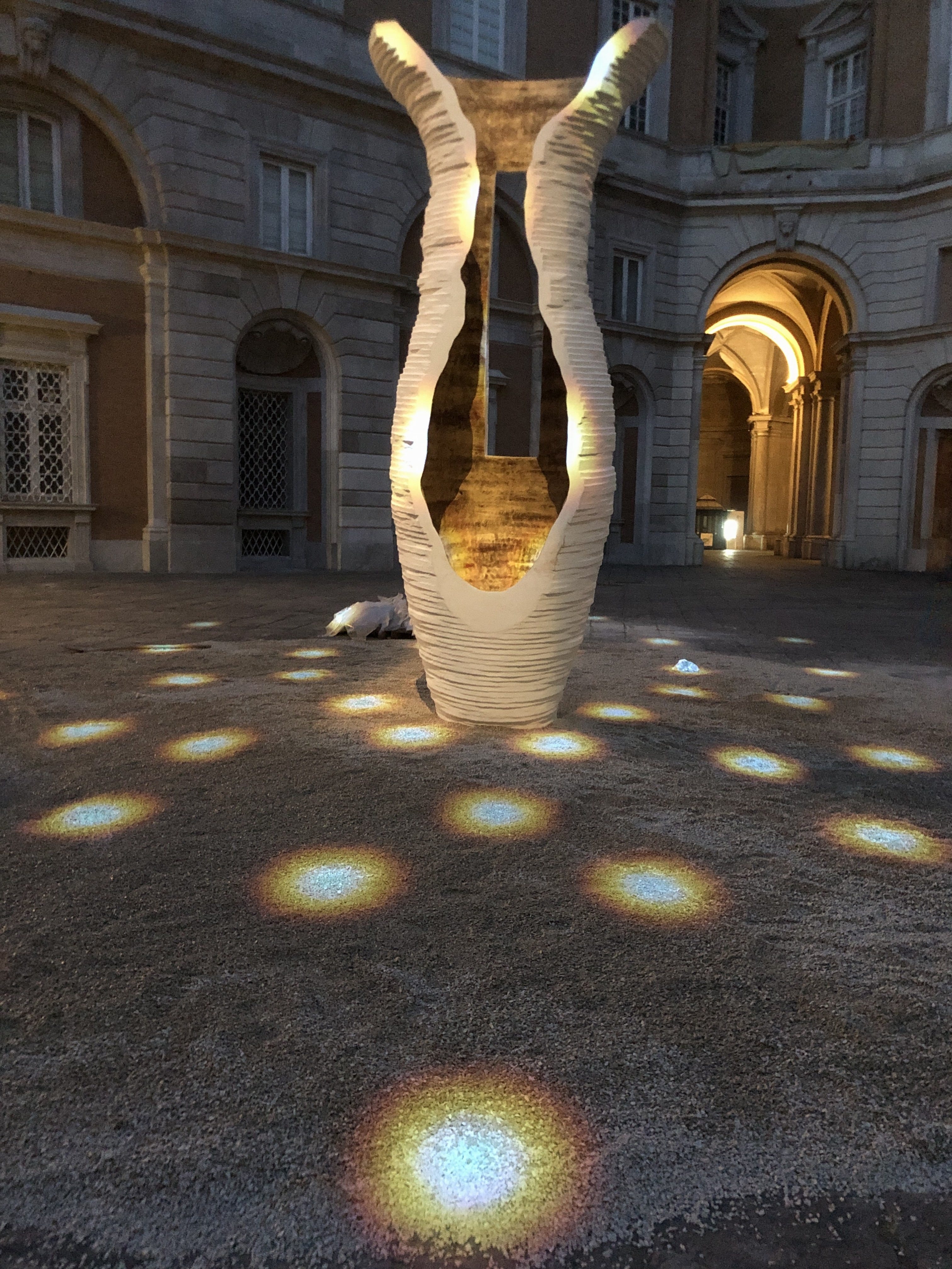
Stand before it, and you will never catch it in motion. No one will. A human life fits inside a single one of its degrees. It keeps time not with us, but with the heavens; patience is its true material. A broken vessel, turning at the pace of the sky, Luria’s cosmology made tangible at the scale of a room.
And notice where he chose to open it. Not at the mouth, where a vessel is meant to receive, but at the side, at the break itself: the flaw turned aperture, the place where sound escapes and light enters. This is his whole grammar in a single gesture. The wound is not the mishap that ruined the vase. The wound is the window. It is the only place through which anything can pass.
The wound is not the accident that ruined the vessel. The wound is the window.
Eight centuries earlier, Rumi opened his great poem with the same shape:
Listen to the story of the reed
As it laments the pain of separation:
Since they have cut me from my reed bed
My wails bring tears to both woman and man
Those ripped away from their beloved
know my song
Having been cut from the source,
they long to return
In celebrations, I laugh with those laughing
And in sadness, I cry with those grieving
The divine secrets are not separate from my cries
But only those who are cooked in the fire of love will hear them
These secrets are for the heart, not for eyes or ears
It is fire, not wind, that makes me sing!
If you don’t have this fire,
you might as well be dead
Oh, how can the uncooked
know the majesty of the fire of love?
If you meet the uncooked,
don’t sing, don’t preach
Instead listen to my advice:
Say goodbye and leave
-Rumi
The reed sings for one reason alone: it was cut, and hollowed. Its music is the sound of its own emptiness. Bagnoli, too, plants the reed in his works.
There is a smaller phrase hidden inside his old formula, the way the gold is hidden inside his vase. Take Spazio × Tempo, space multiplied by time, and strip the words to the bone. Spaz-IO per TE-mpo. What remains is io per te. I, for you. Space and time, reduced to their marrow, become two people turned toward one another. Which is tzimtzum or withdrawal embodied in art. I make an emptiness in myself, and in that emptiness there is finally room for you.
The Emptiness You Keep
This spring, I went back down to the cellar. The jars waited where they always had, holding their darkness, their dust, their patient nothing.
We are taught to dread the sound of our own hollowness. But that sound, ask the reed, ask the broken vase, is the only one that carries.
So I will not turn this into a lesson. I will leave you instead on the cellar steps, with the question the vessels keep asking, one slow degree at a time. Somewhere in you, there is a room no one has ever entered. Do not hurry to furnish it. Something is on its way.
it’s art is free: one essay every few weeks, when something is worth saying.
Know someone who’d sit with this? Send it their way.
I can't say that I understand everything you're trying to express. I'm more of a plumber than a philosopher. But perhaps this experience gets close.
My wife and I were vacationing on a Caribbean island. We met a couple who seemed nice and thought it would be fun to get together during the day. However, they had signed up for every activity the island offered. They asked what activities we were signed up for. When we said none, they expressed concern that we wouldn't see anything. I replied that we would see one thing that they would miss - the shadow of a palm tree crossing from one side of the beach to the other.
This is beautiful. You let the break become the opening, and then you find the same shape in Luria's shattered vessels, Rumi's cut reed, and Bagnoli opening the vase at the flaw instead of the mouth. That connection across all three is really well done. I love that you treat emptiness as a tool.