



I remember walking along a deserted beach in southern Spain. Ahead of me, I noticed an elderly man strolling by the shore, moving with a loose, joyful cadence, almost as if he were drunk, yet with the certainty of sobriety. He seemed genuinely content.
I looked down and saw the fragment of a line drawn on the sand, nearly erased by the gentle waves of that spring day.
Along the path in front of me, between my feet and those of the man walking, I see a myriad of sketches drawn on the sand as if, through his promenading, he was leaving signs of happiness behind him. Happiness that resembled art. A trace of his creativity was evident from his steps of joy.
This scene was not a memory—it was born from my imagination, inspired by a story a friend once told me.
It was the story of Miró’s greatest artworks which left me with much to ponder, and how it then taught me to accept life.
A Story from a frescoed sacristy.
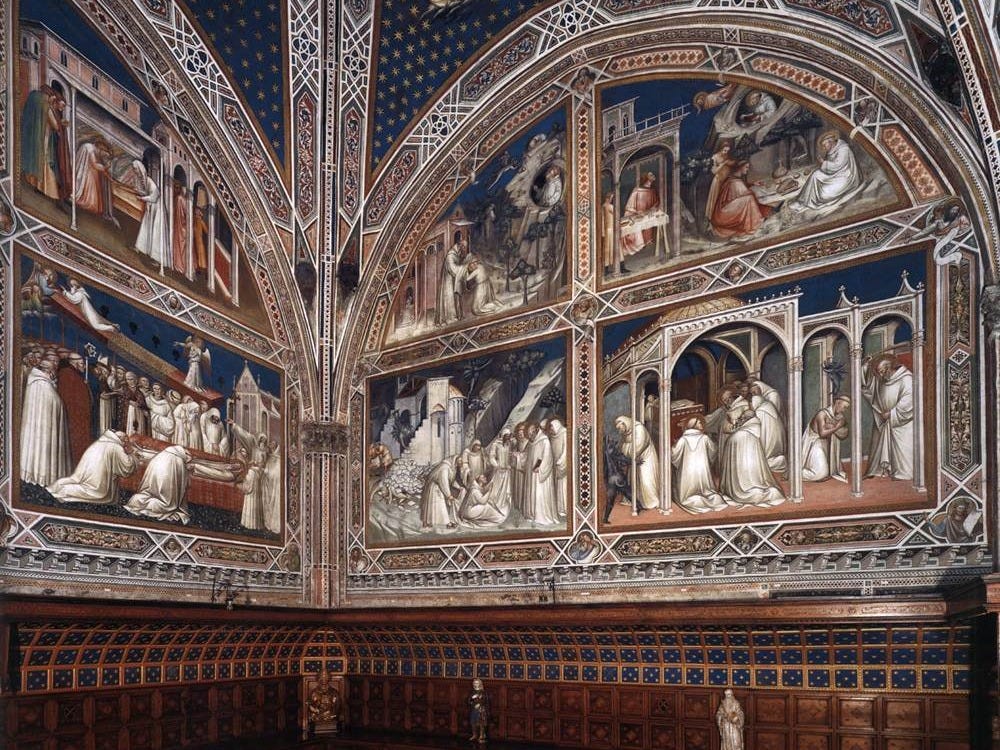
It was a late Sunday afternoon when I visited my friend at the monastery of San Miniato al Monte in Florence. We sat together in the sacristy, beginning with a quiet moment to admire the frescos of Spinello Aretino depicting the life of San Benedict. Our conversations are like those between the sun and the moon—similar in being opposite. I shared stories from my life in Paris, my return to Tuscany, and the loves and tears my heart collected along the way. He spoke of monastic life and the passion that faith ignites within him.
He then tells me how and why he decided to pursue monkhood. He was already a firm believer. But it was thanks to a Thursday afternoon when he went to see the Joan Miró exhibition in Florence decades ago. At the very beginning of the exhibition, the curator decided to welcome the visitors with an apocryphal or maybe true quote attributed to Miró himself. The quote, next to a picture of the artist smiling joyfully, reads as follows:
“For my greatest works of art are the sketches I draw peeing on the sand of the southern shores of Spain”.
Perhaps the words shifted in my friend’s memory, or perhaps the curator invented them to spark surprise. Still, the quote’s value endures.
It is by that very quote, thanks to that human and saline imagery of urine, sand, and the immensity of the sea, that my friend decided to pursue the monastic life. He understood that there is art in ephemerality, in disappearing, and in accepting simplicity and humility. He realised, thanks to it, that we do not need to dream of becoming a shining marble statue in order to live our lives as a work of art. We do not need to plan our success as the greatest sculptors and architects do, with stone-like rigidity and delusion of grandeur. We can live as great art, accepting that we are just a sketch on the sand, ready to be washed away by the ever-returning waves of the sea. We can draw our life like Miró does with his sketches, and be as valuable as his masterpieces are for art history.
Nietsche, Miró, and the Benedictine Aboot.
I must admit that Nietzsche was right. Socrates’s influence on the West is so predominant that we cannot help but all be Socratic. We all accepted the Appolinian in arts, and hence in our lives too. By default, we all live by the motto:
“The Unexamined Life is not worth living.”
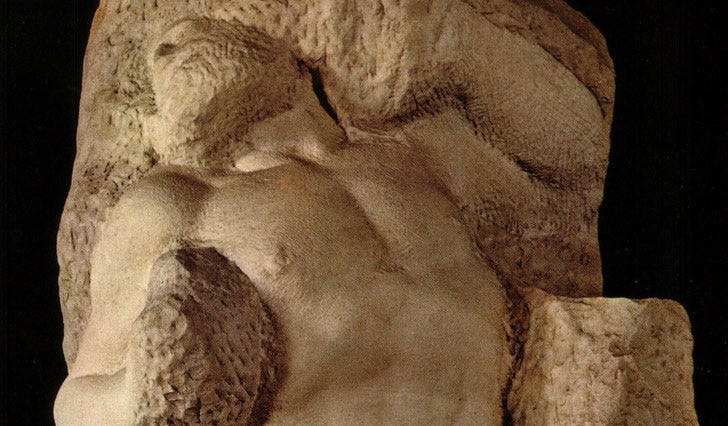
With examination, programs, and expectations come. We start thinking about ourselves as Michelangelo was envisioning his marbles - carving out a piece at the time to arrive at the perfection of harmony and its statuary contemplation.
The Appolinian seems to have won. Not only in art, philosophy, or music, but it has also won our hearts over. We build our lives as architects do. Our internal monologue about ourselves looks like a conversation between Iktinos, Callicrates, and Phidias speculating about the best ways to erect the first column of the Parthenon.
It seems that, for all its chaos, for all its liquidity, modernity forces us to approach our lives like sculpture. It tells us to chisel our identity, career, or status following a harmony that, in the end, might not suit us. It might please the old Apollo, who many sculptors alike he inspired, but it does not really please our hearts. So, we carve out what we like, we see our destiny as an act of subtraction, and we envision greatness as solidity.
We wrest ourselves out of marble when maybe we just longed to be a sketch on the beach.
Dionysus, Sand, and the Sea.
Perhaps some parts of our lives should not be carved. Perhaps they should be traced, risked, played with, or even washed away into the never-ending sea.
We should welcome Dionysos governing a bit more of the chaotic unfolding of events.
Coherence, planning, controlling, and durable forms are certainly great attributes. But sometimes chaos, simplicity, and letting oneself go to one’s caducity can lead to a life as great and fulfilling as it gets.
Miró’s disappearing drawings are a small Dionysian corrective - saline, humble lines traced on sand, brave in accepting the upcoming wave. As my friend did, we should remind ourselves of Miró’s quote and welcome more Dionysian in our lives. We should remember that there is art also in being a sketch of urine on a forgotten beach.
Miró’s gesture is almost scandalous. The drawing is not made to last or even to be seen. It exists only for the satisfaction of its creation, embracing its brief existence. Some may see this as a lack of ambition, but in not aspiring to survive time or judgment, the simple sketch becomes art.
There is a sort of quiet courage in this: living without always projecting ourselves into the future, being present without chiselling our identity into something meant to endure forever. Some moments are not meant to be accumulated, but simply experienced and then let go—like the tide erasing a sketch in the sand. The passage of time does not diminish such gestures; rather, it completes them, giving meaning through their impermanence.
Letting Go.


When captured by the rambles and errands of my mind, I often return to the sweet saline taste of that story. I imagine myself promenading along that very beach peacefully, admiring the sea taking within its immensity Miró’s greatest artworks.
We are constantly reminded of the Apollonian. Social media, careers, daily conversations with friends who portray themselves as they are not, rewarding the appearance of solidity, and pretending to possess unwavering confidence.
Yet, the more I endeavour to be like a sketch on the sand rather than a glimmering statue, the more I discover the gentle joys and freedom of changing my mind, forgiving errors, and beginning again when the tide recedes.
Perhaps this is exactly what Miró understood. We are all sketches on the sand; we are all meant to be redrawn, reimagined, and sometimes washed away. Our impermanence, caducity, and immanence are not a flaw, but the gift allowing us to live with fulfilment as one of the greatest works of art.
I write essays at the intersection of art and life—on aesthetics, impermanence, and the forms we give to our existence.
If this resonated, you can subscribe below.
What a beautiful sentence! “We wrest ourselves out of marble when maybe we just longed to be a sketch on the beach.” i loved your point of the apollonian perspective being so entrenched, and it is certainly amplified by capitalism and the pressure to show productivity/constant progress rather than instinctual, unguided expressions
Love your article about art, but surprised by Miro's quotation. I love Miro pictures; they remind me of a happy child's pictures. And i am happy that we have Miro and the best Italian painting of all the times, I can open my art books any minute and enjoy them.