



This essay grew out of a long conversation with my friend Armand Louis, designer and glass artist, working in Murano alongside the Maestro Roberto of Wave Murano Glass. With thanks to both, who let me steal their words and watch them work.
The First Lesson is Silence
The furnaces of Murano roar and seethe; their bellies blaze at more than 1200 C; the air thick with the perfume of scorched oil and the sweat; Hephaestuses of Glass raptured in an act of creation. One might expect only chaos here, a cacophony fit for the gods. Yet, amid the tumult, the first lesson is silence.
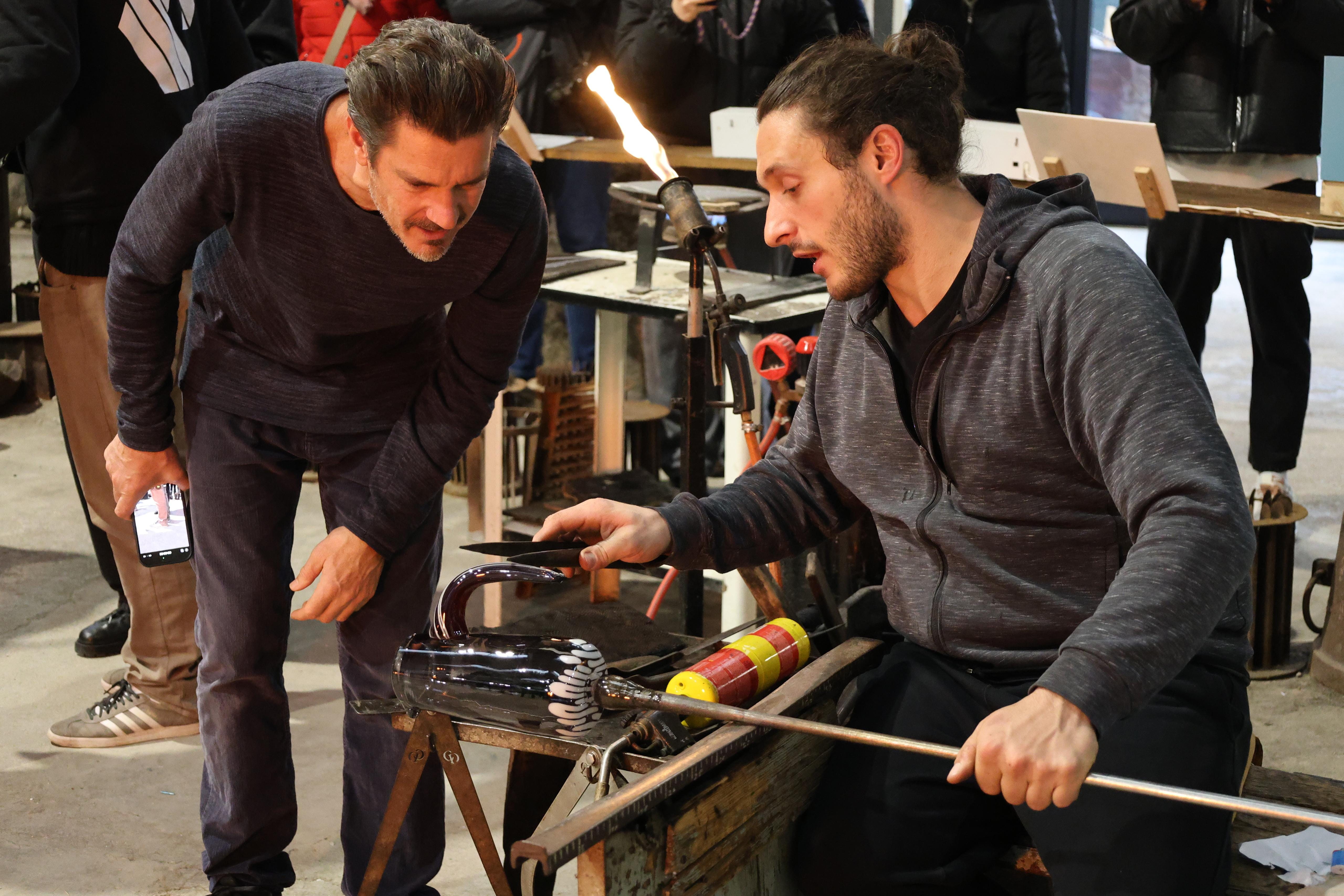
Only in silence can one truly listen to the interplay of the three idioms uttered at the scagno - the master’s betch. The artist arrives fluent in the dialect of ideas, sketching eloquence in lines and intentions, and in dreamed-away silhouettes. The Glass-Master, by contrast, is a linguist of gesture, for whom meaning resides in the tilt of a cane, the pirouette of molten glass, the measured cadence of breath. Then, there is Glass itself, always the last to speak, murmuring in the secret tongue of viscosity and temperature, whispering its verdict through the tension of its surface.
“Only in silence can one truly listen to the interplay of the three idioms uttered at the scagno.”
None of the three understands the others directly. The work takes place at the intersections of a game of translations, where, when one speaks, the other two remain silent.
In Murano, the artist’s role is curiously oblique. The artist is the dreamer, the gestator, who must ultimately trust his creation to the Glass-master. So, my friend Armand Louis describes the artistic process. His hand might convulsively materialise concepts into drawings. He describes form and harmony. But then, the moment arrives: the idea, still warm from its incubation, is handed over to Roberto, the glass master.
He likens this act of letting go to the art of fatherhood - wise, patient, and tinged with apprehension. There is a breathless pause before the first exhalation, a moment when the world shifts from the artist’s hands to those of the maestro. The piece might fall. Something unexpected might happen. Yet, as any parent knows, growth demands risk. You watch, you hope, but you do not interfere. The maestro is no mere instrument; he is the second author, guiding the fledgling idea toward its own maturity.
Then, both the artist and the glass-master need to listen to the voice of glass. The artist has dreamed, the master has breathed life into molten sand, but it is the newborn crystal that utters the first true words. As any spirited being, glass might accept to the fullest the idea of the artist and the process of the master, or it might rebel and insist on a path of its own design.
So Armand Louis, the artist, and Roberto, the glass-master, listened to what glass told them, and they heard the whispers and murmurations of the sea coming back from the soul-transparent shell coming to life in front of them.
Echinozoa - Hearing the whispers of the Sea
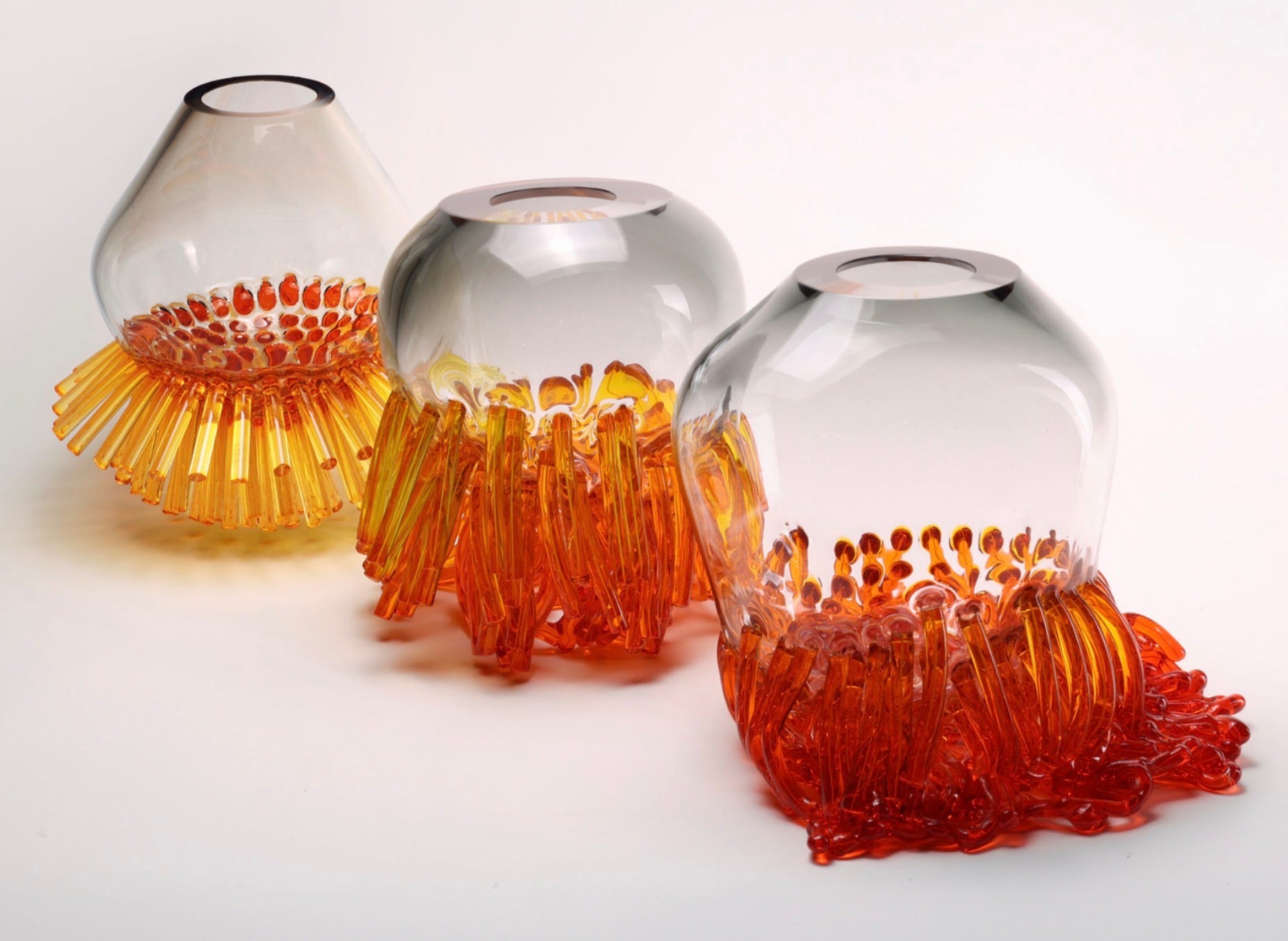
Echinozoa began as a flirtation with instability, in which the glass canes, meant as decorative tools, became structural, highlighting the paradoxical nature of glass - fragility made rigid, stability made still. Yet, as the material found its voice, it echoed the soft roar of the brackish Venetian sea. Firstly conceived with the abstraction of pencil and paper, the work became organic. It transformed itself into living urchins, whose Aristotle’s lantern guided this artistic endeavour. It transformed itself into the moving shells that seemed to carry the sea’s own secrets within their curves.


The artist’s pencil wanted to play with the glass’s instability. At first, he decided to give further linearity and a structure that looks rock-solid, but is precarious by design. The first sketches on the project Echonozoa reflected this attempt at linearity and solid geometry. The canes, meant to be mere decorative tools destined to be molten and diffused into colour, now thrust into the spotlight as structural protagonists. The first drawings capture this paradox of stable instability, and the inversion that makes patent what would otherwise have disappeared under the melting blaze of the furnace.
The dialogue started. Yet, the master, Roberto, and the capricious material, glass, had yet to talk.
Positioning the molten glass symmetrically atop upright canes proved a delicate dance. The right temperature had to be found. The right density and flexibility of the flaming-hot glass had to be achieved. Roberto experimented, chasing that elusive balance between fluidity and form.
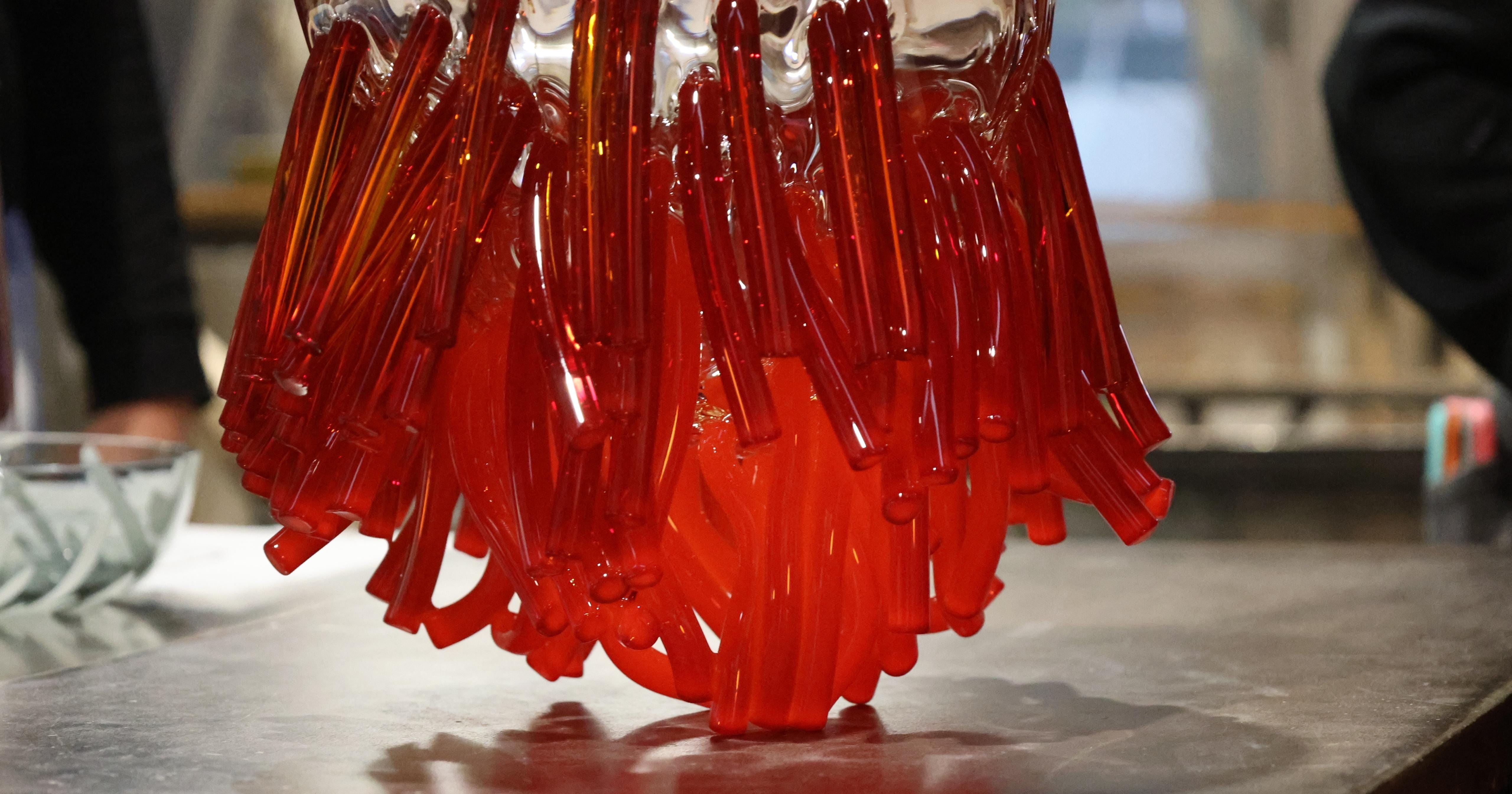
At last, a method emerged. Yet, as if revealing a long-held secret, the glass made its desires known: it wished to move, to breathe, to live, quickened by Roberto’s first animating breath.
In the final act, a flaming torch coaxed the canes from the sphere, and they bloomed like spring flowers under the right touch. The work started to move with the soft pace of sea urchins, or the languid drift of a jellyfish suspended in its watery waltz.
It was then chosen to set those yearning tentacles free. As the temperature changed, the material dictated its own evolution. Some of them blossomed like flowers; others crept across the showroom floor, their tendrils caressing the imagined heft of sea rocks; others hovered like jellyfish caught mid-gesture in the endless tide.
The Humanity of Glass - Stable where it is most fragile
In the lexicon of physics, glass is a supercooled liquid caught in a state of arrested motion - a substance that has simply forgotten how to flow. Its rigidity is not the serenity of atoms at rest, but the exhaustion of a race unfinished; the atoms, denied their destination, are frozen mid-journey. Glass is stable, in other words, because it failed to rest.
Glass’s intimate relationship with fragility is written into its very structure. In Angell’s classification, glass’s fragility is defined as the steepness with which a glass-pervious viscosity rises and approaches the transition temperature. The most fragile glasses are the impatient ones - those that rushed toward stability, only to find it precarious and short-lived.
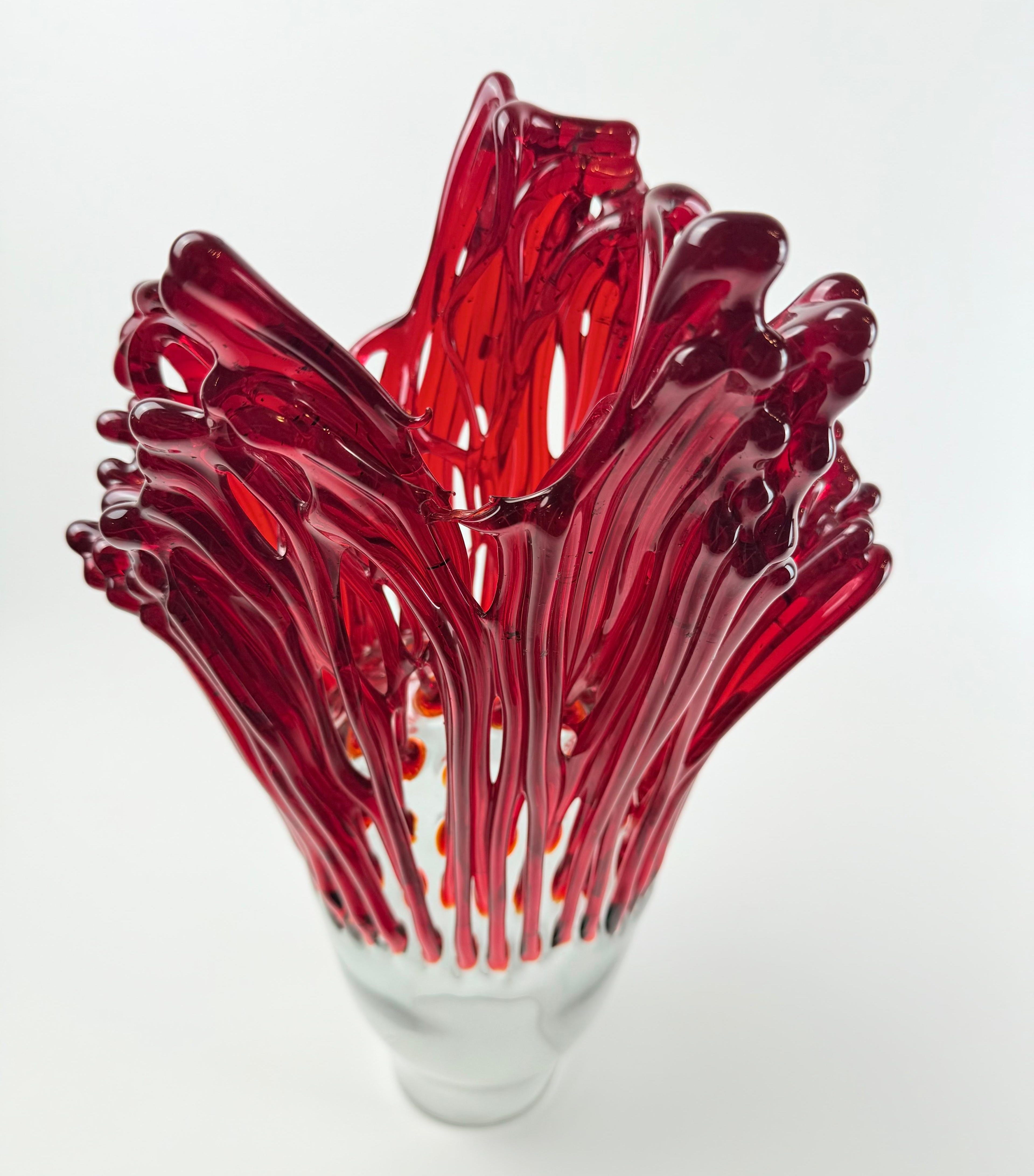
Seen this way, glass art is stable precisely where it is most fragile. Glass must inhabit its own paradox, learning to listen to the contradictions at its core. Like us, it develops in the blazing heat of youth, malleable and wild, before searching for the right moment to settle. Rush the process, and stability is a mirage, shattered at the first hesitation and tremor. Wait too long, and the result is amorphous and deprived of its crystalline transparency. Glass, that capricious rebel, mirrors our own journey: shaped by many hands, many lessons, many experiences, but ultimately responsible for choosing when to become stable, and to accept its own fragility.
Glass art is the only art that, like us, is scared of light because it renders our soul transparent to every curious gaze. But very much like us, light is also the only force that can coax forth the kaleidoscopic colours of its spirit- sometimes blazing like the sun, sometimes glowing with the gentle softness of moonlight, sometimes glimmering with the quiet guidance of stars.
“Fragility is not an enemy to be outrun, but a companion to be welcomed in its time.”
Looking at a Murano piece, at the Echinozoa taking the path of self-assertion, we catch our own reflection, half-mirrored back to us on the shining surface, and half-hidden within glass’ transparency. We remember that fragility is not an enemy to be outrun, but a companion to be welcomed in its time. We recall that stability, if seized too soon, will only shatter us, but if earned, will let us shine. We remind ourselves that, however exposed we may feel in our transparency, only through such honesty do our true colours emerge.
Thank you for reading. If something here resonated, the most useful thing you can do is share it with one person who’d like it.
Thank you for your time!
Beautifully written, Vittorio. I loved the idea of glass having its own language, fragile yet deeply human. A very elegant and poetic piece.