



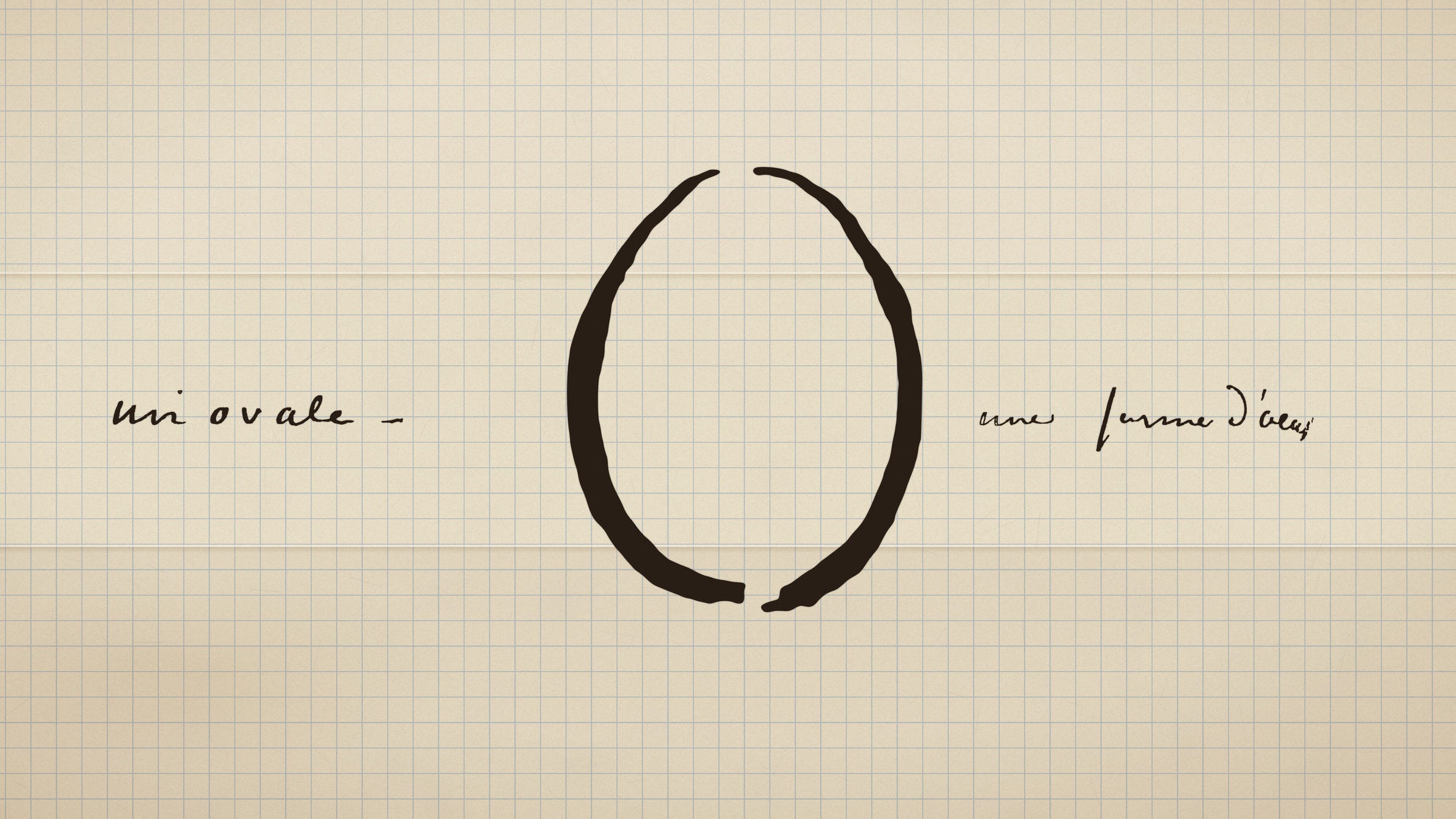
On or about Sunday, 5 August 1888, in the heat of an Arles summer, a thirty-five-year-old painter sat down to write to a twenty-year-old painter, and for most of the letter, the two could have been sitting at the same table, talking shop. Van Gogh praises two of Bernard’s still lifes and the two portraits of his grandmother, tells him he has never been closer to Rembrandt, calls Vermeer of Delft “the incomparable sphinx”, and then, in the tone in which one passes on a story heard long ago, he writes: “I myself rather like this anecdote about Giotto”. There was once a competition for a painting of the Virgin, and the proposals were sent to “the fine arts authorities of those days”; one of them, signed Giotto, was simply “an oval”, and here the pen leaves the sentence, draws an oval on the page, and comes back to the sentence to call it “an egg shape”. The authorities, “intrigued and trusting”, give him the Virgin. “Whether it’s true or not I don’t know, but I rather like the anecdote.”
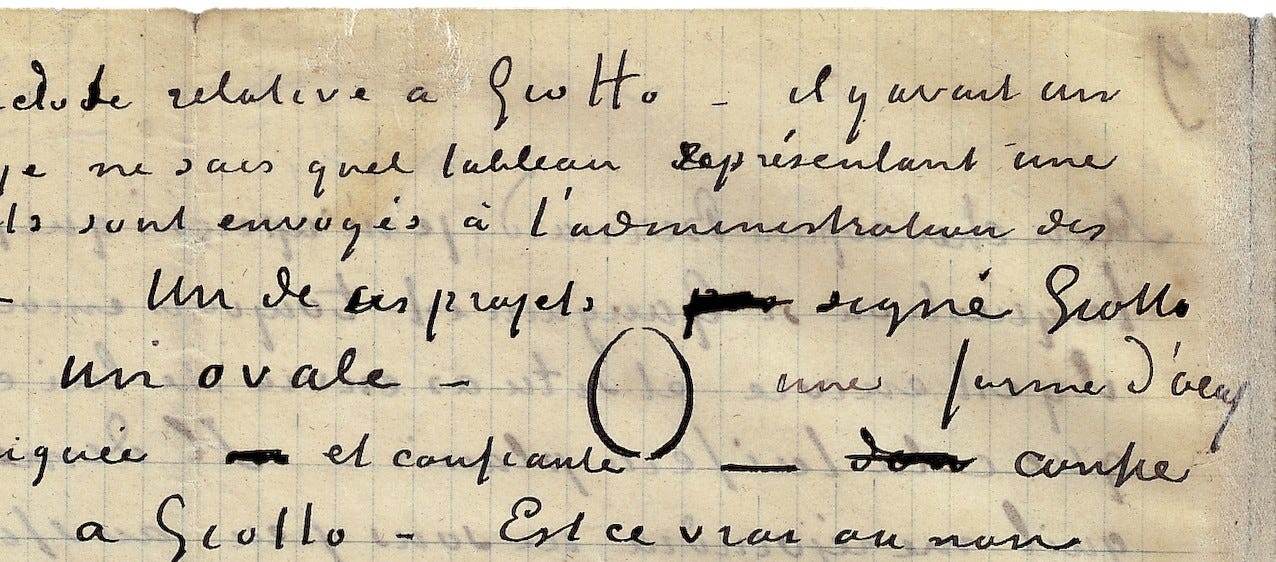
He had already written the word, and he drew it anyway, as though the word alone might not arrive. Of the 244 sketches that survive in his letters, this small oval is the one that is most purely a thought, since it records no painting, neither his own nor anyone else’s, only the shape an idea has before it has a shape, closed upon itself like an egg around something no one has seen yet; and in the end it is the shape of everything he sent, a thought folded small enough to travel, waiting for someone to open it.
The first fugitive thought
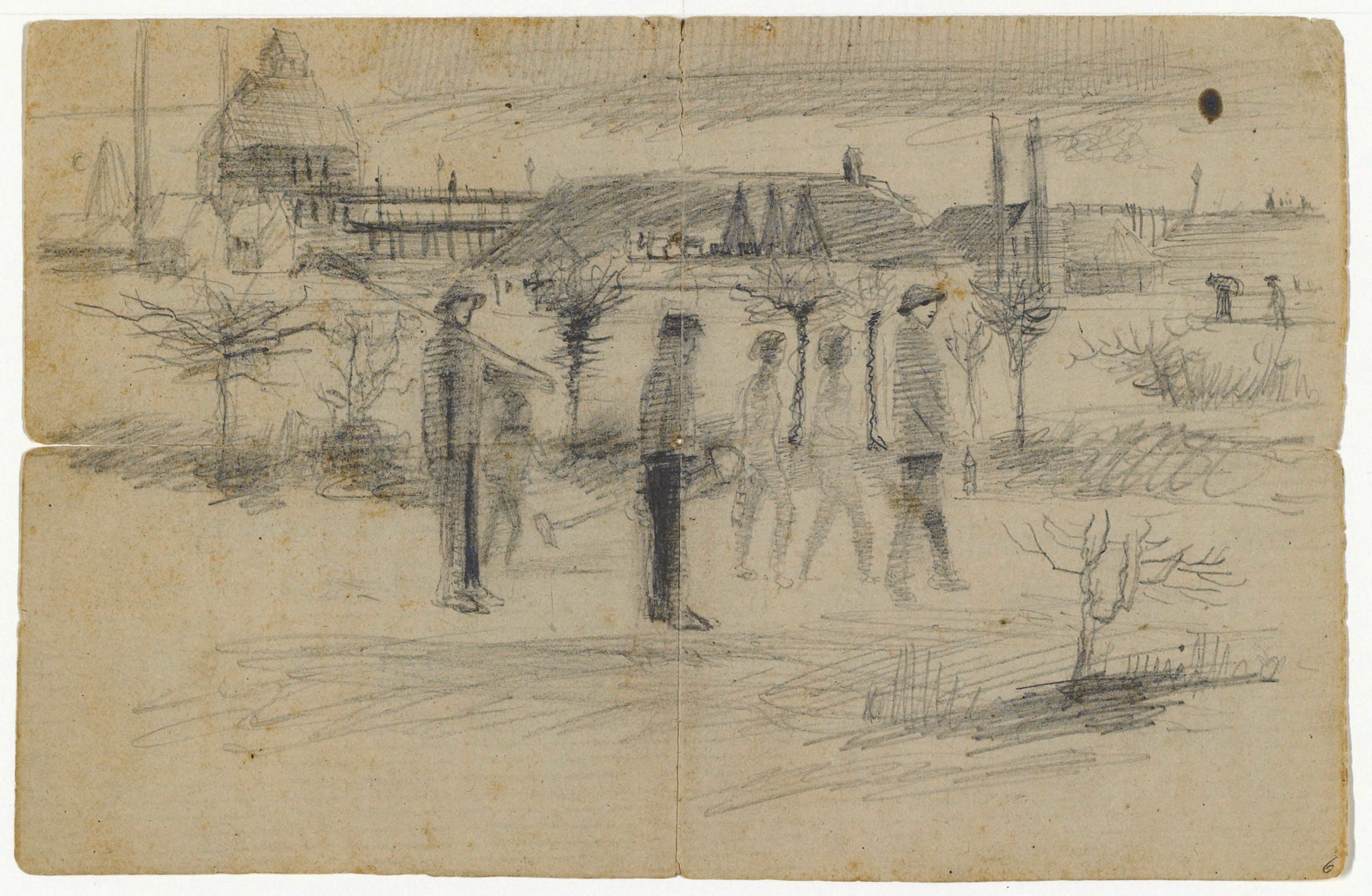
In the first letter to survive after about a year of silence between the brothers, written in June 1880 among the mines of the Borinage, he imagines Theo’s question (“But what’s your ultimate goal, you’ll say”) and answers that the goal “will take shape slowly and surely, as the croquis becomes a sketch and the sketch a painting”, out of “the originally vague idea, the first fugitive, passing thought”. The French verb is se dessinera, which the edition gives as “will take shape” and which means, word for word, “will draw itself”; so that before the sketch was a way of showing a picture, it was his way of imagining a life, one that would draw itself slowly out of a vague thought, provided there was someone to ask where it was going. Two months later he posted the first composition of his life as a would-be artist, miners walking to the pit at dawn through the snow, with a sentence that already holds the whole correspondence to come, “I’m sending you the croquis so that you can picture it for yourself”, and a few lines further down, a question: “Does the idea seem good to you?”
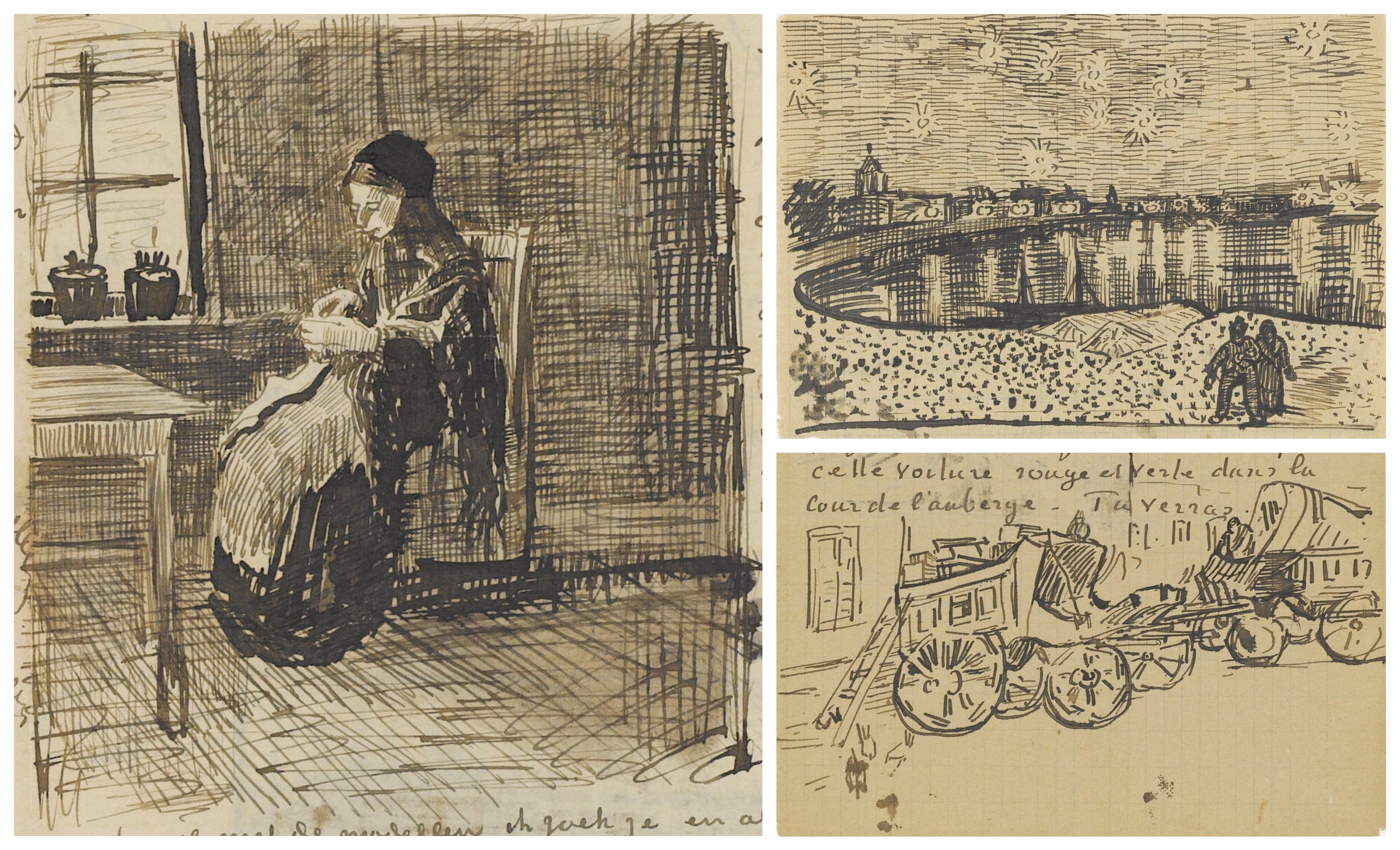
Three in every four drawings he made as an artist in his letters were drawn for that one reader: his brother. He called them “scratches”, or croquis, and he rarely thought well of them, calling one “terrible”, another “a very bad croquis”, another “this hasty croquis”; and the counting shows how modest their task usually was, because two in every three show a work of his own that already existed, and only four record an idea with no known work behind it, all four from his years in Holland. The Van Gogh Museum, explaining them today, puts it in a sentence that is true as far as it goes: “Nowadays, we’d send a photo by WhatsApp or email.”
But a photograph keeps everything that happens to stand in front of the lens, while a croquis keeps only what the hand thought worth carrying, and in May 1888, in a letter about drawing, he described that choice in a sentence that could stand for every croquis he ever sent: “I’m trying now to exaggerate the essence of things, and to deliberately leave vague what’s commonplace.” The camera keeps the commonplace, and the croquis throws it away, so that what remains on the page is no longer a record of the picture but a thought about it. Nowhere can we watch that thought being made more closely than in a room he drew twice, on two consecutive days.
The room, twice
On Tuesday, 16 October 1888, after a few days in which his tired eyes had forced him to rest, he wrote to Theo: “My eyes are still tired, but anyway I had a new idea in mind, and here’s the croquis of it.” The croquis travelled on a separate sheet, “the same size as the letter” and “drawn on the same squared paper”, and it shows his bedroom, the bed, the two chairs, the small table, the window, the doors and the portraits on the wall, all of it in pen; and since a pen line has no colour, the colours followed in words, one sentence at a time, as if he were handing Theo the ingredients of a vision: “The walls are of a pale violet.” “The bedstead and the chairs are fresh butter yellow.” “The blanket scarlet red.” Then comes a sentence that reads almost like a statement of method, “I’ll work on it again all day tomorrow, but you can see how simple the idea is”.
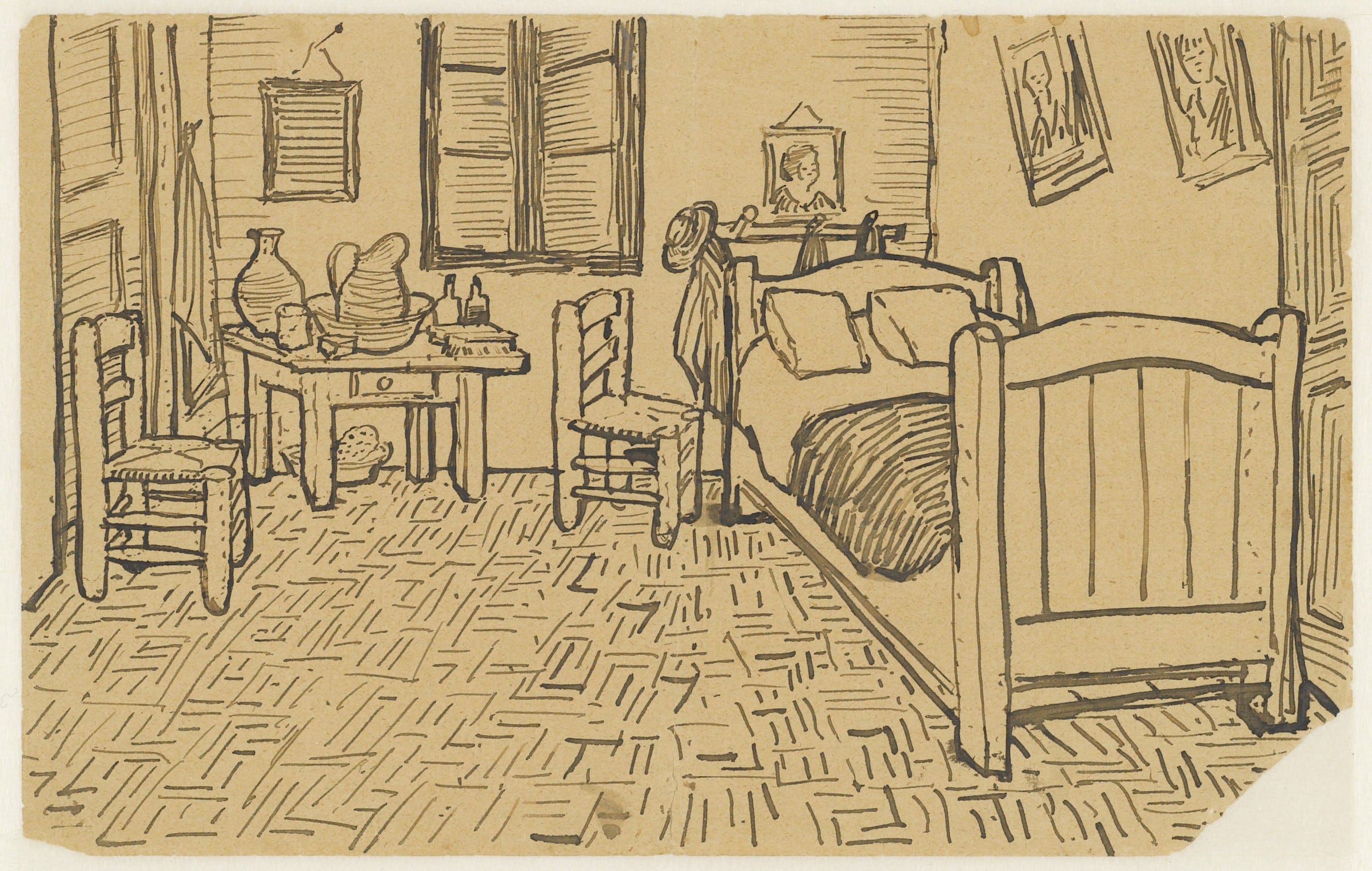
The room did not stay still, and the editors of the letters noticed that the sketch has a portrait above the bed where the painting has a landscape, that the hat hangs on the left where the painting hangs it on the right, and that there is a washbasin under the small table which the painting does not have: “So Van Gogh probably made changes to his painting after he did the sketch.” The next day, Wednesday 17 October, he drew the room again for Gauguin, who was about to join him in Arles, this time inside the letter, between two sentences, and in its finished state; and the colour words changed with the painting, so that the walls became “pale lilac”, the chairs and the bed “chrome yellow”, the blanket “blood-red”. In the same letter he wrote the sentence that belongs in any essay about thinking with the hand: “Because I often don’t know what I’m doing, working almost like a sleepwalker.”
The sheet for Theo is thick with hatching, the floor above all, tile after tile, while the sketch for Gauguin is nearly all outline, and its floor is left empty for the words to fill: “a broken and faded red”. To his brother Van Gogh writes in the words of home, “fresh butter yellow”; to the painter about to arrive in Arles, in the words of the trade, “chrome yellow”, “coarsely brushed”, “full impasto”.
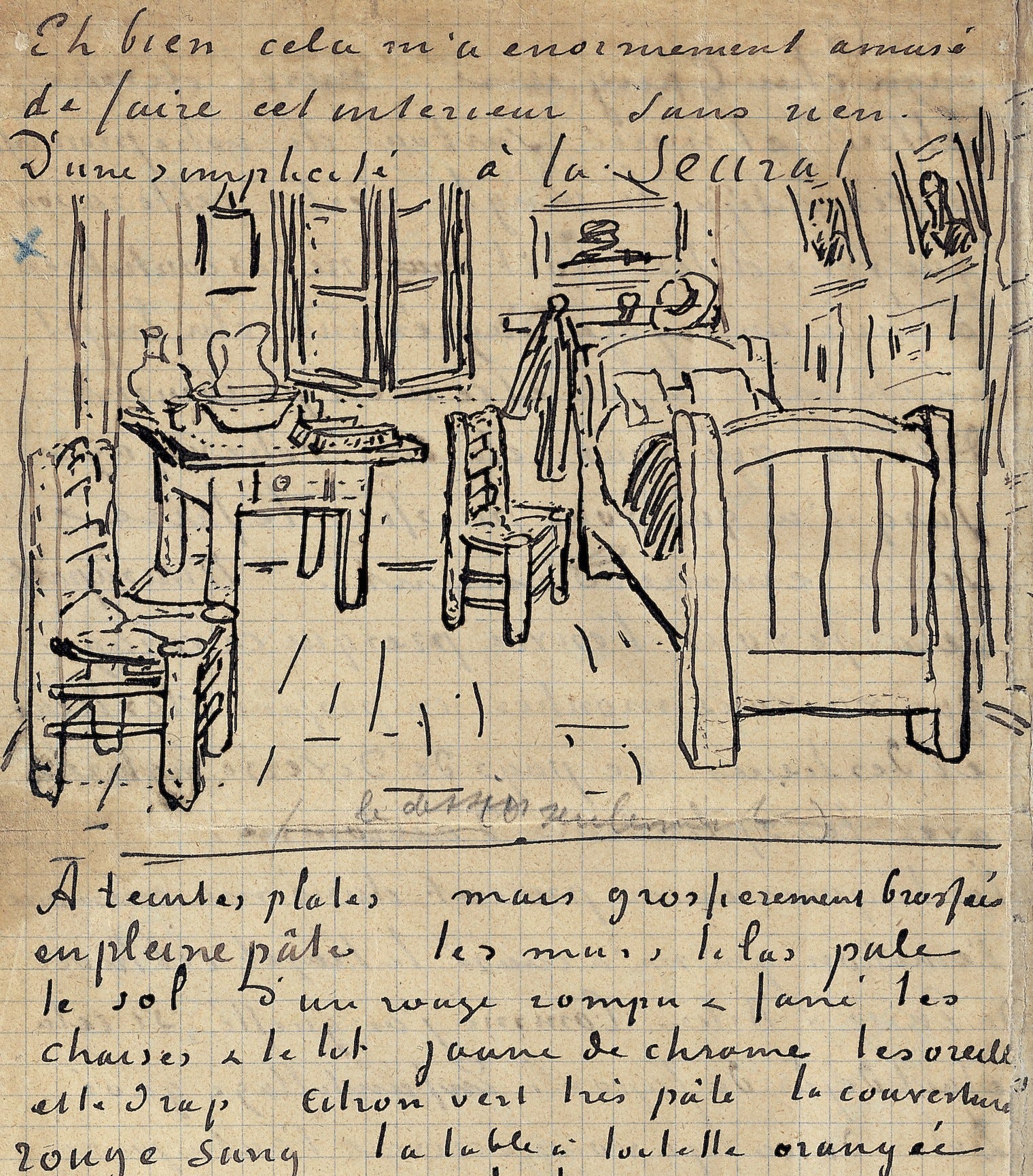
A photograph of the canvas, that Tuesday, would have shown a room; the croquis shows a conception, a room in the act of being thought, with its colours spelt out for someone who was not there to see them.
A letter that could not say it
In 1907 Hugo von Hofmannsthal, who five years earlier had made the failure of words into a modern classic with the letter of Lord Chandos, published “Die Briefe des Zurückgekehrten”, five fictional letters dated in the spring of 1901, written to a friend he left behind by a man who has come back to Europe after eighteen years abroad. In the fourth he describes an exhibition of about sixty pictures, “Gemälde und Handzeichnungen”, paintings and drawings, among them a few peasants round a table eating potatoes, and he cannot say what they have done to him:
“Ich könnte mir Photographien von den Bildern verschaffen und sie Dir schicken, aber was könnten sie Dir geben”,
I could get photographs of the paintings and send them to you, but what could they give you.
So he does what Van Gogh did for his brother, and spells the colours out instead: “an unbelievable, strongest blue that keeps coming back, a green like molten emeralds, a yellow going to orange.”
The letter is dated 26 May 1901, and it closes with a postscript, “PS. Der Mann heißt Vincent van Gogh”, the man is called Vincent van Gogh; going by the dates in the catalogue, the narrator adds, he must be alive, and something in him insists that the painter belongs to his own generation, a little older than himself, when Van Gogh had in fact been dead for almost eleven years. The narrator was wrong about the date and right about everything else, because the painter he met in those rooms was alive in the only place where an image goes on living once it has left the hand, in the person who looks at it; and the colours he could not send in a photograph were, as they had been for Theo, the part of the picture that has to be said because it cannot be shown.
Most grains go to the mill
Maurice Merleau-Ponty gave this its philosophical form in 1945, in an essay on Cézanne. “‘Conception’ cannot precede ‘execution.’ There is nothing but a vague fever before the act of artistic expression,” he wrote, and even when the hand has finished, the picture has not: “The painter can do no more than construct an image; he must wait for this image to come to life for other people.” Some years later he wrote of Van Gogh by name that if he could have reached himself without painting, “he would stop painting”. I think this is the deepest reason for the croquis, deeper than the wish to keep a brother informed or a friend curious: an image that lives only in its maker is still the vague fever, still the first fugitive thought of 1880, and it becomes a picture only when someone else receives it.
In November 1882, after quoting Carlyle, “Blessed is he who has found his work”, he wrote: “I may be here on my own, but while I’m here holding my tongue my work may be speaking to my friend”; and in September 1888, from Arles: “My great sorrow is that you can’t see what I see here.” But he had already found the image that holds all the others in a letter from Paris to his sister Willemien, in the late October of 1887, where he tells her that most grains of wheat “do not develop but go to the mill”, and then, in Dutch:
“Wat de kiemkracht in het graan is, is de liefde in ons.”
What the power to germinate is in wheat, so love is in us.
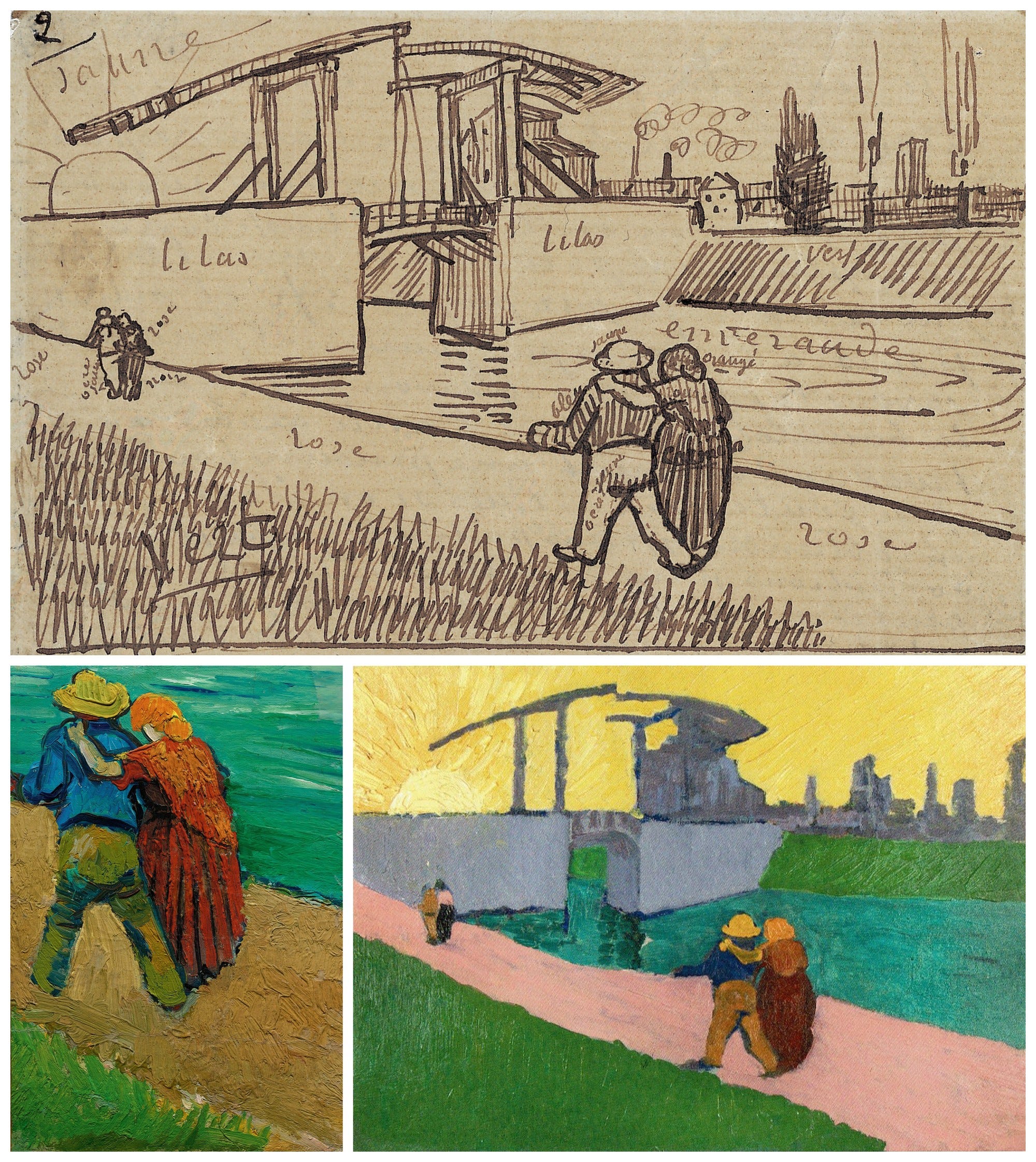
Some of the grains he posted did germinate, and in ground he never knew. On 18 March 1888 he sent Bernard a croquis of “a study that’s preoccupying me as to how to make something of it”, the Langlois bridge at sunset with a couple walking; a week later he told Theo, “I completely worked this study to death trying to finish it at home”, and only a fragment of the canvas survives, so that the whole composition lives only in the letter. In 1906 Giovanni Giacometti tried to paint the lost picture back from a reproduction of that sketch, eighteen years after it was posted. Others found no ground at all, like the scratch of 1883 of a traveller paying for his brandy at a village inn before dawn, drawn “in that kind of daydream”, with no known work behind it: “the scratch is nothing too”. And four months before the oval for Bernard, three orchards he still hoped to paint were, in his words, “still only in the state of embryos or foetuses”; the egg was never far from his hand.
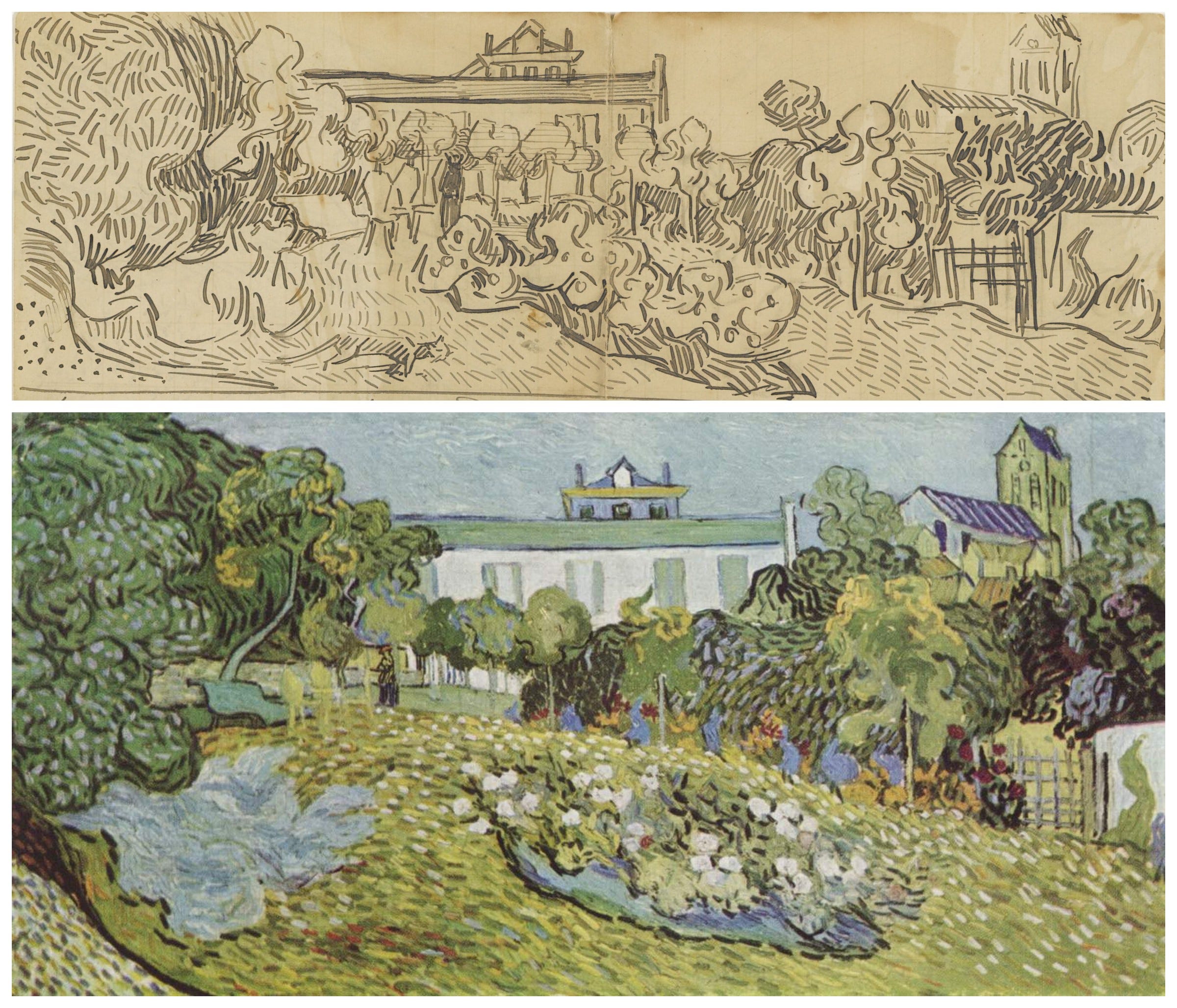
On 23 July 1890, at Auvers, he wrote to Theo for the last time: “I’d perhaps like to write to you about many things, but first the desire has passed to such a degree, then I sense the pointlessness of it.” Then, instead of writing, he drew: four croquis, among them Daubigny’s garden, “one of my most deliberate canvases”, with a black cat in the foreground which, the editors note, was painted out later, so that one of the last drawings he posted keeps a creature the painting no longer has. Two days later Theo told his wife that the letter had included a couple of sketches of paintings in progress, “which look very nice”.
He died on 29 July 1890, and Theo died at Utrecht six months later, on 25 January 1891; in 1914 Jo van Gogh-Bonger published the letters, and in the same year Theo was reburied beside his brother at Auvers.
In painting, Van Gogh once wrote, it is sometimes a matter of sowing, “even if the painter doesn’t reap the harvest himself”, and Merleau-Ponty’s artist launches his work like the first word ever spoken, not knowing whether it will be anything more than a shout, towards “the open community of future monads”. We are that community now, reading over the shoulder of a reader who is gone, and every one of those small drawings is still what it was when it was folded into an envelope, an egg shape, a thought small enough to travel, waiting to be opened.
it’s art: one essay a week, when something is worth saying.
If there is someone you still write to, send them this.
I used to translate various texts for the Kröller-Müller Museum in Otterlo https://www.krollermuller.nl/en, and I remember with fondness the letters from Vincent van Gogh to Theo. They show a man with a fierce intellect, a curious mind, and a kind heart, but the best part was seeing how much the two brothers loved and respected each other. It breaks my heart that both died so young.
I thoroughly enjoyed this. The little oval in the letter to Bernard made me smile. Van Gogh had already described it perfectly well, but he couldn't resist drawing it anyway! I was especially fascinated by the two sketches of his bedroom and the different ways he described the colors to Theo and Gauguin. There's something wonderfully intimate about seeing an artist's thoughts develop in correspondence rather than simply looking at the finished painting.