



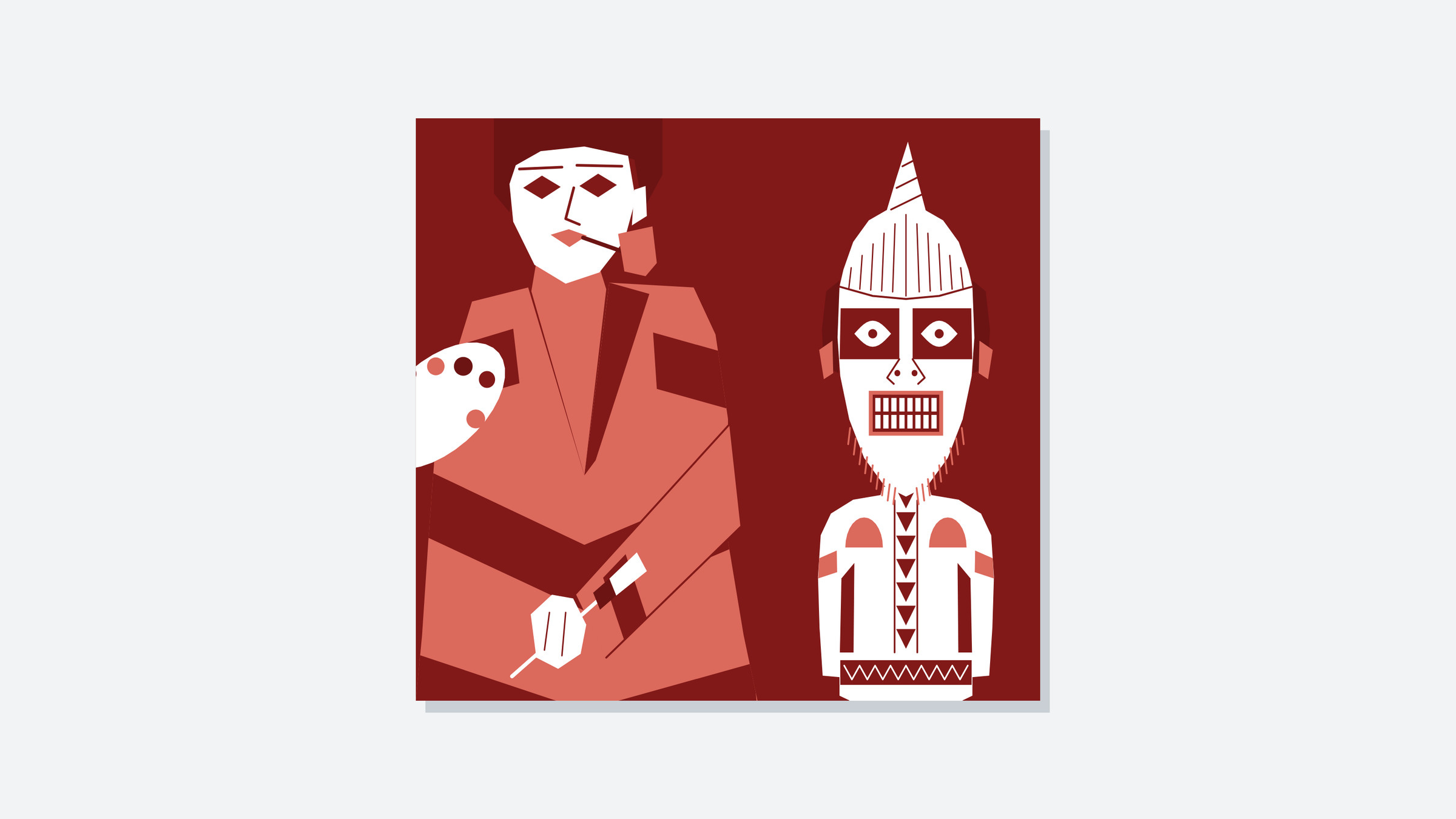
In an art history lecture, the topic was colonialism and its relation to Expressionism. Expressionism is an art movement from the early 20th century which was influenced by art from foreign cultures, particularly by its more raw and expressive style. The influence these foreign art traditions, African and Oceanic, had on Expressionists like the German art group Die Brücke is undeniable. But in the course book, this influence was dismissed, without much reasoning behind it, as cultural appropriation.
When I did some more research, I came across an exhibition the Stedelijk Museum Amsterdam held in 2021, called Kirchner and Nolde: Expressionism. Colonialism. It put the work of the two painters next to the works from Africa and Oceania that had inspired it. The title ties Expressionism to colonialism, and the museum’s own text goes further: the exhibition, it says, “tells the story of the appropriation of other visual cultures”. The Expressionists, according to the makers, “were fascinated by the aesthetic features of art from regions in Africa and Oceania, but paid little attention to the objects’ cultural background and significance.” Their fascination was viewed as a kind of taking. The rich works of Die Brücke, in all the ways it could have been described, were called “colonial art”, as if the core defining element of their art was its indirect ties to colonialism.
A moral colouring
Over the last years, the term ‘cultural appropriation’, and the accusation it carries, have become more and more common on social media and in academia. The Oxford English Dictionary, which added the term in March 2018, defines it as “the unacknowledged or inappropriate adoption of the practices, customs, or aesthetics of one social or ethnic group by members of another (typically dominant) community or society.” The word ‘appropriation’ already gives the term a moral colouring: the Cambridge Dictionary marks it “disapproving”. Rather than a more neutral word like borrowing or inspiration, or even a more positive one like appreciation, the act of adopting elements from another culture gets described as appropriation or, more plainly, theft.
Of course there is an important caveat: it is only cultural appropriation if the adoption is inappropriate or unacknowledged. But when does using elements of another culture become inappropriate? And if it is inappropriate, does that make it appropriation? And can adopting elements of certain cultures without acknowledging them be appropriation?
From their perspective
Of course the colonisation that Germany took part in, which began in the 1880s, was horrifying, and because of colonisation some of the art of Africa and the Pacific ended up in German museums, where it inspired Die Brücke. In June 1910, Ernst Ludwig Kirchner sent his friend Erich Heckel a postcard about a carved beam from the Palau islands in Dresden’s ethnographic museum: “Der Balken ist doch immer wieder schön”, the beam is beautiful every time. That beam was a gift: a chief of the village of Aibukit had given it to the naturalist Carl Semper, his friend, in 1862, thirty-seven years before Germany ruled the islands. Earlier that spring Kirchner had written with the same delight about the museum’s bronzes from Benin, and those British soldiers had looted in 1897.
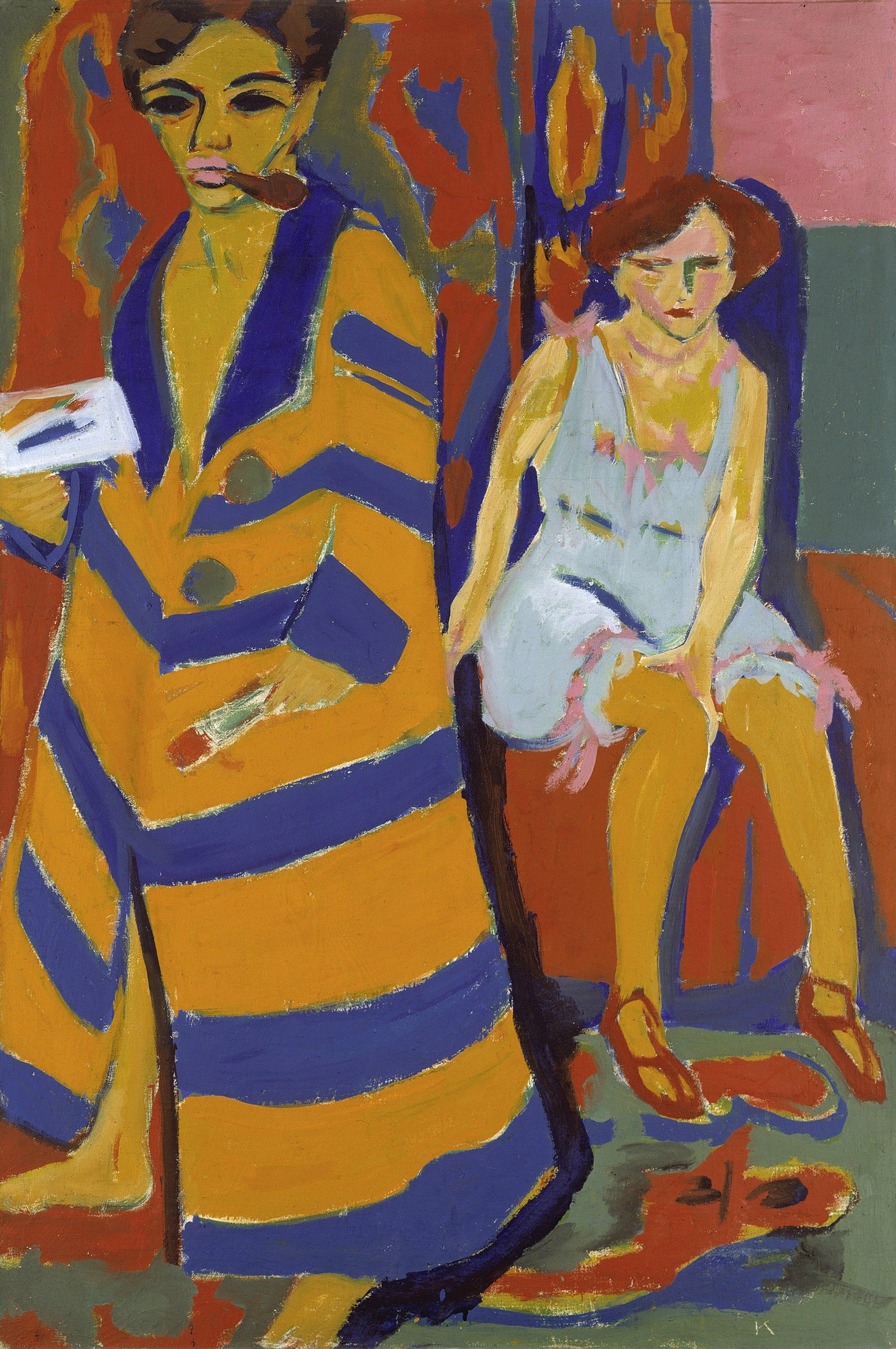
We can see here a link between colonialism and Die Brücke, indirect for most of them, but the members of Die Brücke themselves can, at least in my opinion, not be held accountable for that. From their perspective they were inspired by this art, which led them to adopt some of its elements.
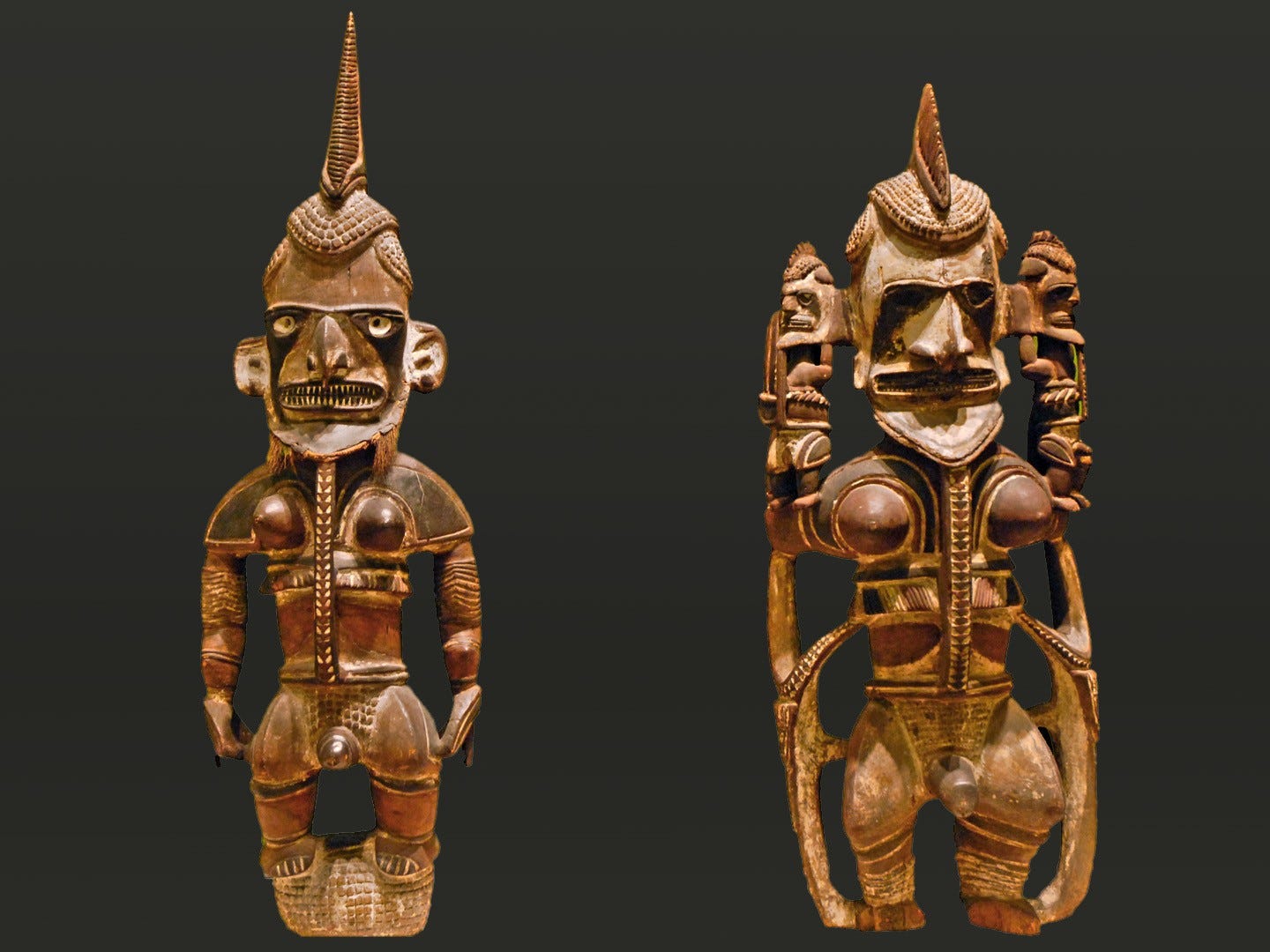
Nolde, for one, did not hide what he owed. He was, according to art historian Peter Selz “one of the first artists to protest against the relegation of primitive art objects to anthropological museums”. And in 1915, a year after he came home from German New Guinea with a number of such carvings, he painted the portrait of one: an uli, an ancestor figure like the two below.
An age-old process
This is, of course, not new. Virgil, a Roman, was inspired by Homer, a Greek, and the Kyoto School, a philosophical movement in 20th-century Japan, was influenced by Nietzsche and Heidegger. Just as in science, where the mathematics of Ancient Greece was further developed by scholars writing in Arabic during the medieval period, and in sport, where Japanese jiu-jitsu inspired Brazilian jiu-jitsu, intercultural dialogue has only enriched art.
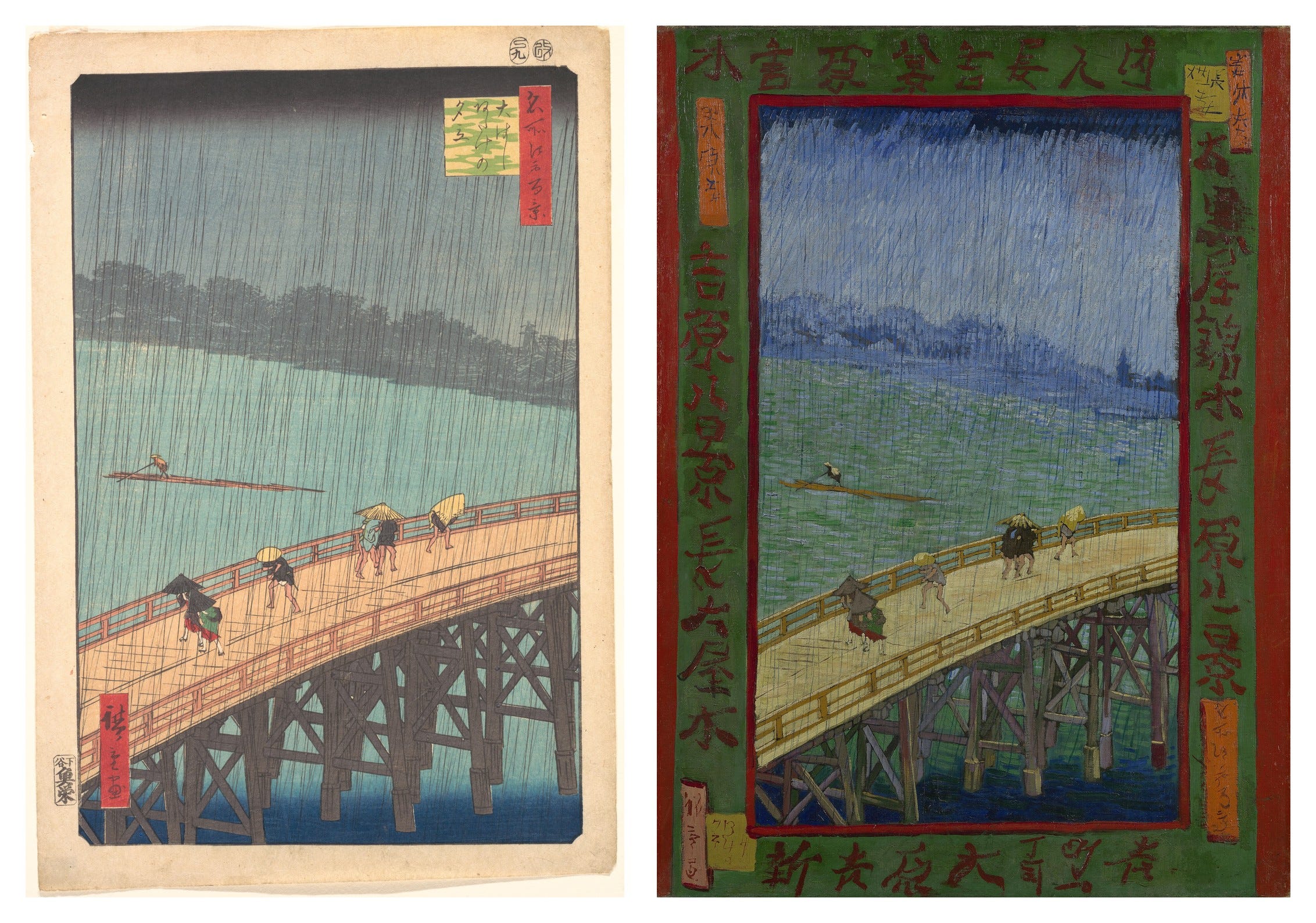
Painting shows it most plainly. In the autumn of 1887 Vincent van Gogh copied two woodcuts by Hiroshige in oil, a plum orchard in flower and a bridge in the rain, and around the bridge he painted a border of Japanese characters copied from other prints. The next summer he wrote to his brother: “All my work is based to some extent on Japanese art.” And the borrowing went both ways. The blue of Hokusai’s Great Wave, a print Van Gogh very much wanted to own, is Berlin blue, a pigment discovered in Berlin in about 1705 that the Japanese called bero, after the Dutch name for it.
So why would we now prohibit ourselves from engaging in this age-old process, or call others out for it, under the pretext of cultural appropriation?
A product of colonialism
There is a crucial difference between these examples and Die Brücke, however: the connection with colonialism. The reasoning of the curators would probably be something like the following: the art of Kirchner and Nolde is in part a product of colonialism; colonialism did not rightfully acknowledge the cultures of the colonised countries; therefore the painters were engaging in cultural appropriation.
This can seem fair. However, I believe that being, in part, a result of colonialism does not make a thing itself responsible for the horrors of colonialism: it can still be a good thing. My own first example shows it, and it is closer to Die Brücke than it looks. When Virgil wrote, Rome had long since conquered Greece, and Roman generals had carried Greek statues home as spoils. Those copies are in part a product of conquest, and without them we would not know many of the most famous statues of Greece.
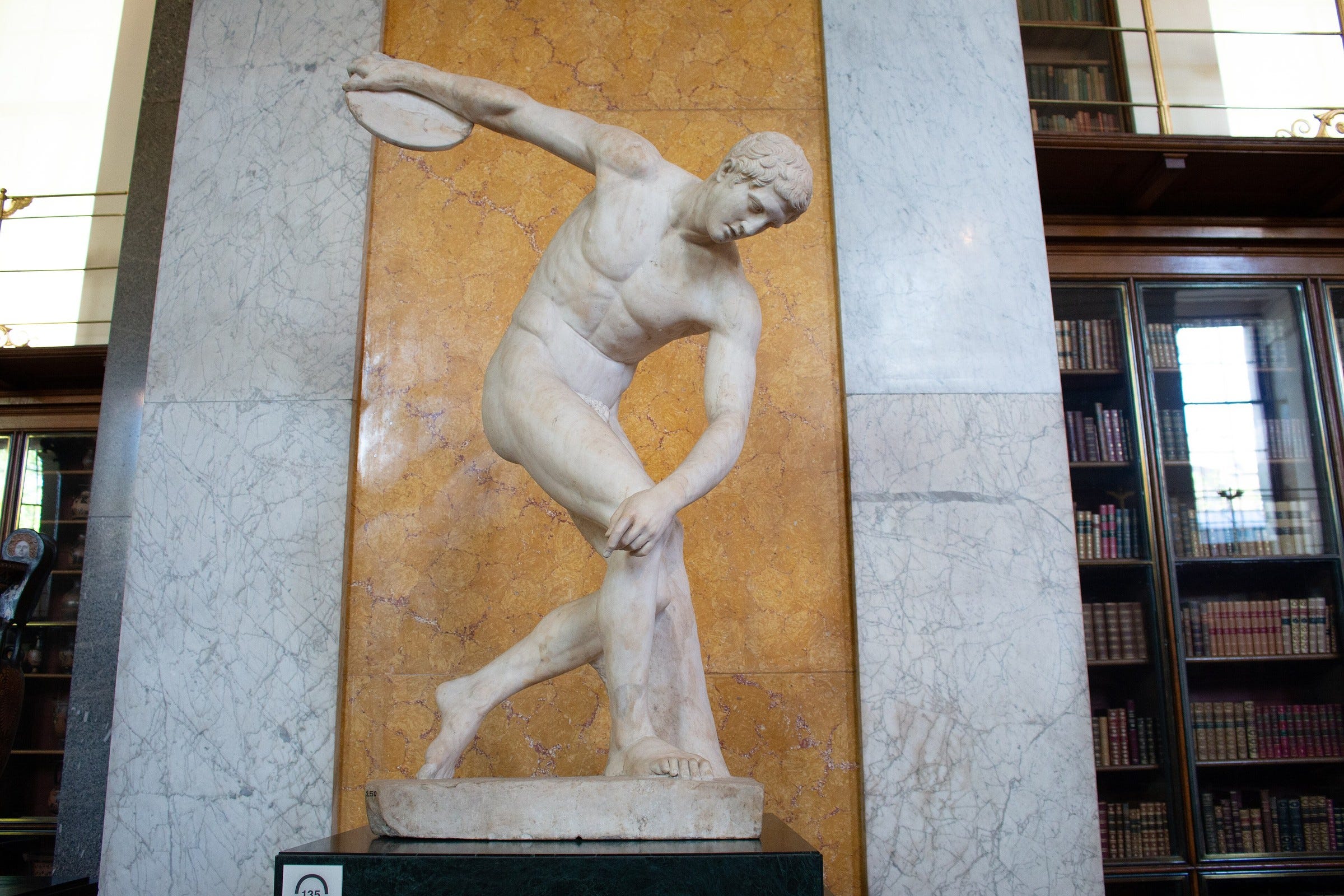
The Expressionist art of Die Brücke can, and in my opinion should, be seen as a beautiful synthesis of art from different cultures, and as evidence of what can happen when a completely unfamiliar tradition influences people’s own. Calling their art ‘colonial’ does not do their work justice: it is far greater than a mere product of colonialism.
The art of Die Brücke is cultural appreciation, not appropriation.
Can a culture belong to anyone?
Another factor is the idea that a culture can ‘claim’ certain styles, materials or ways of life, and that somebody from another culture who wants to make use of those either has to ask for permission or just straight up would not be allowed to, ‘because it’s not theirs’. But can a culture belong to anyone? And why would it be bad if people from a culture that is not yours immersed themselves in your own?
The most standard answer to the first question would probably be: to the native people of that culture. That is probably true, it belongs to them, but that doesn’t mean they have a special right to prohibit others from engaging with elements of their culture. The philosopher James O. Young, in his book Cultural Appropriation and the Arts, draws the line between objects and styles. When British soldiers carried off the bronzes of Benin in 1897, that was, in his words, “morally equivalent to a bank heist”, and in 2022 Germany began to hand the bronzes in its museums back to Nigeria. A style is another matter. Under the copyright rules most countries share, Young writes, a style “cannot be owned”, and his book sets out to show that “there can be no blanket condemnation of cultural appropriation.”
In a world that is more and more globalised, I am sure that it should only be encouraged if people want to spend their time and money on ideas, art or clothing foreign to them. Doesn’t that only improve mutual understanding and appreciation? Doesn’t the concept of cultural appropriation work regressively in this time of increasing connection between people? Especially when intercultural dialogue has such a positive track record, having mostly led to enrichment.
This all leads me to believe that the term cultural appropriation should be treated and used very carefully, and that overall people should only cherish cultures foreign to them and, if they would like to do so, participate in them, to enrich not only their own culture but also themselves as individuals. Let’s leave the analysis of power structures behind; let’s forget the School of Resentment and let people actually enjoy and partake in foreign art. The concept of power has always been secondary in art, so why make it the primary lens through which we view it? I think we lose lots of its richness that way, so let’s forget cultural appropriation and replace it with cultural appreciation.
If you would like to read more articles about the misstep modern culture has taken in viewing all art through a lens of power dynamics, I highly recommend reading Liza Libes and especially this article:

it’s art: one essay a week, when something is worth saying. This one is by Floris van Doorn, who writes it’s philosophy.
If you know someone who would argue with this, send it to them.
If this kept you company:


As someone deeply interested in feminist art history, I've spent a lot of time thinking about who gets to borrow, who gets recognized, whose contributions get erased, and who gets to tell the story. Artists have always learned from and been transformed by other cultures, and that exchange can be incredibly enriching. But context, acknowledgment, respect, and who benefits from that exchange matter. We don't have to shut down cross-cultural influence to have meaningful conversations about colonialism and appropriation. In fact, those conversations can make our understanding of art much richer. I don't think it's necessarily appropriation OR appreciation. The difference often lies in how we engage, what we acknowledge, and whose voices we include. That's a conversation worth having.
You are right. "Cultural appropriation"is usually a smug way of dismissing art that the author could not possibly produce themself. I have recently written about Die Brücke and other movements from about the same time. They all looked at each other's work and learned from each other--and from artists around the world. It is a form of admiration. Then the Nazis destroyed much of it as "Degenerate Art." That is the name of my Substack post:Degenerate Art.